Home
Class 12
PHYSICS
A conducting disc of radius R is placed ...

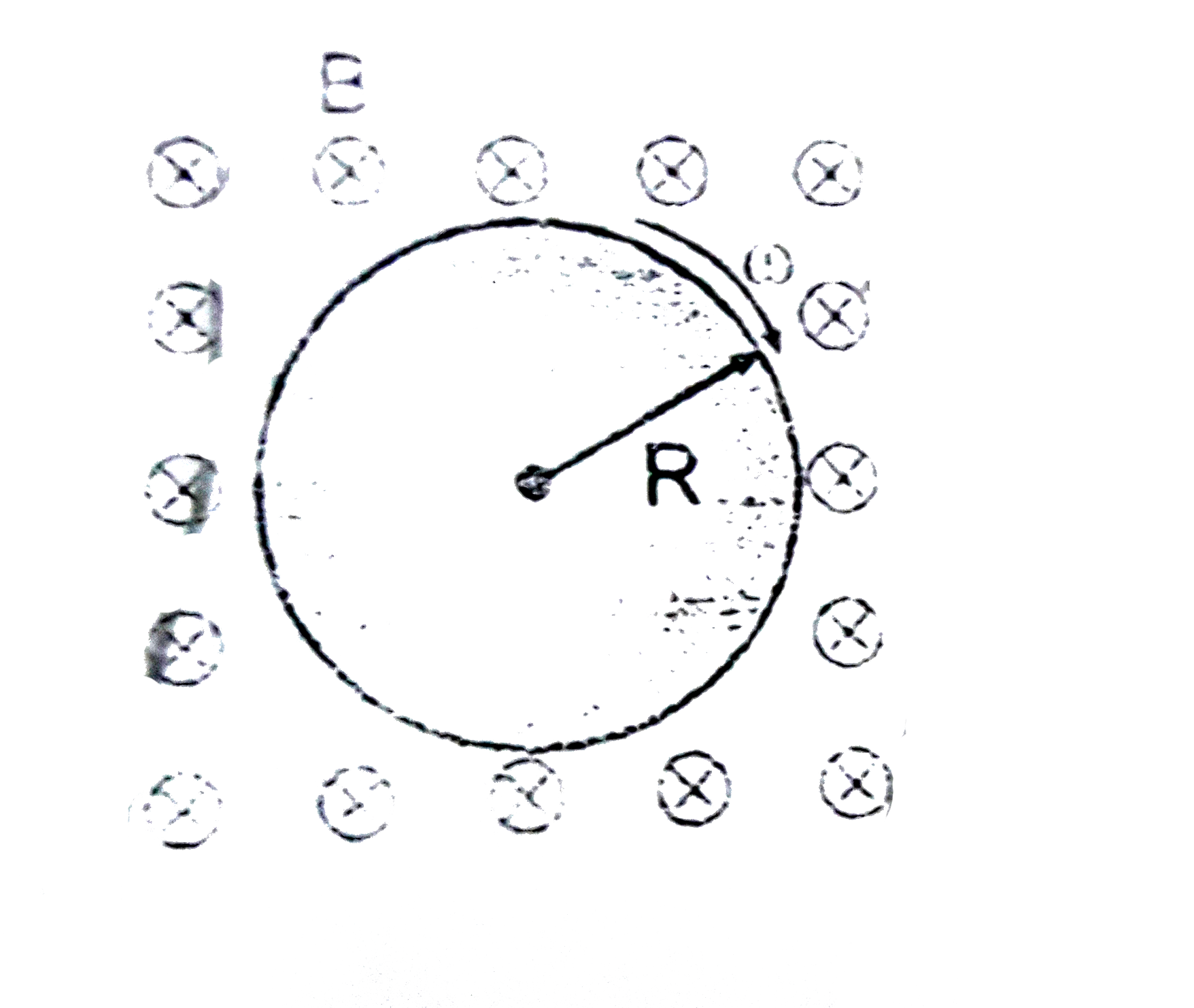
A conducting disc of radius `R` is placed in a uniform and constant magnetic field `B` parallel to the axis of the disc.With what angular speed should the disc be rotated about its axis such that no electric field develops in the disc (the electric charge and mass are `e` and `m`)

A

`(eB)/(2m)`

B

`(eB)/(m)`

C

`(2pim)/(eB)`

D

`(pim)/(eB)`

Text Solution

Verified by Experts

The correct Answer is:

B
Promotional Banner

Similar Questions

Explore conceptually related problems

Find the electric field on the axis of a charged disc.

A conducting disc of radius r rotaes with a small but constant angular velocity omega about its axis. A uniform magnetic field B exists parallel to the axis of rotation. Find the motional emf between the centre and the periphery of the disc.

A disc of radius R is pivoted at its rim. The period for small oscillations about an axis perpendicular to the plane of disc is

A uniform disc of mass M and radius R is hinged at its centre C . A force F is applied on the disc as shown . At this instant , angular acceleration of the disc is

A negatively charged disc is rotated clock-wise. What is the direction of the magnetic field at any point in the plane of the disc?

A quarter disc of radius R and mass m is rotating about the axis OO' (perpendicular to the plane of the disc) as shown. Rotational kinetic energy of the quarter disc is

A plastic disc of radius 'R' has a charge 'q ' uniformly distributed over its surface. If the disc is rotated with a frequency 'f' about its axis, then the magnetic induction at the centre of the disc is given by

A non-conducting thin disc of radius R charged uniformly over one side with surface density s rotates about its axis with an angular velocity omega . Find (a) the magnetic induction at the centre of the disc, (b) the magnetic moment of the disc.

A thin disc of radius R and mass M has charge q uniformly distributed on it. It rotates with angular velocity omega . The ratio of magnetic moment and angular momentum for the disc is

A charge Q is uniformly distributed over the surface of non - conducting disc of radius R . The disc rotates about an axis perpendicular to its plane and passing through its centre with an angular to its plane and passing through its centre of the disc. If we keep both the amount of charge placed on the disc and its angular velocity to be constant and vary the radius of the disc then the variation of the magnetic induction at the centre of the disc will br represented by the figure:
