Home
Class 12
PHYSICS
A long circular tube of length 10 m and ...

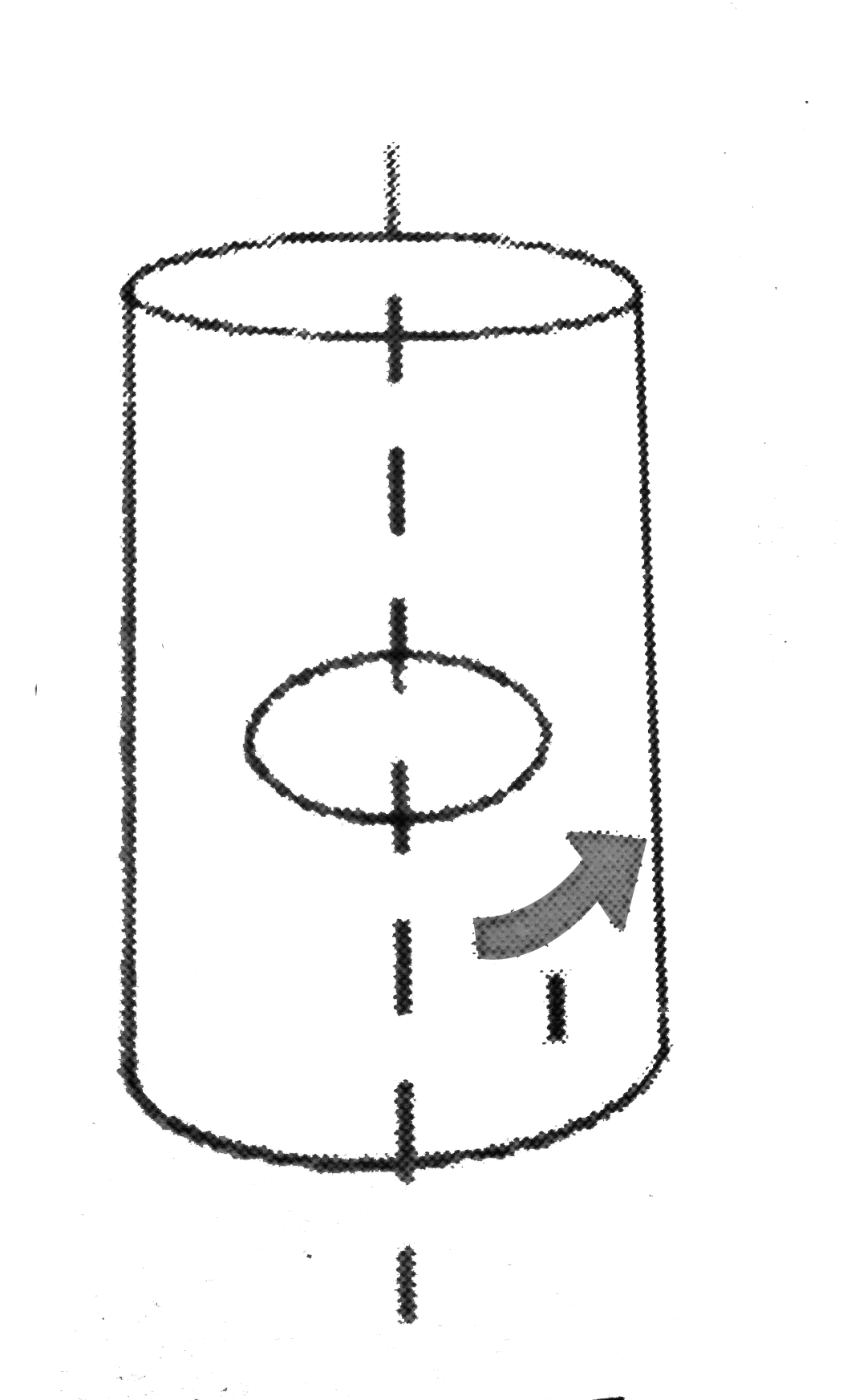
A long circular tube of length `10 m` and radius `0.3 m` carries a current `I` along its curved surface as shows in Fig. A wire-loop of resistance `0.005 Omega` and of radius `0.1 m` is placed inside the tube with its axis coincding with the axis of the tube. The current varies as `= I = I_(0) cos(300 t)` where `I_(0)` is constant. If the magnetic moment of the loop is `Nmu_(0)I_(0) sin (300t)`, then `N` is

Text Solution

Verified by Experts

The correct Answer is:

6
Promotional Banner

Similar Questions

Explore conceptually related problems

A long circular tube of length 10 m and radius 0.3 m carries a current I along its curved surface as shown . A wire - loop of resistance 0.005 ohm and of radius 0.1 m is placed inside the tube its axis coinciding with the axis of the tube . The current varies as I = I_(0)cos(300 t) where I_(0) is constant. If the magnetic moment of the loop is Nmu_(0)I_(0) sin (300 t) , then 'N' is

A long copper tube of inner radius R carriers a current i . The magnetic field B inside the tube is

A single circular loop of wire radius 0.02 m carries a current of 8.0 A . It is placed at the centre of a solenoid that the length 0.65 m , radius 0.080 m and 1300 turns.

A long wire having a semi-circular loop of radius r carries a current I, as shown in Fig. Find the magnetic field due to entire wire.

A thin but long, hollow, cylindrical tube of radius r carries a current i along its length. Find the magnitude of the magnetic field at a distance r/2 from the surface (a) inside the tube (b) outside the tube.

A long straight wire of circular cross- section carries a current along its length. On the axis inside the wire, it follows that

A long, cylindrical tube of inner and outer radii a and b carries a current i distributed uniformly over its cross section. Find the magnitude of the magnetic field at a point (a) just inside the tube (b) just outside the tube.

In the figures shown current in the long straight wire varies as I=I_(0)((t_(0)-t)/(t_(0))) where I_(0) is the initial current The charge flown through resistance in the time t_(0) is

Find the rms value of current from t = 0 to t=(2pi)/omega if the current varies as i=I_(m)sin omegat .

A circular wire loop of radius R, mass m carrying current I lies on a rough surface (as shown in Fig. 1.86). There is a horizontal magnetic field vec B. How large can the current I be before one edge of the loop will lift off the surface?
