Home
Class 12
PHYSICS
A Uniformly charged solid non-conducting...

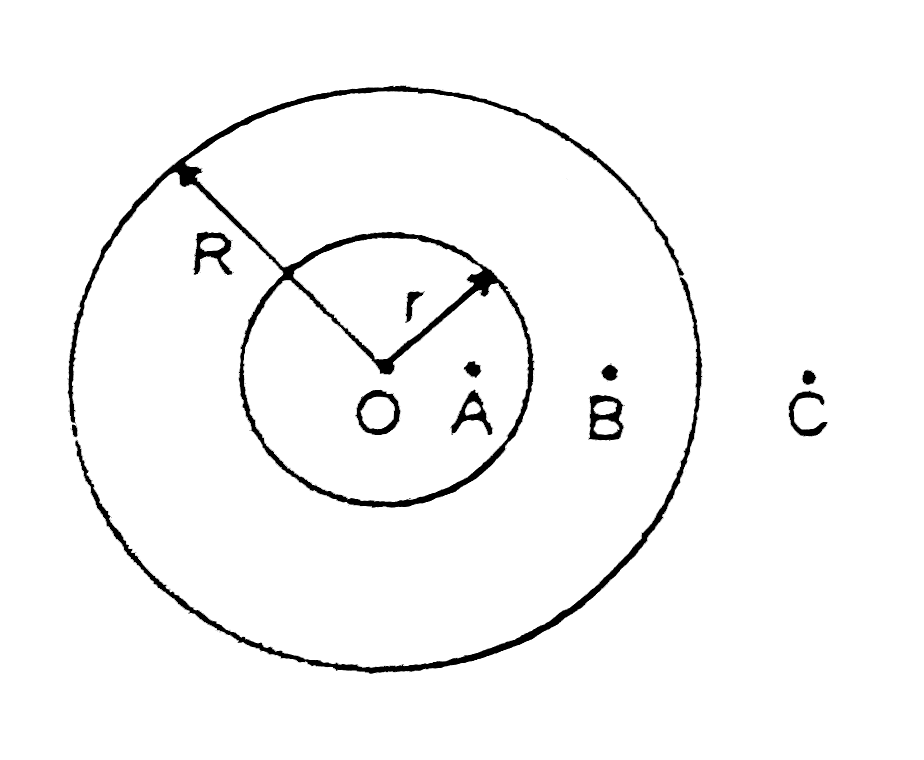
A Uniformly charged solid non-conducting sphere of uniform volume charge density `rho` and radius R is having a concentric spherical cavity of radius r. Find out electric field intensity at following points, as shown in the figure :

(i) Point A (ii) Point B
(iii) Point C (iv) Centre of the sphere

Text Solution

Verified by Experts
Method-I :
(i) For point A : We can consider the solid part of sphere to be made of large number of spherical shells which have uniformly distributed charge on its surface. Now, since point A lies inside all spherical shells so electric field intensity due to all shells will be zero.
`vec(E_(A))=0`
(ii) For point B : All the spherical shells for which point B lies inside will make electric field zero at point B. So electric field will be due to charge present from radius r to OB.
So, `vec(E_(B))=(K 4/3 pi (OB^(3) - r^(3)) rho)/(OB^(2))vec(OB)=rho/(3 epsi_(0)) ([OB^(3)-r^(3)])/(OB^(3)) vec(OB)`
(ii) For point C, similarly we can say that for all the shell points C lies outside the shell
So, `vec(E_(C))=(K[4/3 pi (R^(3)-r^(3))])/([OC]^(3)] vec(OC) = rho/(3 epsi_(0)) (R^(3)-r^(3))/([OC]^(3)) vec(OC)`
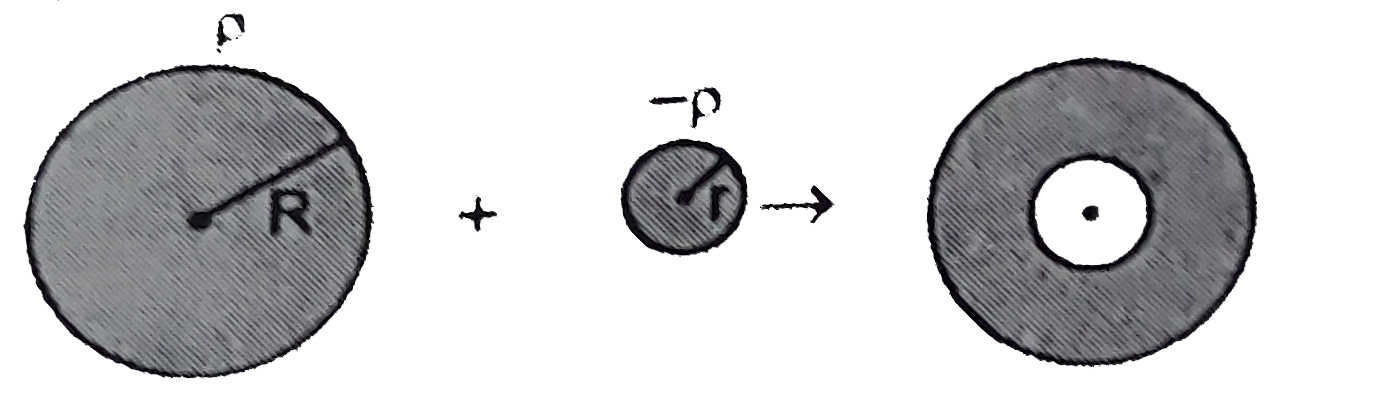
Method-II : We can consider that the spherical cavity is filled with charge density `rho` and also `-rho`, thereby making net charge density zero after combining. We can consider two concentric solid spheres : One ofradius R and charge density `rho` and other of radius r and charge density `-rho`. applying susperposition principle :

(i) `vec(E_(A))=vec(E_(rho))+vec(E_(-rho))=(rho (vec(OA)))/(3 epsi_(0))+ ([-rho (vec(OA))])/(3 epsi_(0))=0`
(ii) `vec(E_(B))=vec(E_(rho))+vec(E_(-rho))=(rho(vec(OB)))/(3 epsi_(0))+(K[4/3 pi r^(3)(-rho)])/((OB)^(3)) vec(OB)`
`=[rho/(3 epsi_(0))-(r^(3) rho)/(3epsi_(0) (OB)^(3))]vec(OB)=rho/(3 epsi_(0))[1-r^(3)/(OB^(3))] vec(OB)`
(iii) `vec(E_(C))=vec(E_(rho))+vec(E_(-rho))=(K(4/3 pi R^(3) rho))/(OC^(3)) vec(OC)+(K(4/3 pi r^(3) (-rho)))/(OC^(3))vec(OC)=rho/(3e_(0) (OC)^(3))[R^(3)-r^(3)] vec(OC)`
(iv) `vec(E_(O))=vec(E_(rho))+vec(E_(-rho))=0+0=0`
Promotional Banner

Topper's Solved these Questions

  • ELECTROSTATICS

    RESONANCE ENGLISH|Exercise Problems|22 Videos
  • ELECTROSTATICS

    RESONANCE ENGLISH|Exercise Exercise-1 Section (A)|9 Videos
  • ELECTROMAGNETIC INDUCTION

    RESONANCE ENGLISH|Exercise A.l.P|19 Videos
  • EXPERIMENTAL PHYSICS

    RESONANCE ENGLISH|Exercise PART -II|10 Videos

Similar Questions

Explore conceptually related problems

A solid non conducting sphere of radius R and uniform volume charge density rho has its centre at origin. Find out electric field intensity in vector form at following positions : (i) (R//2, 0, 0)" " (ii) (R/sqrt(2), R/sqrt(2), 0)" " (iii) (R, R, 0)

A solid sphere having uniform charge density rho and radius R is shown in figure. A spherical cavity ofradius (R)/(2) is made in it. What is the potential at point O?

A solid non conducting sphere of radius R and uniform volume density rho has centre at origin. Find out electric field intensity in vector form at following positions : (i) (R, 0, 0) (ii) (0, 0, R/2) (iii) (R, R, R)

A non-conducting solid sphere has volume charge density that varies as rho=rho_(0) r, where rho_(0) is a constant and r is distance from centre. Find out electric field intensities at following positions. (i) r lt R" " (ii) r ge R

The electric potential due to uniformly charged sphere of radius R ,having volume charge density rho having a spherical cavity of radius R/2 as shown as in figure at point p is

A solid uniformly charged ficed non-conducting sphere of total charge Q and radius R contains a tunnel of negligible diameter. If a point charge '-q' of mass 'm' is released at rest from point P as shown in figure then find out its velocity at following points (i) At the surface of sphere (ii) At the centre of the sphere

A uniformly charged non-conducting spherical shell is given +q charge and a point charge -q is placed as shown. The electric field lines will be

A uniformly charged non conducting disc with surface charge density 10nC//m^(2) having radius R=3 cm . Then find the value of electric field intensity at a point on the perpendicular bisector at a distance of r=2cm

A nonconducting sphere of radius R is filled with uniform volume charge density -rho . The center of this sphere is displaced from the origin by vecd . The electric field vecE at any point P having position vector inside the sphere is

A solid of radius 'R' is uniformly charged with charge density rho in its volume. A spherical cavity of radius R/2 is made in the sphere as shown in the figure. Find the electric potential at the centre of the sphere.

RESONANCE ENGLISH-ELECTROSTATICS-HLP
  1. A Uniformly charged solid non-conducting sphere of uniform volume char...

    Text Solution

    |

  2. An electrometer consister of a fixed vertical metal bar OB at the top ...

    Text Solution

    |

  3. A uniform rod AB of mass m and length l is hinged at its mid point C. ...

    Text Solution

    |

  4. Three equal charge q(0) each are placed at three corners of an equilat...

    Text Solution

    |

  5. A solid of radius 'R' is uniformly charged with charge density rho in ...

    Text Solution

    |

  6. A uniform surface charge of density sigma is given to a quarter of a d...

    Text Solution

    |

  7. Figure shows a rod of length L which is uniformly charged with linear ...

    Text Solution

    |

  8. A charged ball of mass 5.88xx10^(-4) kg is suspended from two silk str...

    Text Solution

    |

  9. A charge of 16xx10^(-9) C is fixed at the origin of coordinates. A sec...

    Text Solution

    |

  10. Two large conducting plates are placed parallel to each other with a ...

    Text Solution

    |

  11. A ball of mass 10^(-2) kg and having charge + 3 xx 10^(-6)C is tied at...

    Text Solution

    |

  12. A system consists of a thin charged wire ring of radius r and a very l...

    Text Solution

    |

  13. A thin nonconducting ring of radius R has a linear charge density ...

    Text Solution

    |

  14. Two point charges q and -q are separated by a distance 2a. Evaluate th...

    Text Solution

    |

  15. A system consits of a uniformly charged sphere of radius R and a surro...

    Text Solution

    |

  16. Find the electric field potential and strength at the center of a hem...

    Text Solution

    |

  17. A nonconducting disk of radius a and uniform positive surface charge d...

    Text Solution

    |

  18. The potential difference between two large parallel plates is varied a...

    Text Solution

    |

  19. Four point charges +8muC-1muC,-1muC and +8muC are fixed at the points ...

    Text Solution

    |

  20. A small ball of mass 2 xx 10^-3 kg, having a charge 1 mu C, is suspend...

    Text Solution

    |

  21. Three point charges q, 2q and 8q are to be placed on a . 9cm long st...

    Text Solution

    |

