Home
Class 12
PHYSICS
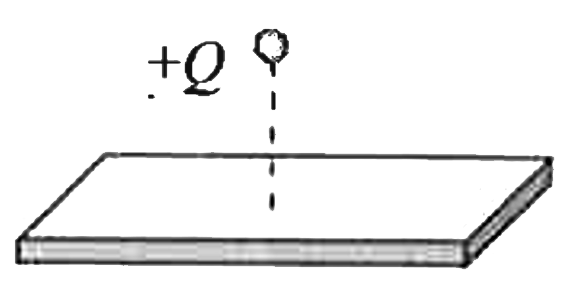
A charge Q is fixed at a distance d in f...

A charge Q is fixed at a distance d in front of an infinite metal plate. The lines of force are represented by

Text Solution

Verified by Experts
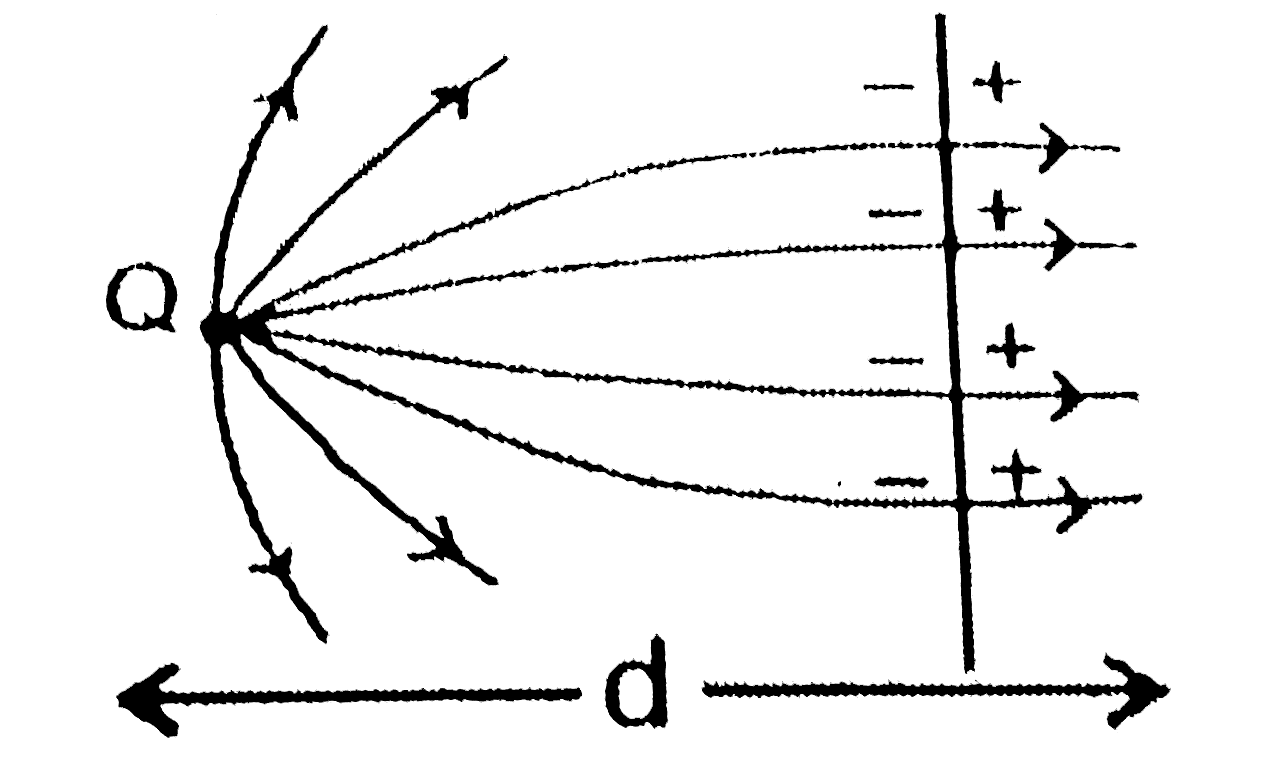
There will be induced charge on two surfaces of conducting plate, so ELOF will start from + Q charge and terminate at conductor and then will again start from other surface of conductor.
Promotional Banner

Topper's Solved these Questions

  • ELECTROSTATICS

    RESONANCE ENGLISH|Exercise Problems|22 Videos
  • ELECTROSTATICS

    RESONANCE ENGLISH|Exercise Exercise-1 Section (A)|9 Videos
  • ELECTROMAGNETIC INDUCTION

    RESONANCE ENGLISH|Exercise A.l.P|19 Videos
  • EXPERIMENTAL PHYSICS

    RESONANCE ENGLISH|Exercise PART -II|10 Videos

Similar Questions

Explore conceptually related problems

Two point charge Q and 4Q are fixed at a distance of 12cm from each other. Sketch lines of force and locate the neutral point, if any .

Two connected charges of +q and -q respectively are at a fixed distance AB apart in a non uniform electric field whose lines of force are shown in the figure The resultant effect on the two charges is

A charge particle q is released at a distance R_(@) from the infinite long wire of linear charge density lambda . Then velocity will be proportional to (At distance R from the wire)

A charge +q is placed at a distance 'd' from the centre of the uncharged metallic cube of side 'a'. The electric field at the centre of the cube due to induced charges on the cube will be

Statement-1 : If a point charge q is placed in front of an inifinite grounded conducting plane surface, the point charge will experience a force. Statement-2: This forc is due to the induced charge on the conducing surface which is at zero potential

An uncharged sphere of metal is placed in between two charged plates as shown. The lines of force look like

Consider an electron in front of metallic surface at a distance d (treated as an infinite plane surface). Assume the force of attraction by the plate is given as 1/4 (q^(2))/(4pi in_(0)d^(2)) . Calculate work in taking the charge to an infinite distance from the plate. Taking d=0.1nm, find the work done in electron volts. [Such a force law is not valid for d lt 0.1nm].

A metallic partical having no net charge is placed near a finite metal plate carrying a positive charge. The electric force on the particale will be

A metallic partical having no net charge is placed near a finite metal plate carrying a positive charge. The electric force on the particale will be

Three charges +Q, q, +Q are placed respectively, at distance, 0, d//2 and d from the origin, on the x-axis. If the net force experienced by +Q placed at x=0, is zero, then value of q is :

RESONANCE ENGLISH-ELECTROSTATICS-HLP
  1. A charge Q is fixed at a distance d in front of an infinite metal plat...

    Text Solution

    |

  2. An electrometer consister of a fixed vertical metal bar OB at the top ...

    Text Solution

    |

  3. A uniform rod AB of mass m and length l is hinged at its mid point C. ...

    Text Solution

    |

  4. Three equal charge q(0) each are placed at three corners of an equilat...

    Text Solution

    |

  5. A solid of radius 'R' is uniformly charged with charge density rho in ...

    Text Solution

    |

  6. A uniform surface charge of density sigma is given to a quarter of a d...

    Text Solution

    |

  7. Figure shows a rod of length L which is uniformly charged with linear ...

    Text Solution

    |

  8. A charged ball of mass 5.88xx10^(-4) kg is suspended from two silk str...

    Text Solution

    |

  9. A charge of 16xx10^(-9) C is fixed at the origin of coordinates. A sec...

    Text Solution

    |

  10. Two large conducting plates are placed parallel to each other with a ...

    Text Solution

    |

  11. A ball of mass 10^(-2) kg and having charge + 3 xx 10^(-6)C is tied at...

    Text Solution

    |

  12. A system consists of a thin charged wire ring of radius r and a very l...

    Text Solution

    |

  13. A thin nonconducting ring of radius R has a linear charge density ...

    Text Solution

    |

  14. Two point charges q and -q are separated by a distance 2a. Evaluate th...

    Text Solution

    |

  15. A system consits of a uniformly charged sphere of radius R and a surro...

    Text Solution

    |

  16. Find the electric field potential and strength at the center of a hem...

    Text Solution

    |

  17. A nonconducting disk of radius a and uniform positive surface charge d...

    Text Solution

    |

  18. The potential difference between two large parallel plates is varied a...

    Text Solution

    |

  19. Four point charges +8muC-1muC,-1muC and +8muC are fixed at the points ...

    Text Solution

    |

  20. A small ball of mass 2 xx 10^-3 kg, having a charge 1 mu C, is suspend...

    Text Solution

    |

  21. Three point charges q, 2q and 8q are to be placed on a . 9cm long st...

    Text Solution

    |

