Home
Class 12
PHYSICS
Figure shows two large cylindrical shell...

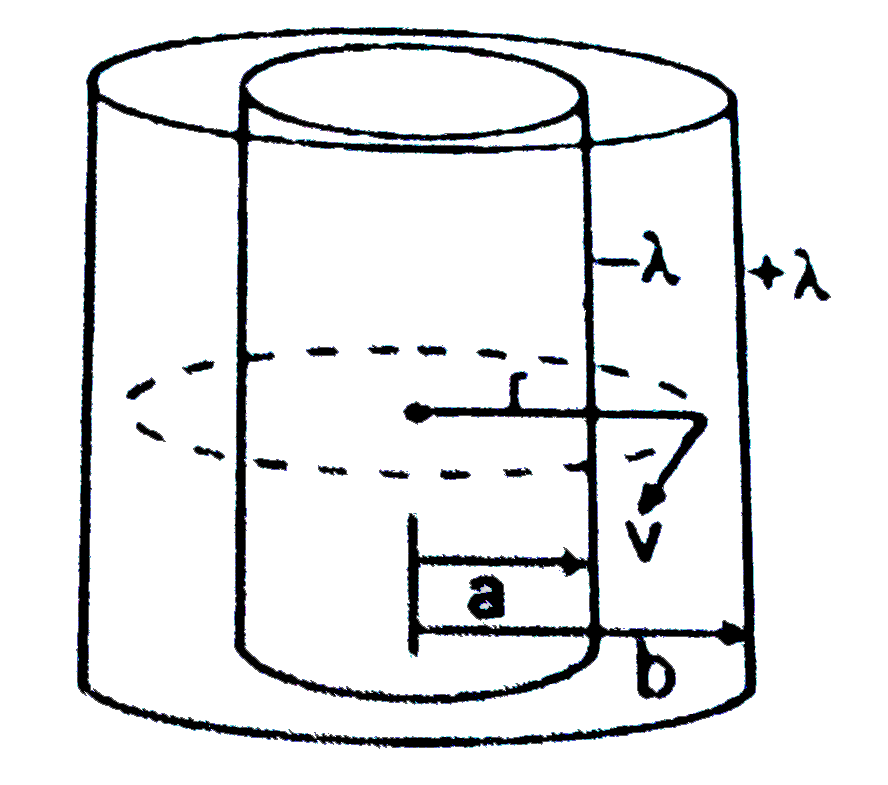
Figure shows two large cylindrical shells having uniform linera charge densities `+ lambda` and `- lambda`. Radius of inner cylinder is 'a' and that of outer cylinder is 'b'. A charged particle of mass m, charge q revolves in a circle of radius r. Then, its speed 'v' is : (Neglect gravity and assume the radii of both the cylinders to be very small in comparison to their length.)

A

`sqrt((lambda q)/(2pi in_(0) m))`

B

`sqrt((2 lambda q)/(pi in_(0) m))`

C

`sqrt((lambda q)/(pi in_(0) m))`

D

`sqrt((lambda q)/(4pi epsi_(0) m))`

Text Solution

Verified by Experts

The correct Answer is:

A
Promotional Banner

Topper's Solved these Questions

  • ELECTROSTATICS

    RESONANCE ENGLISH|Exercise Part - II Section (J)|13 Videos
  • ELECTROSTATICS

    RESONANCE ENGLISH|Exercise Part - III|20 Videos
  • ELECTROSTATICS

    RESONANCE ENGLISH|Exercise Part - II Section (H)|8 Videos
  • ELECTROMAGNETIC INDUCTION

    RESONANCE ENGLISH|Exercise A.l.P|19 Videos
  • EXPERIMENTAL PHYSICS

    RESONANCE ENGLISH|Exercise PART -II|10 Videos

Similar Questions

Explore conceptually related problems

A charged particle of mass m is moving with a speed u in a circle of radius r. If the magnetic field induction at the centre is B, the charge on the particle is

A charged particle of mass m and charge q describes circular motion of radius r in a uniform magnetic field of strength B the frequency of revolution is

A particle of mass m having a charge q enters into a circular region of radius R with velocity v directed towards the centre. The strength of magnetic field is B . Find the deviation in the path of the particle.

The particle of mass m and charge q will touch the infinitely large of uniform charge density sigma if its velocity v is more than : {"Given that "sigmaq gt 0}

Passage XIV) A uniform cylindrical block of mass 2M and cross-sectional area A remains partially submerged in a non viscous liquid of density rho , density of the material of the cylinder is 3rho . The cylinder is connected to lower end of the tank by means of a light spring of spring constant K. The other end of the cylinder is connected to anotehr block of mass M by means of a light inextensible sting as shown in the figure. The pulleys shown are massless and frictionless and assume that the cross-section of the cylinder is very small in comparison to that of the tank. Under equilibrium conditions, half of the cylinder is submerged. [given that cylinder always remains partially immersed) Under equilibrium conditions

Passage XIV) A uniform cylindrical block of mass 2M and cross-sectional area A remains partially submerged in a non viscous liquid of density rho , density of the material of the cylinder is 3rho . The cylinder is connected to lower end of the tank by means of a light spring of spring constant K. The other end of the cylinder is connected to anotehr block of mass M by means of a light inextensible sting as shown in the figure. The pulleys shown are massless and frictionless and assume that the cross-section of the cylinder is very small in comparison to that of the tank. Under equilibrium conditions, half of the cylinder is submerged. [given that cylinder always remains partially immersed) By what maximum distance cylinder will be pushed downward into the liquid from equilibrium position so that when it is set free then tension in the string will not vanish [Assume at equilibrium position system was at rest]

A cylindrical capacitor has has two co-axial cylinders of length 20 cm and radii 2r and r, inner cylinder is gliven a charge 10 mu C and and outer cylinder a charge of - 10 mu C. the potential difference between the two cylinders will be

A smooth chute is made in a dielectric sphere of radius R and uniform volume charge density. rho . A charge particle of mass m and charge -q is placed at the centre of the sphere. Find the time period of motion of the particle?

A particle of charge -q and mass m moves in a circle of radius r around an infinitely long line charge of linear charge density +lamda . Then, time period will be where , k=1/4piepsilon_0)

A cylinder of radius R is surrounded by a cylindrical shell of inner radius R and oputer radius 2R. The thermal conductivity of the material of the inner cylinder is k_(1) and that of the outer cylinder is K_(2) ,Assumming no loss of heat , the effective thermal conductivity of the system for heat flowing along the length of the cylinder is :
