Home
Class 12
PHYSICS
A leaf electroscope is a simple apparatu...

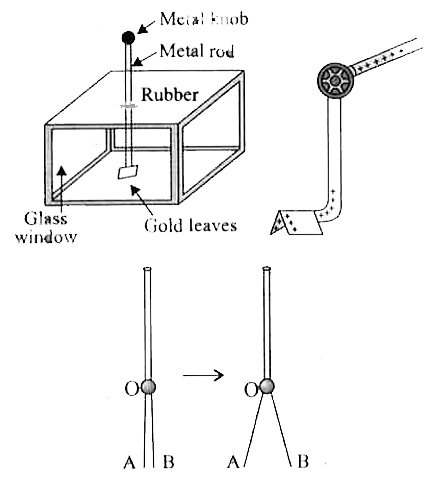
A leaf electroscope is a simple apparatus to detect any charge on a body. It consist of two metal leaves OA and OB, free to rotate about O. Initially both are very slighty separted. When a charged object is touched to the metal knob at the top of the conduction re, charge flows from knob to the top of the conduction rod, charge flows from knob to the leaves through the conducting rod, charge flows from knob to the leaves through the conduction rod. As the leaves are now charged similarly, they start repelling each other and tet separted (deflected by certain angle).

The angle of deflection in static equilibrium is an indicator of the amount of charge on the charged boy.
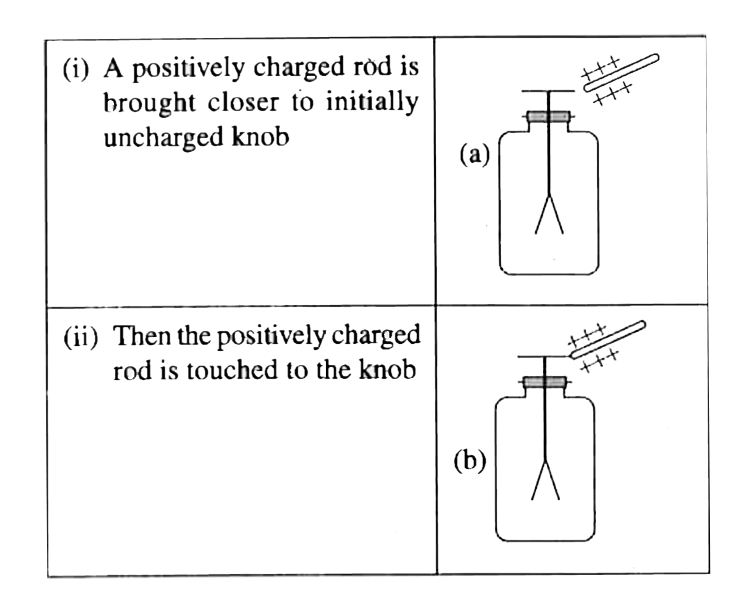
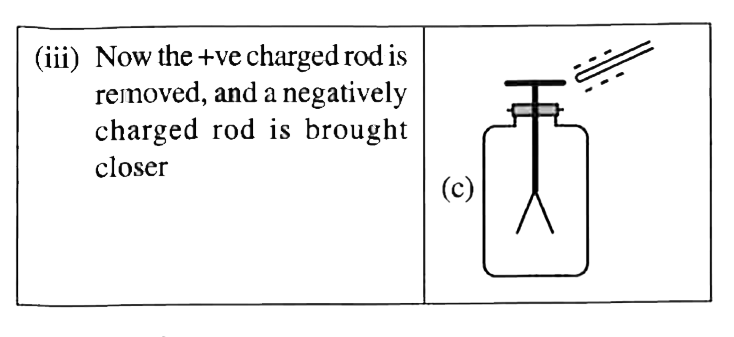
If we perform these steps one by one.


In which case, the leaves will converge (come closer), as compared to the previous state?

A

`((2kq^(2))/(l^(2) mg))^(1//3)`

B

`((kq^(2))/(l^(2) mg))^(1//3)`

C

`((2kq^(2))/(l^(2) mg))^(1//2)`

D

`((64 kq^(2))/(l^(2) mg))^(1//3)`

Text Solution

Verified by Experts

The correct Answer is:

A
Promotional Banner

Topper's Solved these Questions

  • ELECTROSTATICS

    RESONANCE ENGLISH|Exercise Exercise - 3 Part - I|33 Videos
  • ELECTROSTATICS

    RESONANCE ENGLISH|Exercise Part - II|23 Videos
  • ELECTROSTATICS

    RESONANCE ENGLISH|Exercise Part- II|20 Videos
  • ELECTROMAGNETIC INDUCTION

    RESONANCE ENGLISH|Exercise A.l.P|19 Videos
  • EXPERIMENTAL PHYSICS

    RESONANCE ENGLISH|Exercise PART -II|10 Videos

Similar Questions

Explore conceptually related problems

A leaf electroscope is a simple apparatus to detect any charge on a body. It consist of two metal leaves OA and OB, free to rotate about O. Initially both are very slighty separted. When a charged object is touched to the metal knob at the top of the conduction re, charge flows from knob to the top of the conduction rod, charge flows from knob to the leaves through the conducting rod, charge flows from knob to the leaves through the conduction rod. As the leaves are now charged similarly, they start repelling each other and tet separted (deflected by certain angle). The angle of deflection in static equilibrium is an indicator of the amount of charge on the charged boy. When a+20C rod is touched to the knob, the deflection of leaves was 5^(@) , and when an identical rod of -40C is touched, the deflection was found to be 9^(@) . If an identical rod of +30C is touched, then the deflection may be:

An uncharged electroscope can tell the nature of charge on a charged body .

When two isolated conductors A and B are connected by a conducting wire positive charge will flow from .

In Fig. C, what would be the charge on the rod and the sphere after touching. In which direction would the charges flow: from the rod to the sphere or from the sphere to the rod? Why?

Assertion : When bodies are charged through friction, there is a transfer of electric charge from one body to another, but no creation or destruction of charge. Reason : This follows from conservation of electric charges.

if a charged body is brought near a charged electroscope, then

Two large plates are given the charges as shown in figure. Now, the left plane is earthed. Find the amount of charge that will flow from the earth to the plate.

Assertion : When two charged spheres are connected to each other by a thin conducting wire, charge flow bigger sphere to smaller sphere, if initial charges on them are same. Reason : Electrostatic potential energy will be lost in redistribution of charges.

In case of electronic current the charge flows from negatively charged body to the Positively charged body. The body which is at higher potential is :

When a charged metal sphere of +10 charges is connected to a neutral body, what would be the charge on both the bodies after connecting (Fig. B)? Which principle helped you to come to the reasoning? In which direction would the charges flow? a to b or b to a? Why?
