Home
Class 12
PHYSICS
A square of side d, made from a thin ins...

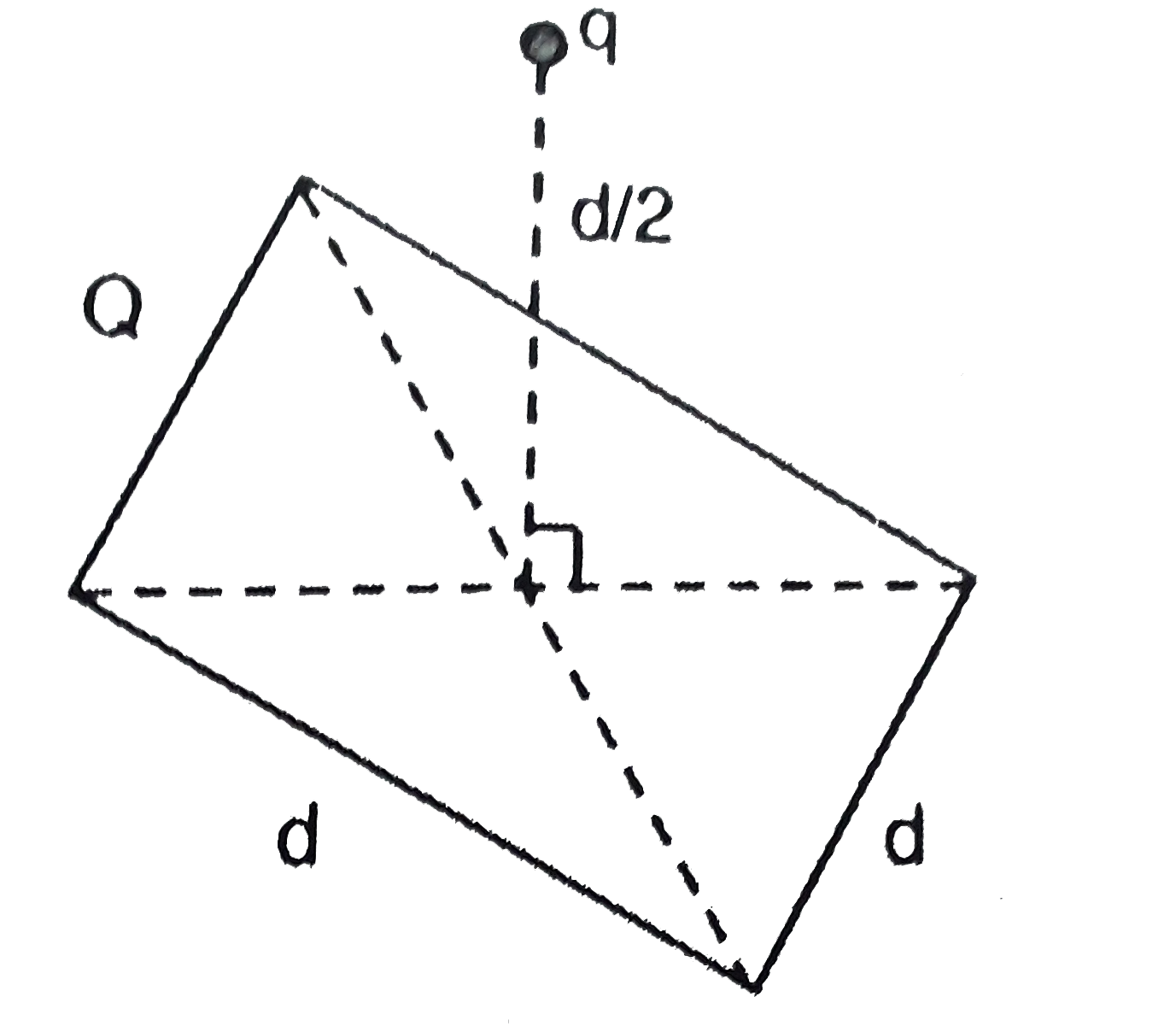
A square of side d, made from a thin insulating plate, is uniformly charged and carries a total charge of Q. A point charge q is placed on the symmetrical normal axis of the square at a distance d/2 from the plate. How large is the force acting on the point charge ?

Text Solution

Verified by Experts

According to Newton's third law, the insulating plate acts on the point charge with a force of the same magnitude (but opposite direction) as the point charge does on the plate. We calculate the magnitude of this latter force.
Divide the plate (notionally) inot small pieces, and denote the area of the `i^(th)` piece by `Delta A_(i)`. Because of the uniform charge distibution, the charge on this small piece is `Delta Q_(i) = (Q)/(d^(2)) Delta A_(i)`. and so the electric force acting on it is `Fi = Ei Qi`, where Ei is the magnitude of the electric field produced by the point charge q at the position of the small piece.
. The force acting on the insulating plate, as a whole, can be calculated as the vector sum of the forces acting on the individual pieces of the plate. Because of the axial symmetery, the net force is erpendicular to the plate, and so it is sufficient to sum the perpendicular components of the forces: :br" `F = underset(i)sum F_(i) cos theta_(i) = underset(i)sum E_(i) (q)/(d^(2)) DeltaA_(i) cos theta_(i) = (Q)/(d^(2)) underset(i) sum E_(i) Delta A_(i) cos theta_(i)`
Where `theta_(i)` is the angle between the normal to the plate and the line that connects the point charge to the its piece of it.
The Sum in the given expression is nothing other than the electric flux through the square sheet produced by the point charge `q : psi = (q)/(6_(epsi_(0)))`
Using this and our previous observations, we calculate the magnitude of the force acting on the point charge due to the presence of the charged insulating plates as `F = (Qq)/(6e_(0)d^(2))`
Promotional Banner

Topper's Solved these Questions

  • ELECTROSTATICS

    RESONANCE ENGLISH|Exercise Part - II|23 Videos
  • ELECTROMAGNETIC INDUCTION

    RESONANCE ENGLISH|Exercise A.l.P|19 Videos
  • EXPERIMENTAL PHYSICS

    RESONANCE ENGLISH|Exercise PART -II|10 Videos

Similar Questions

Explore conceptually related problems

A sperical shell is uniformly charged by a charge q. A point charge q_(0) is at its centre , then

A point charge q is placed at the origin . How does the electric field due to the charge very with distance r from the origin ?

A point charge Q is placed at the corner of a square of side a. Find the flux through the square.

Figure shows a uniformly charged sphere of radius R and total charge Q. A point charge q is situated outside the sphere at a distance r from centre of sphere. Find out the following : (i) Force acting on the point charge q due to the sphere. (ii) Force acting on the sphere due to the point charge.

Electric charge Q is uniformly distributed around a thin ring of radius a. find the potential a point P on the axis of the ring at a distance x from the centre of the ring .

A ring of radius R carries a uniformly distributed charge +Q. A point charge -q is placed on the axis of the ring at a distance 2R from the centre of the ring and released from rest. The particle executes a simple harmonic motion along the axis of the ring. State True or False.

A uniformly charged non-conducting spherical shell is given +q charge and a point charge -q is placed as shown. The electric field lines will be

A uniformly charged square plate having side L carries a uniform surface charge density sigma . The plate lies in the y - z plane with its centre at the origin. A point charge q lies on the x-axis. The flux of the electric field of q through the plate is phi0 , while the foce on the point charge q due to the plate is F_(0) , along the x-axis. Then,

A point charge q is placed at a distance a//2 directly above the centre of a square of side a . The electric flux through the square is

Consider a thin conducting shell of radius R carrying total charge Q . Two point charges Q and 2Q are placed on points A and B , which are at a distances of R/2 and 2R from the center of the cell respectively as shown in the figure. If the cell is earthed how much charge will flow to the earth?

RESONANCE ENGLISH-ELECTROSTATICS-HLP
  1. A particle of charge -q and mass m moves in a circular orbit about a f...

    Text Solution

    |

  2. The field potentail in a certain region of space depends only on the...

    Text Solution

    |

  3. A conducting sphere S1 of radius r is attached to an insulating handle...

    Text Solution

    |

  4. The intensity of an electric field depends only on the coordinates x a...

    Text Solution

    |

  5. A solid non conducting sphere of radius R has a non-uniform charge dis...

    Text Solution

    |

  6. Two electric charges q and - 2 q are placed at a distance 6 m apart on...

    Text Solution

    |

  7. Two small metallic balls of radii R(1) & R(2) are kept in vacuum at a ...

    Text Solution

    |

  8. A ball of radius R carries a positive charges whose volume density at ...

    Text Solution

    |

  9. Consider an equilateral triangle ABC of side 2a in the plane of the pa...

    Text Solution

    |

  10. An electrostatic field line leaves at angle alpha from charge q(1) and...

    Text Solution

    |

  11. Figure shown two infinitely large conducting plates A and B. If electr...

    Text Solution

    |

  12. In a conducting hollow sphere of inner and outer radii 5 cm and 10 cm,...

    Text Solution

    |

  13. Figure shows a system of three concentric metal shells, A, B and C wit...

    Text Solution

    |

  14. A point charge q is brought slowly from infinity and is placed at the ...

    Text Solution

    |

  15. Consider two solid dielectric spheres of radius a, separated by a dist...

    Text Solution

    |

  16. A triangle is made from thin insulating rods of different lengths, and...

    Text Solution

    |

  17. A square of side d, made from a thin insulating plate, is uniformly ch...

    Text Solution

    |

  18. A point charge q is located between two mutually perpendicular conduct...

    Text Solution

    |

  19. A point charge q is located at a distance l from an infinite condutin...

    Text Solution

    |

  20. Four charges 2C, – 3C, –4C and 5C respectively are placed at all the ...

    Text Solution

    |

