Home
Class 12
CHEMISTRY
The pressure-volume of various thermodyn...

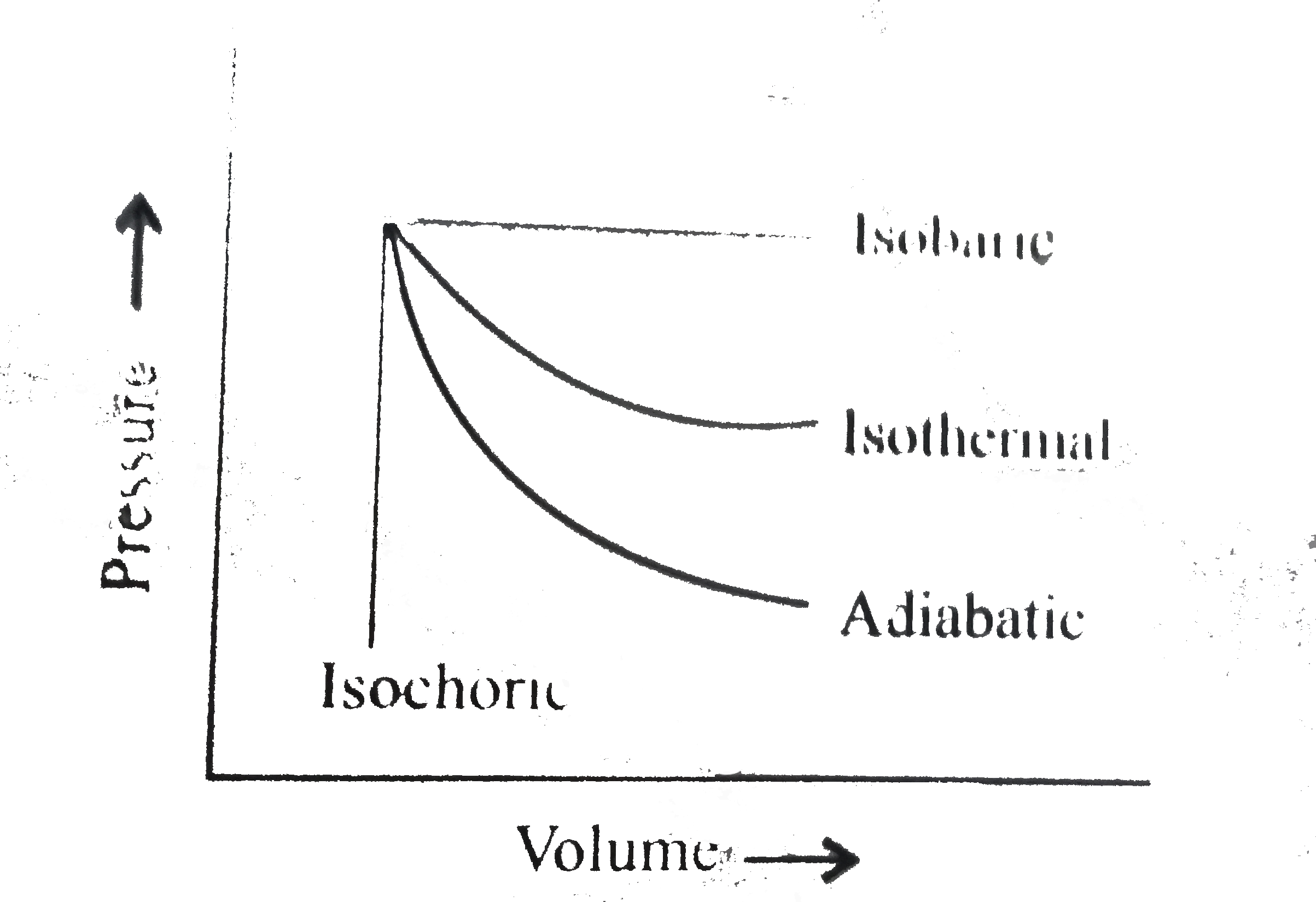
The pressure-volume of various thermodynamic process is shown in graphs:

Work is the mole of transference of energy. It has been observed that reversible work done by the system is the maximum obtainable work.
`w_(rev) gt w_(irr)`
The works of isothermal and adiabatic processes are different from each other.
`w_("isothermal reversible") = 2.303 nRT log_(10) ((V_(2))/(V_(1)))`
`= 2.303 nRT log_(10)((P_(2))/(P_(1)))`
`w_("adiabatic reversible") = C_(V) (T_(1)-T_(2))`
If `w_(1),w_(2),w_(3)` and `w_(4)` are work done in isothermal, adiabatic, isobaric, and isochoric reversible processes, respectively then the correct sequence (for expansion) would be

Text Solution

Verified by Experts

Although each of the above has same electronic distribution in bonding orbitals, nitrogenis inert because of non-polar nature of bond and high `N -= N` dissociation energy. Rest all `(CO, CN^(-), NO^(+))` are polar.
Promotional Banner

Topper's Solved these Questions

  • NITROGEN & OXYGEN FAMILY

    RESONANCE ENGLISH|Exercise Exercise 1 (Part-II : Only one option correct type)|50 Videos
  • NITROGEN & OXYGEN FAMILY

    RESONANCE ENGLISH|Exercise Exercise 1 (Part-III: Match the column)|2 Videos
  • NITROGEN & OXYGEN FAMILY

    RESONANCE ENGLISH|Exercise Part-III Practice Test-2 (JEE (Advanced Pattern))|23 Videos
  • METALLURGY

    RESONANCE ENGLISH|Exercise ORGANIC CHEMISTRY(Alkyl Halide, Alcohol,Phenol,Ether)|17 Videos
  • NITROGEN CONTAINING COMPOUNDS

    RESONANCE ENGLISH|Exercise ORGANIC CHEMISTRY(Nitrogen containing Compounds)|30 Videos

Similar Questions

Explore conceptually related problems

The pressure-volume of varies thermodynamic process is shown in graphs: Work is the mole of transference of energy. It has been observed that reversible work done by the system is the maximum obtainable work. w_(rev) gt w_(irr) The works of isothermal and adiabatic processes are different from each other. w_("isothermal reversible") = - 2.303 nRT log_(10) ((V_(2))/(V_(1))) = 2.303 nRT log_(10)((P_(2))/(P_(1))) w_("adiabatic reversible") = C_(V) (T_(1)-T_(2)) Calculate work done when 1 mole of an ideal gas is expanded reversibly from 30L to 60L at a constant temperature of 300K

The pressure-volume of varies thermodynamic process is shown in graphs: Work is the mole of transference of energy. It has been observed that reversible work done by the system is the maximum obtainable work. w_(rev) gt w_(irr) The works of isothermal and adiabatic processes are different from each other. w_("isothermal reversible") = 2.303 nRT log_(10) ((V_(2))/(V_(1))) = 2.303 nRT log_(10)((P_(2))/(P_(1))) w_("adiabatic reversible") = C_(V) (T_(1)-T_(2)) P-V plots for two gases during adiabatic processes are given in the given figure: Plot D and Plot C should correspond to

If w_(1).w_(2),w_(3) and w_(4) are work done in isothermal, adiabatic, isobaric, and isochoric reversible expansion for an ideal gas, respectively, then

The pressure-volume of varies thermodynamic process is shown in graphs: Work is the mole of transference of energy. It has been observed that reversible work done by the system is the maximum obtainable work. w_(rev) gt w_(irr) The works of isothermal and adiabatic processes are different from each other. w_("isothermal reversible") = 2.303 nRT log_(10) ((V_(2))/(V_(1))) = 2.303 nRT log_(10)((P_(2))/(P_(1))) w_("adiabatic reversible") = C_(V) (T_(1)-T_(2)) A thermodynamic system goes in a cyclic process as represented in the following P -V diagram: The network done during the complete cycle is given by the area

The pressure-volume of varies thermodynamic process is shown in graphs: Work is the mole of transference of energy. It has been observed that reversible work done by the system is the maximum obtainable work. w_(rev) gt w_(irr) The works of isothermal and adiabatic processes are different from each other. w_("isothermal reversible") = 2.303 nRT log_(10) ((V_(2))/(V_(1))) = 2.303 nRT log_(10)((P_(2))/(P_(1))) w_("adiabatic reversible") = C_(V) (T_(1)-T_(2)) The q value and work done in isothermal reversible expansion of one mole of an ideal gas from initial pressure of 1 bar to final pressure of 0.1 bar at constant temperature 273K are:

if work is done by the system then W is

If w_(1), w_(2), w_(3) and w_(4) for an ideal gas are magnitude of work done in isothermal, adiabatic, isobaric and isochoric reversible expansion processes, the correct order will be :

P – V graph for a cyclic process is shown in figure . Work done is given by

The work done by 1 mole of ideal gas during an adiabatic process is (are ) given by :

Work done in reversible isothermal expansion is given by

RESONANCE ENGLISH-NITROGEN & OXYGEN FAMILY-Exercise 1
  1. (a) Bond angle in PH(4)^(+) is higher than that in PH(3). Why? (b...

    Text Solution

    |

  2. Write the oxyacids of the following {:("Oxide","Oxyacids"),(N(2)O(3)...

    Text Solution

    |

  3. The pressure-volume of various thermodynamic process is shown in graph...

    Text Solution

    |

  4. Write the oxyacids of the following oxides: (i) P(4)O(6) (ii) P(4)O(1...

    Text Solution

    |

  5. What happens when barium azide is heated ?

    Text Solution

    |

  6. Which stable elements of 15^(th) and 16^(th) group do not react with w...

    Text Solution

    |

  7. Chemiluminescence is a phenomenon in which on element glows in dark wh...

    Text Solution

    |

  8. Write the oxyacids of the following oxides: (i) SO(2) (ii) SO(3)

    Text Solution

    |

  9. When nitrogen dioxide gas is bubbled through water it produces

    Text Solution

    |

  10. Write balanced equation when NH(3) is dissolved in water.

    Text Solution

    |

  11. What happens when phosphine is absorbed in mercuric chloride solution ...

    Text Solution

    |

  12. On being slowly passed through water, PH3 forms bubbles but NH3 dissol...

    Text Solution

    |

  13. How is hydrazine prepared ?

    Text Solution

    |

  14. What is the product when PH(3) reacts with HNO(3) ?

    Text Solution

    |

  15. In the preparation of P(4)O(6), a mixture of N(2) and O(2) is used rat...

    Text Solution

    |

  16. A compound of 15^(th) group element is used as a fast drying agent in ...

    Text Solution

    |

  17. Write the oxyacids of the following oxides: N(2)O(3), N(2)O(5),N(2)O(4...

    Text Solution

    |

  18. Why does NO(2) dimerise?

    Text Solution

    |

  19. Why in the manufacture of H2 SO4 by contact process, sulphur trioxide ...

    Text Solution

    |

  20. How are SO(2) Cl(2).SO(3) and SO(2) obtained from sulphuric acid ?

    Text Solution

    |
