Home
Class 12
CHEMISTRY
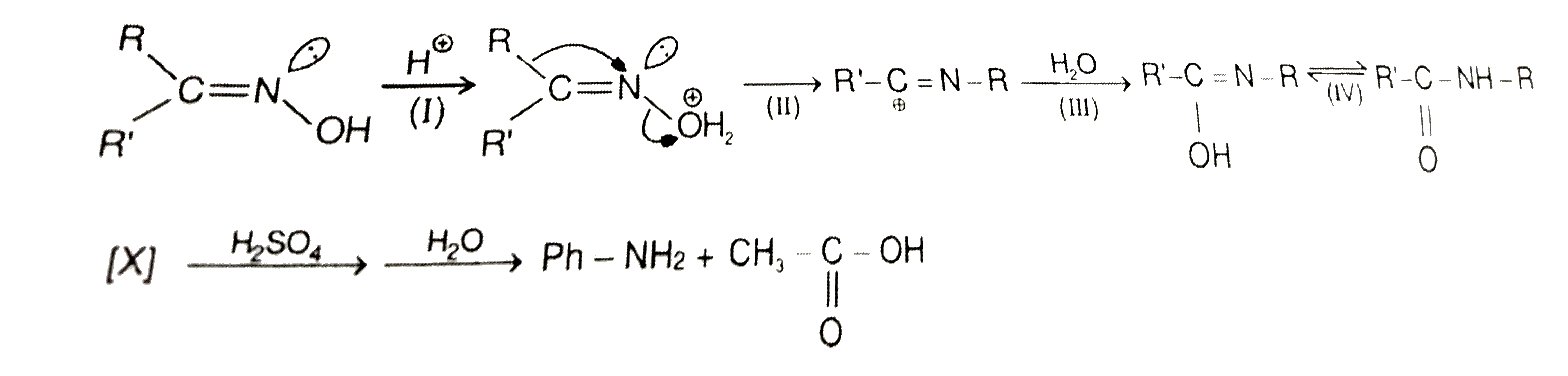
Aldehydes and Ketones react with NH(2)OH...

Aldehydes and Ketones react with `NH_(2)OH` to form aldoximes and Ketoximes respectively. Configuration of these can be determined by Beckmann rearragement as that group migrates which is anti w.r.t -OH

Which step is Rate determening step ?

A

I

B

II

C

III

D

IV

Text Solution

Verified by Experts

The correct Answer is:

B
Promotional Banner

Topper's Solved these Questions

  • CARBONYL COMPOUNDS (ALDEHYDES & KETONES ) & CARBOXYLIC ACID

    RESONANCE ENGLISH|Exercise Exercise-3|1 Videos
  • CARBONYL COMPOUNDS (ALDEHYDES & KETONES ) & CARBOXYLIC ACID

    RESONANCE ENGLISH|Exercise APSP|1 Videos
  • CARBONYL COMPOUNDS (ALDEHYDES & KETONES ) & CARBOXYLIC ACID

    RESONANCE ENGLISH|Exercise Part-I|98 Videos
  • BIOMOLECULES & POLYMER

    RESONANCE ENGLISH|Exercise ORGANIC CHEMISTRY(Biomolecules & Polymer)|34 Videos
  • CHEMICAL KINETICS

    RESONANCE ENGLISH|Exercise PHYSICAL CHEMITRY (CHEMICAL KNIETICS & RADIOACTIVITY)|49 Videos

Similar Questions

Explore conceptually related problems

Alldehydes and Ketones react with NH_(2)OH to form aldoximes and Ketoximes respectively. Configuration of these can be determined by Beckmann rearragement as that group migrates which is anti w.r.t -OH [X] overset(H_(2)SO_(4))to overset(H_(2)O)to Ph-NH_(2)+CH_(3)-underset(O)underset(||)(C)-OH Identify the configuration of [X] compound

RCONH_2 is converted into RNH_2 by means of Hofmann bromamide degradation. In this RCONHBr is formed form which this reaction has derived its name. Electron-donating group at phenyl activities the reaction. Hofmann degradation reaction is an intramolecular reaction. Which is the rate-determining step in Hofmann bromamide degradation ?

RCONH_2 is converted into RNH_2 by means of Hofmann bromamide degradation. In this RCONHBr is formed form which this reaction has derived its name. Electron-donating group at phenyl activities the reaction. Hofmann degradation reaction is an intramolecular reaction. Which is the rate-determining step in Hofmann bromamide degradation ?

The reaction 2AX(g)+2B_(2)(g)rarr A_(2)(g)+2B_(2)X(g) has been studied kinetically and on the baiss of the rate law following mechanism has been proposed. I. 2A X hArr A_(2)X_(2) " " ("fast and reverse") II. A_(2)X_(2)+B_(2)rarrA_(2)X+B_(2)X III. A_(2)X+B_(2)rarrA_(2)+B_(2)X where all the reaction intermediates are gases under ordinary condition. form the above mechanism in which the steps (elementary) differ conisderably in their rates, the rate law is derived uisng the principle that the slowest step is the rate-determining step (RDS) and the rate of any step varies as the Product of the molar concentrations of each reacting speacting species raised to the power equal to their respective stoichiometric coefficients (law of mass action). If a reacting species is solid or pure liquid, its active mass, i.e., molar concentration is taken to be unity, the standard state. In qrder to find out the final rate law of the reaction, the concentration of any intermediate appearing in the rate law of the RDS is substituted in terms of the concentration of the reactant(s) by means of the law of mass action applied on equilibrium step. Let the equilibrium constant of Step I be 2xx10^(-3) mol^(-1) L and the rate constants for the formation of A_(2)X and A_(2) in Step II and III are 3.0xx10^(-2) mol^(-1) L min^(-1) and 1xx10^(3) mol^(-1) L min^(-1) (all data at 25^(@)C) , then what is the overall rate constant (mol^(-2) L^(2) min^(-1)) of the consumption of B_(2) ?

The reaction 2AX(g)+2B_(2)(g)rarr A_(2)(g)+2B_(2)X(g) has been studied kinetically and on the baiss of the rate law following mechanism has been proposed. I. 2A X hArr A_(2)X_(2) " " ("fast and reverse") II. A_(2)X_(2)+B_(2)rarrA_(2)X+B_(2)X III. A_(2)X+B_(2)rarrA_(2)+B_(2)X where all the reaction intermediates are gases under ordinary condition. form the above mechanism in which the steps (elementary) differ conisderably in their rates, the rate law is derived uisng the principle that the slowest step is the rate-determining step (RDS) and the rate of any step varies as the Product of the molar concentrations of each reacting speacting species raised to the power equal to their respective stoichiometric coefficients (law of mass action). If a reacting species is solid or pure liquid, its active mass, i.e., molar concentration is taken to be unity, the standard state. In qrder to find out the final rate law of the reaction, the concentration of any intermediate appearing in the rate law of the RDS is substituted in terms of the concentration of the reactant(s) by means of the law of mass action applied on equilibrium step. How many times the rate of formation of A_(2) will increase if concentrations of AX is doubled and that of B_(2) is increased theee fold?

Which of the following side chain reaction/s can be used to reduce the acitivating group such as (-OH) or (-NH_(2)) .

Alkenes undergo electrophilic addition reactions. Electrophilic addition to unsymmetrical alkenes involve the formation of a more stable carbocation intermediate in the first step which is rate determining and carbocation is then attacked by a nuclephile to form product Which one of the following alkene reacts most readily with HCI ?
