
Home
Class 12
CHEMISTRY
Compounds P and R upon ozonolysis produc...

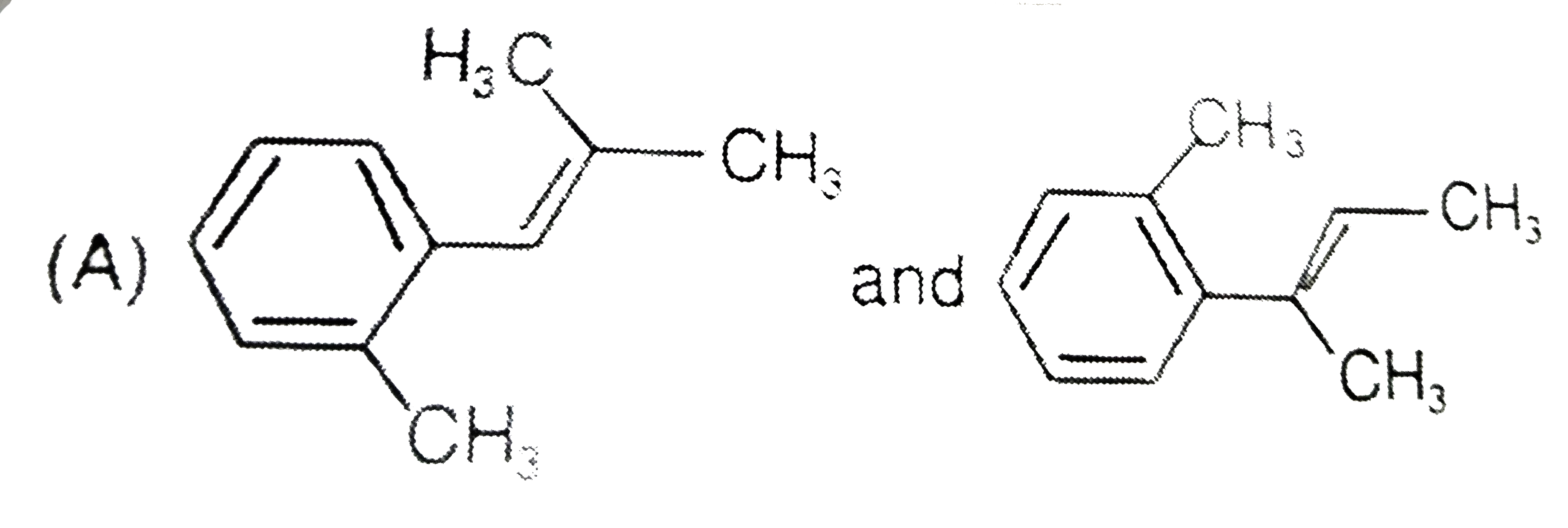
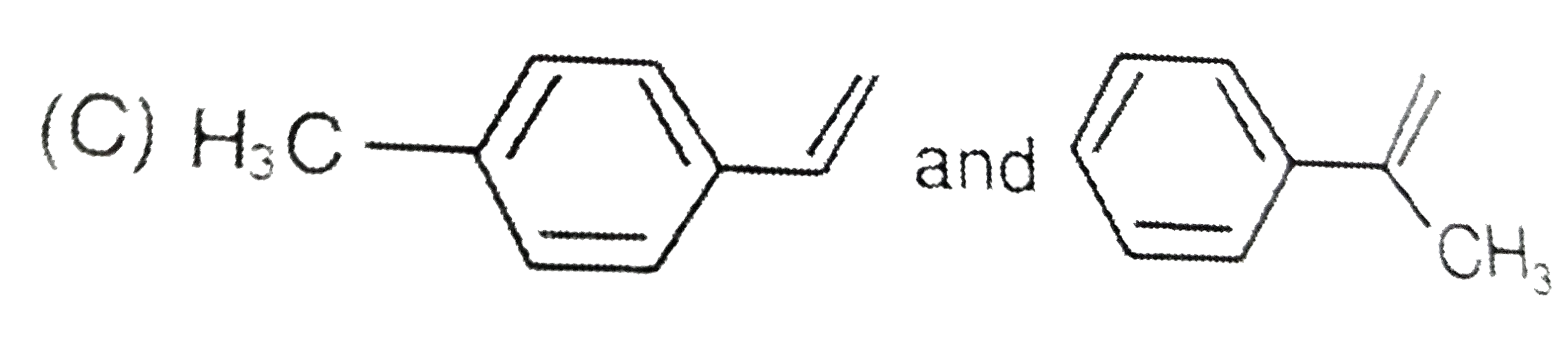
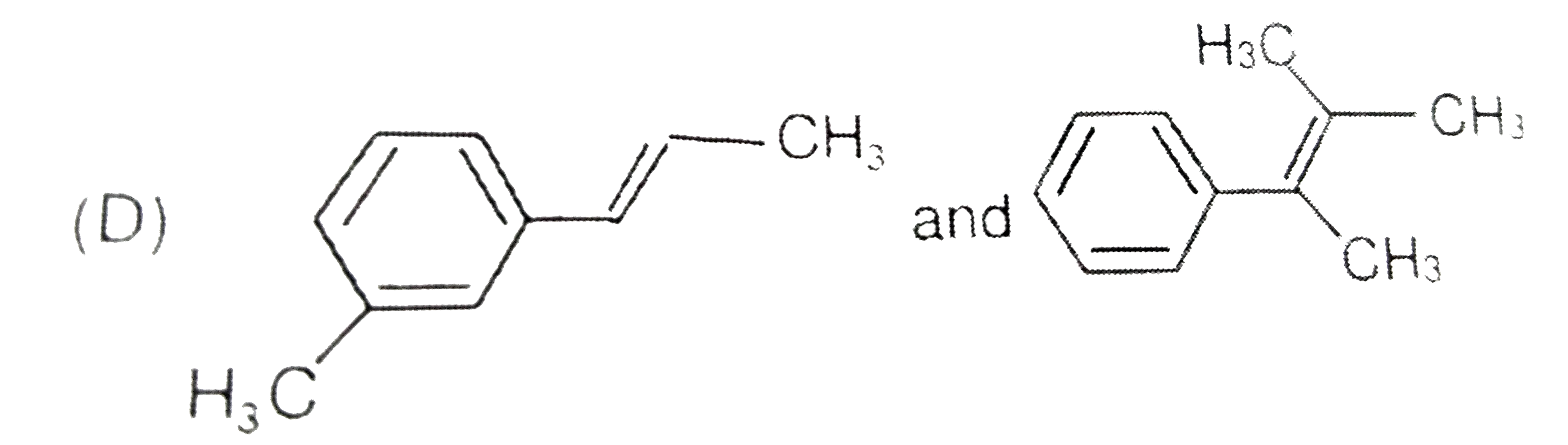
Compounds P and R upon ozonolysis produce Q and S, respectively. The molecular formula of Q and S is `C_(8)H_(8)O`. Q undergoes cannizzaro reactions but not haloform reaction. Whereas S undergoes haloform reactions but not cannizzaro reactions.
(i) P `overset((i) O_(3)//CH_(2)Cl_(2))underset((ii)Zn//H_(2)O)tounderset((C_(8)H_(8)O))(Q) " " (ii) R overset((i) O_(3)//CH_(2)Cl_(2))underset((ii) Zn//H_2O)tounderset((C_(8)H_(8)O))(S)`
The option (s) with suitable combination of P and R , respectively is (are)

A

B

C

D

Text Solution

AI Generated Solution

The correct Answer is:

To solve the problem, we need to analyze the information given about compounds P and R, and their ozonolysis products Q and S. Here’s a step-by-step breakdown of the solution: ### Step 1: Understand the Reactions - Ozonolysis is a reaction where ozone (O3) cleaves double bonds in alkenes to form carbonyl compounds (aldehydes or ketones). - The products Q and S have the same molecular formula, C8H8O. ### Step 2: Analyze the Properties of Q and S - Q undergoes Cannizzaro reaction but not haloform reaction: - Cannizzaro reaction occurs with aldehydes that do not have alpha-hydrogens. - This suggests that Q is likely a non-methyl aldehyde (since it can undergo Cannizzaro). - S undergoes haloform reaction but not Cannizzaro reaction: - The haloform reaction occurs with methyl ketones (ketones with a methyl group adjacent to the carbonyl). - This indicates that S is likely a methyl ketone. ### Step 3: Determine the Structure of P and R - Since Q is a non-methyl aldehyde, P must be an alkene that, upon ozonolysis, yields Q. - Since S is a methyl ketone, R must be an alkene that, upon ozonolysis, yields S. ### Step 4: Identify Possible Structures 1. **For Q**: A possible structure could be 4-octanal (an aldehyde with no alpha-hydrogens). 2. **For S**: A possible structure could be 2-heptanone (a methyl ketone). ### Step 5: Verify the Options - We need to check the options provided in the question to see which combinations of P and R lead to Q and S respectively. - Based on the characteristics of Q and S, we can conclude that: - P could be an alkene like 3-octene (which gives 4-octanal upon ozonolysis). - R could be an alkene like 2-heptene (which gives 2-heptanone upon ozonolysis). ### Conclusion The suitable combinations of P and R that lead to Q and S respectively are options C and D.
Promotional Banner

Topper's Solved these Questions

  • CARBONYL COMPOUNDS (ALDEHYDES & KETONES ) & CARBOXYLIC ACID

    RESONANCE ENGLISH|Exercise PART- IV|13 Videos
  • CARBONYL COMPOUNDS (ALDEHYDES & KETONES ) & CARBOXYLIC ACID

    RESONANCE ENGLISH|Exercise Exercise-3|1 Videos
  • CARBONYL COMPOUNDS (ALDEHYDES & KETONES ) & CARBOXYLIC ACID

    RESONANCE ENGLISH|Exercise Exercise-2 Part-I|1 Videos
  • BIOMOLECULES & POLYMER

    RESONANCE ENGLISH|Exercise ORGANIC CHEMISTRY(Biomolecules & Polymer)|34 Videos
  • CHEMICAL KINETICS

    RESONANCE ENGLISH|Exercise PHYSICAL CHEMITRY (CHEMICAL KNIETICS & RADIOACTIVITY)|49 Videos

Similar Questions

Explore conceptually related problems

What is the final product of the reaction ? (CH-)(3) HC = C (CH_(3)) CH_(2)CH_(3)underset((ii)H_(2)O_(2)//bar(O)H)overset((i)BH_(3)//THF) to underset(CH_(2)Cl_(2))overset(P"CC")tounderset((ii)H_(3)O^(+))overset((i)CH_(3)MgBr) to

underset((alpha))(C_(3)H_(5)N) overset("Hydrolysis")(to) underset((x)) (CH_(3)H_(6)O_(2)) underset((ii)H_(3)O^(+)) overset((i) Cl_(2)//P_("red"))to underset((y))(C_(3)H_(5)O_(2)Cl) overset (NH_(3))(to) underset((z)) (C_(3)H_(7)O_(2)) correct option (s) is/are for the above reaction.

the ozonolysis product(s) of the following reaction is(are) CH_(3)CH_(2)-C-=CH underset("(ii) "H_(2)O)overset((i)" "O_(3))to product(s)

Identify unknown compounds A to E in the following series of chemical reactions. (i) (ii) A+B overset("dil NaOH")to C+ H_(2)O (iii) C overset((i) O_(3)) underset((ii) Zn//H_(2)O) to A+D (iv) D overset(H_(2)//Ni)underset(Delta) to E

(X) overset(O_(3)//Zn)underset(H_(2)O)toCO_(2)+CH_(3)-underset(O)underset(||)(C)-H+OHC -underset(O)underset(||)(C)-CHO X is

R-overset(O)overset(||)(C)-Cl overset(NH_(3))toNH_(4)Cl+(X) overset(P_(4)O_(10))underset(Delta)to(Y) overset((i) DIBAL -H)underset((ii)H_(2)O)to(Z) The compound (Z) is

Write the product of following reactions : (i) CH_(3)-C-=C-CH=CH_(2) overset(O_(3)//H_(2)O_(2))rarr , (ii) , overset(O_(3)//H_(2)O_(2))rarr

CH_(3)C-=C CH_(3) underset((ii) H_(2)O""//Zn)overset((i) X) to CH_(3)-underset(O)underset(||)C-underset(O)underset(||)C-CH_(3) . In the above reaction , X is :

CH_(3)CH_(2)-overset(O)overset(||)C-O-C_(2)H_(2)overset((i)DIBAL.H(1 eq))underset((ii)H_(3)O^(+)) to A+B A and B are respectively.

RESONANCE ENGLISH-CARBONYL COMPOUNDS (ALDEHYDES & KETONES ) & CARBOXYLIC ACID -Part-I
  1. The major product of the following reactions sequence is

    Text Solution

    |

  2. Positive Tollen's test is observed for

    Text Solution

    |

  3. Compounds P and R upon ozonolysis produce Q and S, respectively. The m...

    Text Solution

    |

  4. There is a solution of p-hydroxybenzoic acid and p-amino benzoic acid ...

    Text Solution

    |

  5. Ph-underset(O)underset(||)(C)-NH(2) overset(POCl(3))to products is

    Text Solution

    |

  6. Identify the structure of the major products A,B, C and D formed in th...

    Text Solution

    |

  7. In the following reactions sequence, the correct structures of E,F and...

    Text Solution

    |

  8. In the reaction the structures of the product T is

    Text Solution

    |

  9. The carboxyl functional group(-COOH) is present in:

    Text Solution

    |

  10. The compound that undergoes decarboxylation most readily under mild co...

    Text Solution

    |

  11. The major product H of the given reaction sequence is : CH(3)-CH(2)-...

    Text Solution

    |

  12. The total number of carboxylic acid groups in the product P is

    Text Solution

    |

  13. The only CORRECT combination in which the reaction proceeds throu...

    Text Solution

    |

  14. Column 1,2 and 3 contain starting materials, reaction conditions, and ...

    Text Solution

    |

  15. Column 1,2 and 3 contain starting materials, reaction conditions, and ...

    Text Solution

    |

  16. Treatment of benzene with CO/HCl in the presence of anhydrous "AlCl"(3...

    Text Solution

    |

  17. Treatment of benzene with CO/HCl in the presence of anhydrous "AlCl"(3...

    Text Solution

    |

  18. An organic acid P (C(11)H(12)O(2)) can easily be oxidized to a dibasic...

    Text Solution

    |

  19. An organic acid P (C(11)H(12)O(2)) can easily be oxidized to a dibasi...

    Text Solution

    |

  20. Which of the following will be products of following reaction ?

    Text Solution

    |
