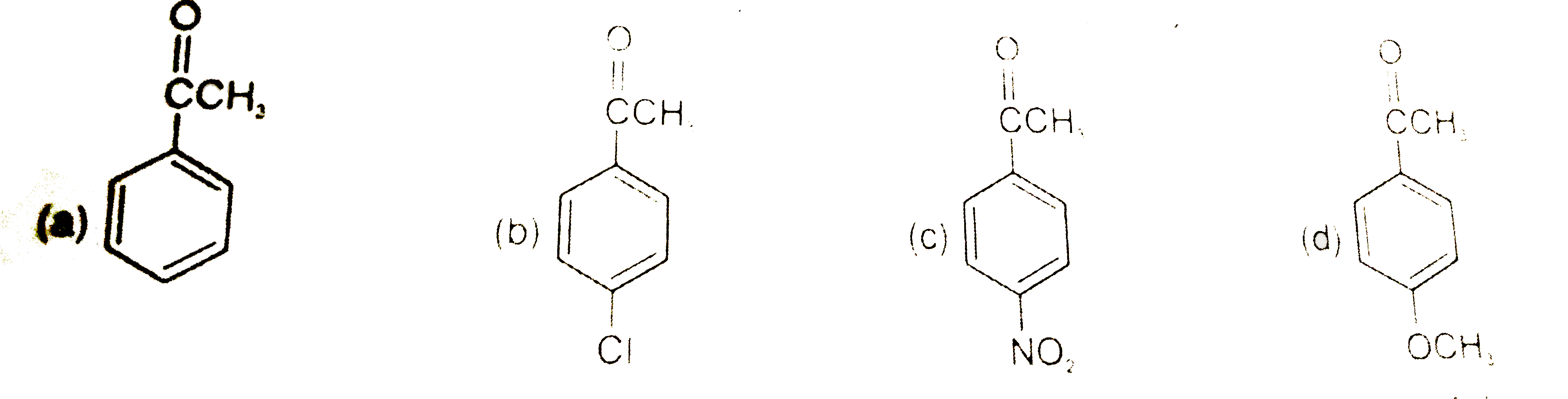
Text Solution
Verified by Experts
The correct Answer is:



Topper's Solved these Questions
CARBONYL COMPOUNDS (ALDEHYDES & KETONES ) & CARBOXYLIC ACID
RESONANCE ENGLISH|Exercise Part -IV|23 VideosCARBONYL COMPOUNDS (ALDEHYDES & KETONES ) & CARBOXYLIC ACID
RESONANCE ENGLISH|Exercise Part -II|39 VideosBIOMOLECULES & POLYMER
RESONANCE ENGLISH|Exercise ORGANIC CHEMISTRY(Biomolecules & Polymer)|34 VideosCHEMICAL KINETICS
RESONANCE ENGLISH|Exercise PHYSICAL CHEMITRY (CHEMICAL KNIETICS & RADIOACTIVITY)|49 Videos
Similar Questions
Explore conceptually related problems
RESONANCE ENGLISH-CARBONYL COMPOUNDS (ALDEHYDES & KETONES ) & CARBOXYLIC ACID -Part -III
- When semicarbazide reacts with a ketone (or aldehyde) to form semicarb...
Text Solution
|
- Arrange the following compounds in decreasing ordres of K(eq) for hydr...
Text Solution
|
- When acetone is treated with excess of bezaldehyde in the presence of ...
Text Solution
|
- Write the components which on claisen condensation could be used to pr...
Text Solution
|
- Predict the product for each of the following reactions.
Text Solution
|
- Products is
Text Solution
|
- Write the product of following reactions :
Text Solution
|
- A compound 'A' when treated with HNO(3) (in presence of H(2)SO(4) ) gi...
Text Solution
|
- A+B, Find A and B
Text Solution
|
- C(6)H(12)O(2)(X) overset(H(3)O^(+))toC(2)H(5)CO(2)H+C(3)H(7)OH, X is
Text Solution
|
- In the given reaction the products is : CH(3)-CH(2)-underset(O)under...
Text Solution
|
- Product of following reactions is
Text Solution
|
- 2-Methychlcyclohexanone is allowed to react with matachloroperbenzoic ...
Text Solution
|
- Which optically active compound on reduction with LiAlH(4) will give o...
Text Solution
|
- The reaction,RCOOR'+R''OH (excess) overset(H^(+)or OH^(-))to RCOOR''+R...
Text Solution
|
Text Solution
|
- Match the product of column -II with the reaction given in column -I
Text Solution
|
- How many compounds out of the following are more reactive than ethyl a...
Text Solution
|
- The product of the following reactions is optically inactive and exist...
Text Solution
|
- Ph-overset(O)overset(||)(C)-CH(3)+underset("(excess)")(CH(2)=O) overse...
Text Solution
|