Home
Class 12
CHEMISTRY
Observe the esterification mechanisms fo...

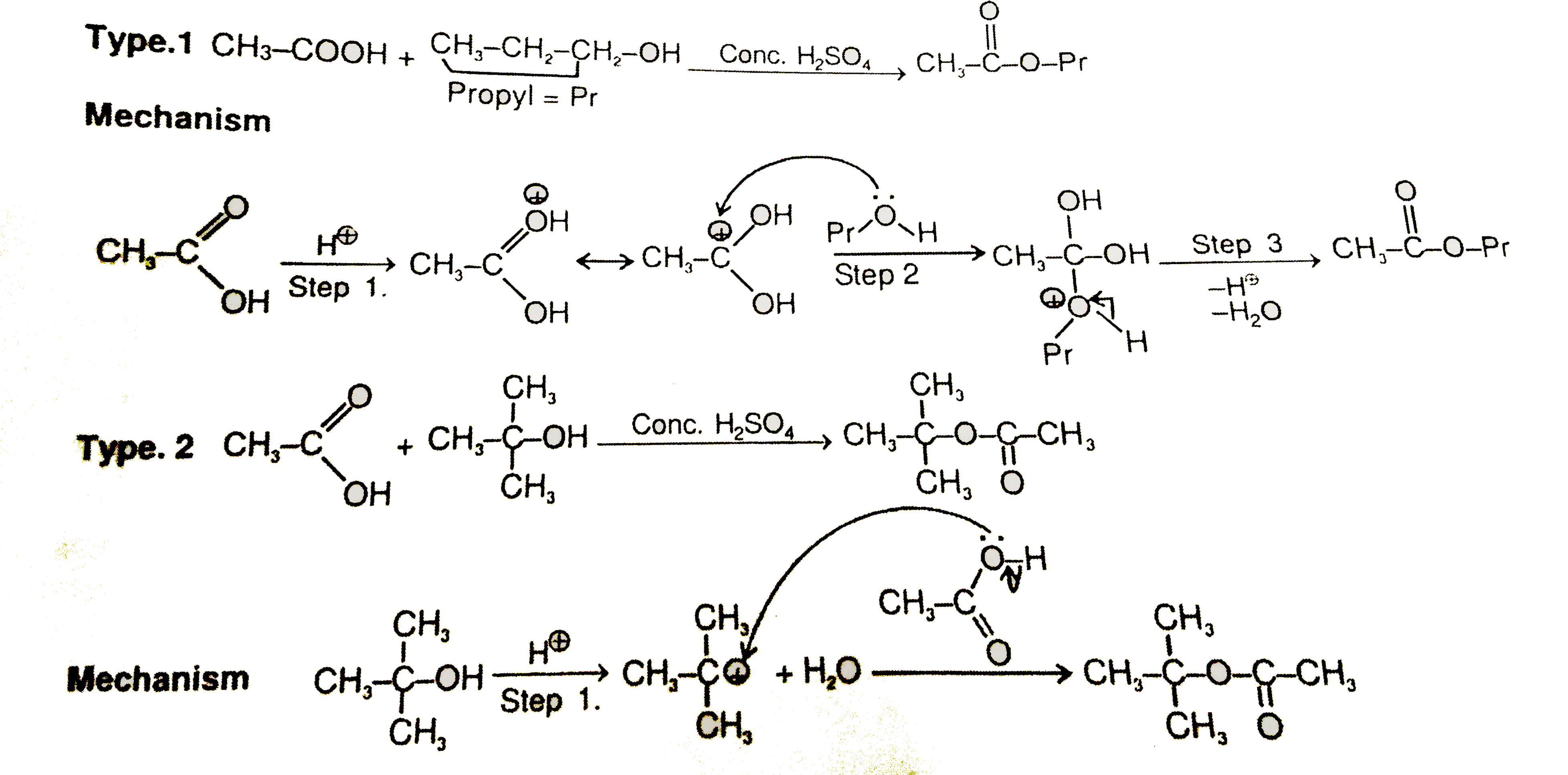
Observe the esterification mechanisms for primary and teriary alcohols.

(+) Octan -2-ol esterifies with Acetic acid to give optically inactive racemised product. It must have gone by

A

Type I mechanism

B

Type II mechanism

C

Mix type I and type II mechanism

D

more by type I and less by type II mechanism

Text Solution

Verified by Experts

The correct Answer is:

B

Since (+) Octan -2-ol racemises on reaction with acetic acid, therefore it must have gone through an `S_(N)1` reaction i.e., type II reaction
Promotional Banner

Topper's Solved these Questions

  • CARBONYL COMPOUNDS (ALDEHYDES & KETONES ) & CARBOXYLIC ACID

    RESONANCE ENGLISH|Exercise Part -IV|23 Videos
  • CARBONYL COMPOUNDS (ALDEHYDES & KETONES ) & CARBOXYLIC ACID

    RESONANCE ENGLISH|Exercise Part -II|39 Videos
  • BIOMOLECULES & POLYMER

    RESONANCE ENGLISH|Exercise ORGANIC CHEMISTRY(Biomolecules & Polymer)|34 Videos
  • CHEMICAL KINETICS

    RESONANCE ENGLISH|Exercise PHYSICAL CHEMITRY (CHEMICAL KNIETICS & RADIOACTIVITY)|49 Videos

Similar Questions

Explore conceptually related problems

Observe the esterification mechanisms for primary and teriary alcohols. CH_(3)-COOH+C_(2)H_(5)overset(18)(O)H overset(Conc. H_(2)SO_(4))to (P) CH_(3)-COOH+(CH_(3))_3C-overset(18)(O)H overset(Conc. H_(2)SO_(4))to (Q) In the above reaction (P) and (Q) are respectively

An optically active compound [A] C_(5)H_(13)N reacts with alkaline CHCl_(3) to give an optically active, compound [B]. [A] also reacts with nitrous acid to give an optically inactive alcohol [C] C_(5)H_(11)OH as the major product. What would be the structure of [A]?

Nucleophilic aliphatic substitution reaction is mainly of two types: S_(N)1 and S_(N)2 . The S_(N)1 mechanism is a two step process. Reaction velocity of S_(N)1 reaction depends only on the concentration of the substrate. Since product formation takes place by the formation of carbocation, optically active substrate gives (+) and (-) forms of the product. In most of the cases the product usually consits of 5-20% inverted product and 80-95% racemised species. The more stable the carbocation, the greater is the proportion of racemisation. In solvolysis reaction, the more nucleophilic the solvent, the greater is the proportion of inversion. For the gives reaction, Which substrate will give maximum racemisation?

Nucleophilic aliphatic substitution reaction is mainly of two types: S_(N)1 and S_(N)2 . The S_(N)1 mechanism is a two step process. Reaction velocity of S_(N)1 reaction depends only on the concentration of the substrate. Since product formation takes place by the formation of carbocation, optically active substrate gives (+) and (-) forms of the product. In most of the cases the product usually consits of 5-20% inverted product and 80-95% racemised species. The more stable the carbocation, the greater is the proportion of racemisation. In solvolysis reaction, the more nucleophilic the solvent, the greater is the proportion of inversion. Which one of the following compound will give S_(N)1 reaction predominantly?

SN reaction is given by these compounds, which have a nuclophilic group and a good leaving EWG . It should be stable after leaving with bonding pair of overline(e)'s and it should have high polarisability. Nucliphilic aliphatic substituion reaction is mainly of two types SN^(-1) and SN^(2). SN^(-1) mechanism is a two step process. Reaction velocity of SN^(-1) depends only on the concentration of the subtrate. It proceeds via the formation of carbocation, optically active substrate gives (o+) and (o-) froms of the product. In most of the cases, the product usually consists of 5-20% inverted and (95-80%) racemised species. The more stable is the carbocation, the greater is the propotion of racemisation. In solvolysis reaction, the more nucleophillic is the solvent, the greater is the proportion of inversion. For the reaction which substrate will give maximum racemismision ?

SN reaction is given by these compounds, which have a nuclophilic group and a good leaving EWG . It should be stable after leaving with bonding pair of overline(e)'s and it should have high polarisability. Nucliphilic aliphatic substituion reaction is mainly of two types SN^(-1) and SN^(2). SN^(-1) mechanism is a two step process. Reaction velocity of SN^(-1) depends only on the concentration of the subtrate. It proceeds via the formation of carbocation, optically active substrate gives (o+) and (o-) froms of the product. In most of the cases, the product usually consists of 5-20% inverted and (95-80%) racemised species. The more stable is the carbocation, the greater is the propotion of racemission. In solvolysis reaction, the more nucleophillic is the solvent, the greater is the proportion of inversion. Which of the following will give SN reaction?

SN reaction is given by these compounds, which have a nuclophilic group and a good leaving EWG . It should be stable after leaving with bonding pair of overline(e)'s and it should have high polarisability. Nucliphilic aliphatic substituion reaction is mainly of two types SN^(-1) and SN^(2). SN^(-1) mechanism is a two step process. Reaction velocity of SN^(-1) depends only on the concentration of the subtrate. It proceeds via the formation of carbocation, optically active substrate gives (o+) and (o-) froms of the product. In most of the cases, the product usually consists of 5-20% inverted and (95-80%) racemised species. The more stable is the carbocation, the greater is the propotion of racemission. In solvolysis reaction, the more nucleophillic is the solvent, the greater is the proportion of inversion. Which of the following gives SN^(1) reaction?

SN reaction is given by these compounds, which have a nuclophilic group and a good leaving EWG . It should be stable after leaving with bonding pair of overline(e)'s and it should have high polarisability. Nucliphilic aliphatic substituion reaction is mainly of two types SN^(-1) and SN^(2). SN^(-1) mechanism is a two step process. Reaction velocity of SN^(-1) depends only on the concentration of the subtrate. It proceeds via the formation of carbocation, optically active substrate gives (o+) and (o-) froms of the product. In most of the cases, the product usually consists of 5-20% inverted and (95-80%) racemised species. The more stable is the carbocation, the greater is the propotion of racemission. In solvolysis reaction, the more nucleophillic is the solvent, the greater is the proportion of inversion. Which of the following gives SN^(1) reaction? Select the correct answer.

Nucleophilic aliphatic substitution reaction is mainly of two types: S_(N)1 and S_(N)2 . The S_(N)1 mechanism is a two step process. Reaction velocity of S_(N)1 reaction depends only on the concentration of the substrate. Since product formation takes place by the formation of carbocation, optically active substrate gives (+) and (-) forms of the product. In most of the cases the product usually consits of 5-20% inverted product and 80-95% racemised species. The more stable the carbocation, the greater is the proportion of racemisation. In solvolysis reaction, the more nucleophilic the solvent, the greater is the proportion of inversion. Which of the following compounds will give S_(N)1 and S_(N)2 reactions with considerable rate? I. C_(6)H_(5)-CH_(2)-Br (II) CH_(2)=CH-CH_(2)-Br (III) CH_(3)-CH(Br)CH_(3) (IV) Select the correct answer from teh codes given below

Read the given passage and answer the questions number 1 to 5 that follow: The substitution reaction of alkyl halide mainly occurs by S_N 1 and S_N 2 mechanism. Whatever mechanism alkyl halides follow for the substitution reaction to occur, the polarity of the carbon halogen bond is responsible for these substitution reactions. The rate of S_N 1 reactions are governed by the stability of carbocation whereas for S_N 2 reactions steric factor is the deciding factor. If the starting material is a chiral compound, we may end up with an inverted product or racemic mixture depending upon the type of mechanism followed by alkyl halide. Cleavage of ethers with HI also governed by steric factor and stability of carbocation, which indicates that in organic chemistry, these two major factors help us in deciding the kind of product formed 1. Predict the stereochemistry of the product formed if an optically active alkyl halide undergoes substitution reaction by S_N 1 mechanism. 2. Name the instrument used for measuring the angle by which the plane polarised light is rotated. 3. Predict the major product formed when 2-Bromopentane reacts with alcoholic KOH. 4. Give one use of CHI_3 5. Write the structures of the products formed when anisole is treated with HI.

RESONANCE ENGLISH-CARBONYL COMPOUNDS (ALDEHYDES & KETONES ) & CARBOXYLIC ACID -Part -III
  1. Product of following reactions is

    Text Solution

    |

  2. 2-Methychlcyclohexanone is allowed to react with matachloroperbenzoic ...

    Text Solution

    |

  3. Which optically active compound on reduction with LiAlH(4) will give o...

    Text Solution

    |

  4. The reaction,RCOOR'+R''OH (excess) overset(H^(+)or OH^(-))to RCOOR''+R...

    Text Solution

    |

  5. Text Solution

    |

  6. Match the product of column -II with the reaction given in column -I

    Text Solution

    |

  7. How many compounds out of the following are more reactive than ethyl a...

    Text Solution

    |

  8. The product of the following reactions is optically inactive and exist...

    Text Solution

    |

  9. Ph-overset(O)overset(||)(C)-CH(3)+underset("(excess)")(CH(2)=O) overse...

    Text Solution

    |

  10. Which of correct against property mentioned ?

    Text Solution

    |

  11. The following conversion is/are possible by Ph-CH(2)-CH=O to overset...

    Text Solution

    |

  12. Observe the esterification mechanisms for primary and teriary alcohols...

    Text Solution

    |

  13. Observe the esterification mechanisms for primary and teriary alcohols...

    Text Solution

    |

  14. Observe the esterification mechanisms for primary and teriary alcohols...

    Text Solution

    |

  15. Observe the following sequence of reaction and answer the questions ba...

    Text Solution

    |

  16. Observe the following sequence of reaction and answer the questions ba...

    Text Solution

    |

  17. Observe the following sequence of reaction and answer the questions ba...

    Text Solution

    |

  18. Ester having alpha-hydrogen on treatement with a strong base eg. C(2)H...

    Text Solution

    |

  19. Ester having alpha-hydrogen on treatement with a strong base eg. C(2)H...

    Text Solution

    |

  20. Ester having alpha-hydrogen on treatement with a strong base eg. C(2)H...

    Text Solution

    |
