

Home
Class 12
MATHS
The spectrum of a black body at two temp...

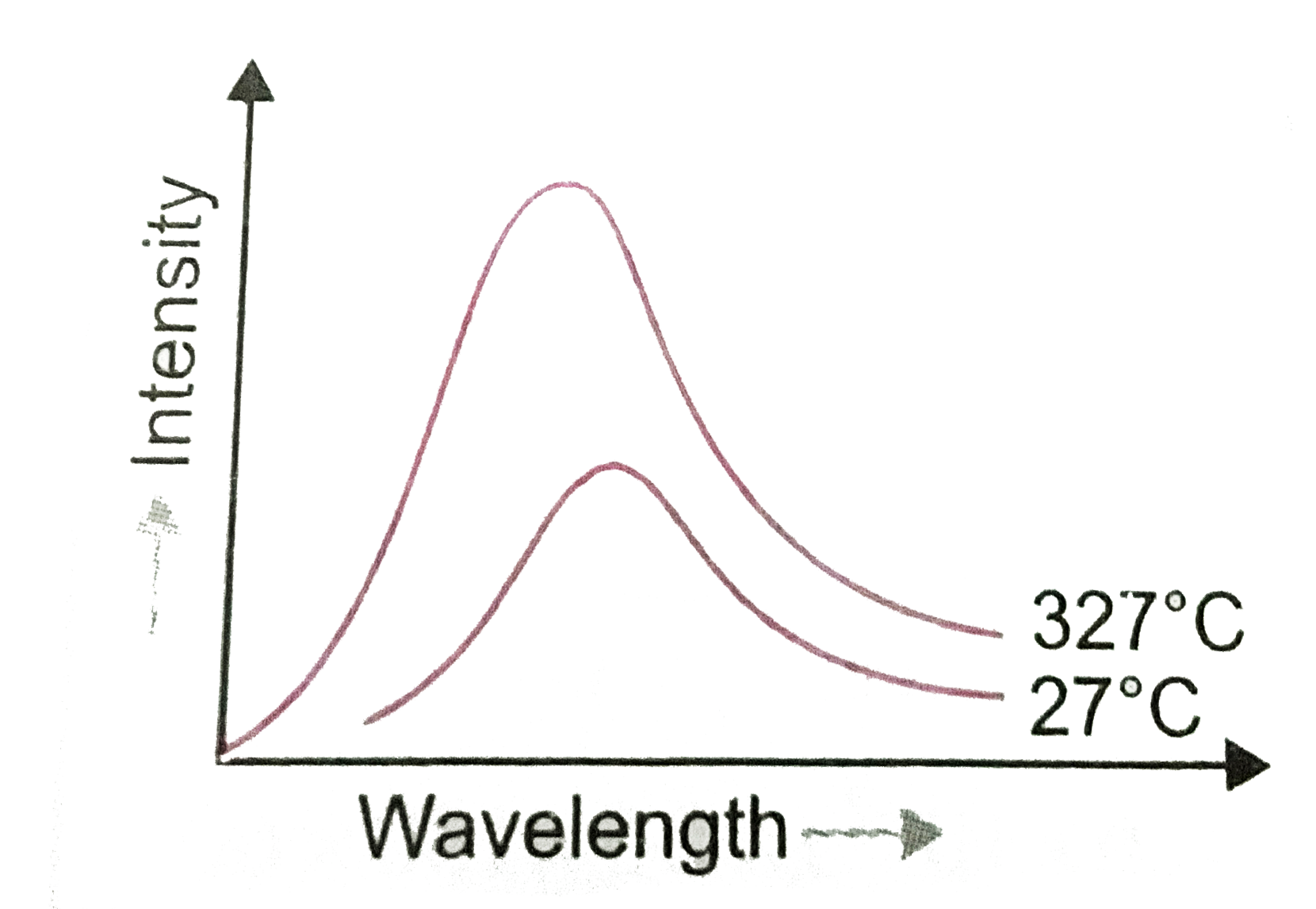
The spectrum of a black body at two temperatures `27^(@)C` and `327^(@)C` is show in the Fig. Let `A_(1)` and `A_(2)` be the respective areas under the two curved. Estimate the ratio `A_(2)//A_(1)`.

Promotional Banner

Similar Questions

Explore conceptually related problems

The specturm of a black body at two temperatures 27^(@)C and 327^(@)C is show in the Fig. 7(e).20 . Let A_(1) and A_(2) be the respective areas tunder the two curved. Estimate the ratio A_(2)//A_(1) .

The spectrum of a black body at two temperatures 27^(@)C and 327^(@)C is shown in the figure. Let A_(1) and A_(2) be the areas under the two curves respectively. Find the value of (A_(2))/(A_(1))

The spectra of a black body at temperatures 273^(@)C and 546^(@)C are shown in the figure. If A_(1) and A_(2) be area under the two curves respectively, the value of (A_(2))/(A_(1)) is

A uniform magnetic field passes through two areas, A_(1) and A_(2) . The angles between the magnetic field and the normals of areas A_(1) and A_(2) are 30.0° and 60.0°, respectively. If the magnetic flux through the two areas is the same, what is the ratio A_(1)//A_(2) ?

If the area of the circle is A_(1) and the area of the regular pentagon inscribed in the circle is A_(2), then find the ratio (A_(1))/(A_(2)) .

A regular pentagons is inscribed in a circle. If A_(1) and A_(2) represents the area of circle and that of regular pentagon respectively, then A_(1) : A_(2) is

Let a and b be two positive real numbers such that a+2b<=1. Let A_(1) and A_(2) be, respectively,the areas of circles with radii ab^(3) and b^(2). Then the maximum possible value of (A_(1))/(A_(2)) is:

Let ABC and AB'C be two non-congruent triangles with sides BC=B'C=5, AC=6, and angleA is fixed. If A_(1) and A_(2) are the area of the two triangles ABC and AB'C, then the value of (A_(1)^(2)+A_(2)^(2)-2A_(1)A_(2)cos 2A)/((A_(1)+A_(2))^(2)) is

The line that joins the saturn to the sun sweeps area A_(1), A_(2) and A_(3) in time intervals of 6 weeks, 3 weeks and 2 weeks respectively as shows in the Fig. What is the correct relation between A_(1), A_(2) and A_(3) ?

If A_(1) and A_(2) are two A.M.'s between a and b, prove that (i) (2A_(1)-A_(2))(2A_(2)-A_(1))=ab (ii) A_(1)+A_(2)=a+b