

Home
Class 11
PHYSICS
A 40 kg slab rests on a frictionless flo...

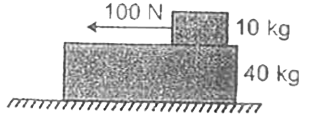
A 40 kg slab rests on a frictionless floor. A 10 kg block rests on top of the slab. The coefficient of friction between the block and the slab is 0.40. The 10 kg block is acted upon by a horizontal force of 100 N. If `g=10m//s^(2)`, the resulting acceleration of the slab will be

Promotional Banner

Similar Questions

Explore conceptually related problems

A 40kg slab rests on a frictionless floor as shown in the figure. A 10kg block rests on the top of the slab. The static coefficient of friction between the block and slab is 0.60 while the kinetic friction is 0.04 . The 10kg block is acted upon by a horizontal force 100N. if g=9.8m//s^(2) , the resulting acceleration of the slab will be.

A 40 kg slb rest on a frictionless floor as shown in the figure. A 10 kg block rests on the top of the slab. The static corfficient of friction between the block and slab is 0.60 while the kinetic friction is 0.40 the 10 kg block is acted upon by a horizontal force 100N. If g=9.8(m)/(s^2) , the resulting acceleration of the slab will be.

A 40 kg slab rests on a frictionless floor . A 10 kg block rests on top of the slab (Fig . 7. 121). The static coefficient of friction between the block and the slab is 0.60 while the kinetic coefficient is 0.40 . The 10 kg block is acted upon by a horizontal force of 100 N . if g = 9.8 m//s^(2) the resulting acceleration of the slab will be :

A 40 kg slab rests on a frictionless floor . A 10 kg block rests on the top of the slab . [Fig. 7.81 (a)] . The coefficients of static and dynamic friction are 0.60 and 0.40 respectively . The 10 kg block is pulled by a horizontal force of 100 N . what are the resulting accelerations of (a) the block (b) the slab ? ( g = 10 m// s^(2) )

Block A of mass 5 kg is resting on a frictionless floor. Another block B of mass 7kg is resting on it as shown in the figure. The coefficient of friction between the blocks is 0.5 while kinetic friction is 0.4. If a force of 100 N is applied to block B, the acceleration of the block A will be ( g =10 ms^(-2)) :

A large slab of mass 5kg lies on a smooth horizontal surface, with a block of mass 4kg lying on the top of it. The coefficient of friction between the block and the slab is 0.25 . If the block is pulled horizontally by a force of F =6N , the work done by the force of friction on the slab, between the instants t=2s and t=3s , is (g=10ms^-2)

Block A of mass 35 kg is resting on a frictionless floor.

A slab of 40 kg lying on a frictionales floor and a block of 10 kg rests on the slab as shown in the figure. The coefficients of static and kinetic friction between the slab and the block are 0.6 and 0.4 respectively. If a force of 100 N is applied on the block, then the acceleration the slab will be (g = 10 m//s^(2))