

Home
Class 12
PHYSICS
A ring of radius R having a linear charg...

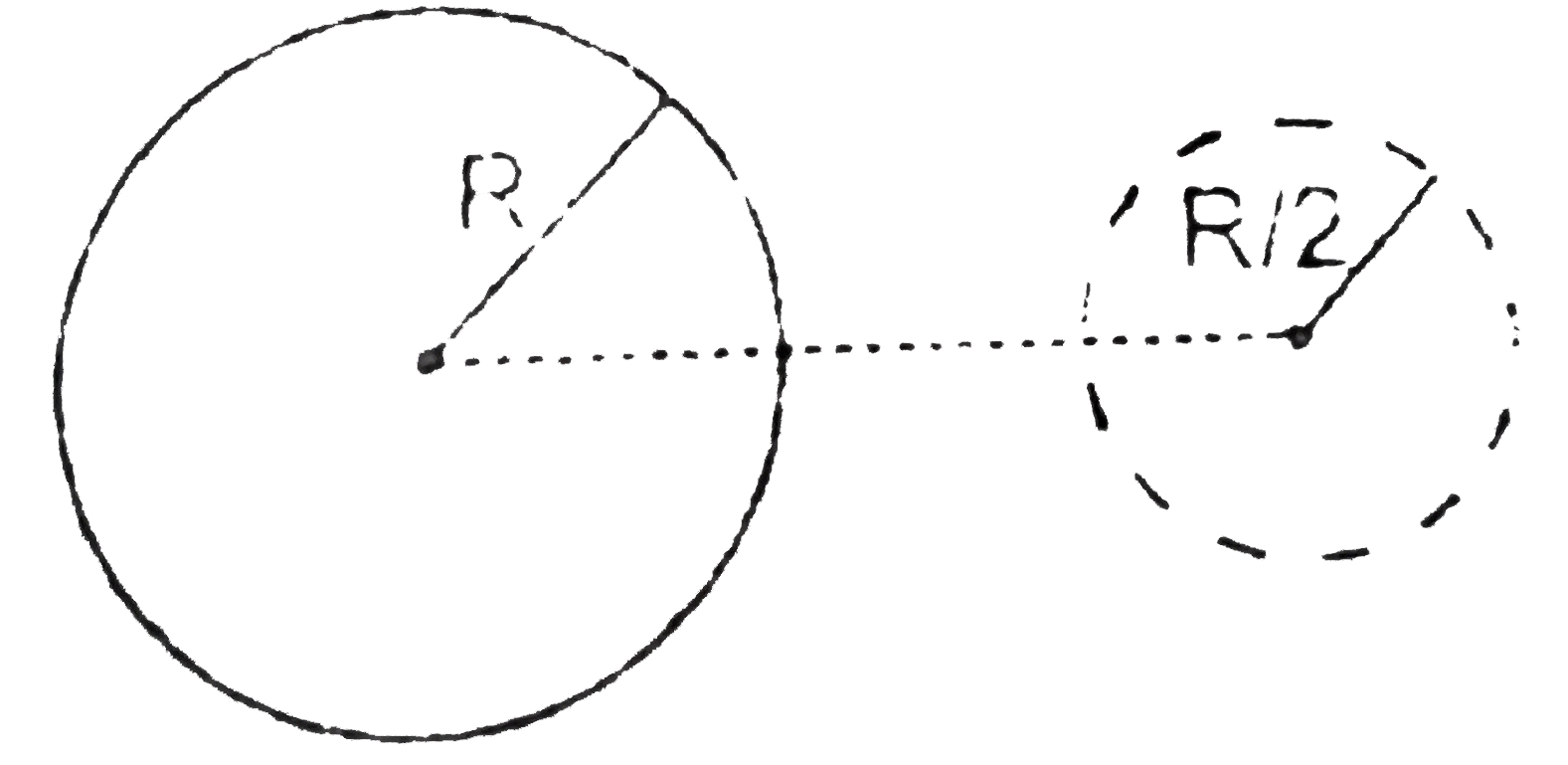
A ring of radius `R` having a linear charge density `lambda` moves towards a solid imaginary sphere of radius `(R)/(2)`, so that the centre of ring passes through the centre of sphere. The axis of the ring is perpendicular to the line joining the centres of the ring and the sphere. The maximum flux through the sphere in this process is

Promotional Banner

Similar Questions

Explore conceptually related problems

A half ring of radius r has a linear charge density lambda .The potential at the centre of the half ring is

Find the gravitational force of attraction between the ring and sphere as shown in the diagram, where the plane of the ring is perpendicular to the line joining the centres. If sqrt8R is the distance between the centres of a ring (of mass 'm') and a sphere (mass "M") where both have equal radius "R'

A solid conducting sphere of radius r is having a charge of Q and point charge q is a distance d from the centre of sphere as shown. The electric potential at the centre of the solid sphere is :

Flux passing through the shaded surface of a sphere when a point charge q is placed at the center is (radius of the sphere is R)

A quarter ring of radius R is having uniform charge density lambda . Find the electric field and potential at the centre of the ring.

A sphere of radius R and charge Q is placed inside an imaginary sphere of radius 2R whose centre coincides with the given sphere. The flux related to imaginary sphere is:

Charge density of a sphere of radius R is rho = rho_0/r where r is distance from centre of sphere.Total charge of sphere will be

There is a ring of radius r having linear charge density lambda and rotating with a uniform angular velocity omega. the magnetic field produced by this ring at its own centre would be

Three identical spheres each of mass M and radius R are arranged in a row touching each other and their centres collinear.The moment of inertia of the system about an axis passing through the centre of the middle sphere and perpendicular to the line joining their centres is "