

Home
Class 12
PHYSICS
In the figure shown S is a large noncond...

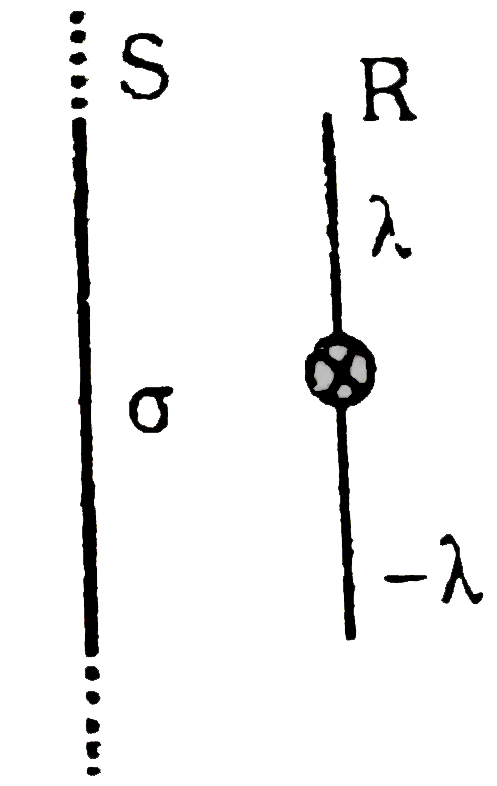
In the figure shown S is a large nonconducting sheet of uniform charge density `sigma`. A rod R of length `l` and mass 'm' is parallel to the sheet and hinged at its mid point. The linear charge densities on the upper and lower half of the rod are shown in the figure. Find the angular acceleration of the rod just after it is released.

Promotional Banner

Similar Questions

Explore conceptually related problems

In the figure shown S is a large nonconducting sheet of uniform charge density sigma . A rod R of length l and mass 'm' is parallel to the sheet and hinged at its point. The linear charge densities on the upper and lower half of the rod are shown in the figure. Find the angular acceleration of the rod just after it is released [(3sigmalambda)/(2m in_(0))]

A large nonconducting sheet M is given a uniform charge density. Two unchared small metal rods A and B are placed near the sheet as shown in figure

A uniform rod of mass m length l is attached to smooth hinge at end A and to a string at end B as shown in figure. It is at rest. The angular acceleration of the rod just after the string is cut is :

A rod PQ of mass M and length L is hinged at end P . The rod is kept horizontal by a massless string tied to point Q as shown in the figure. When string is cut, the initial angular accleration of the rod is.

A uniform thin rod is released from rest in the horizontal position as shown in the figure. For what value of x, the angular acceleration is maximum.

A large sheet carries uniform surface charge density sigma . A rod of length 2l has a linear charge density lamba on one half and -lambda on the second half. The rod is hinged at the midpoint O and makes an angle theta with the normal to the sheet. The torque experience by the rod is

A L shaped rod of mass M is free to rotate in a vertical plane about axis A A as shown in figure. Maximum angular acceleration of rod is