

Home
Class 12
PHYSICS
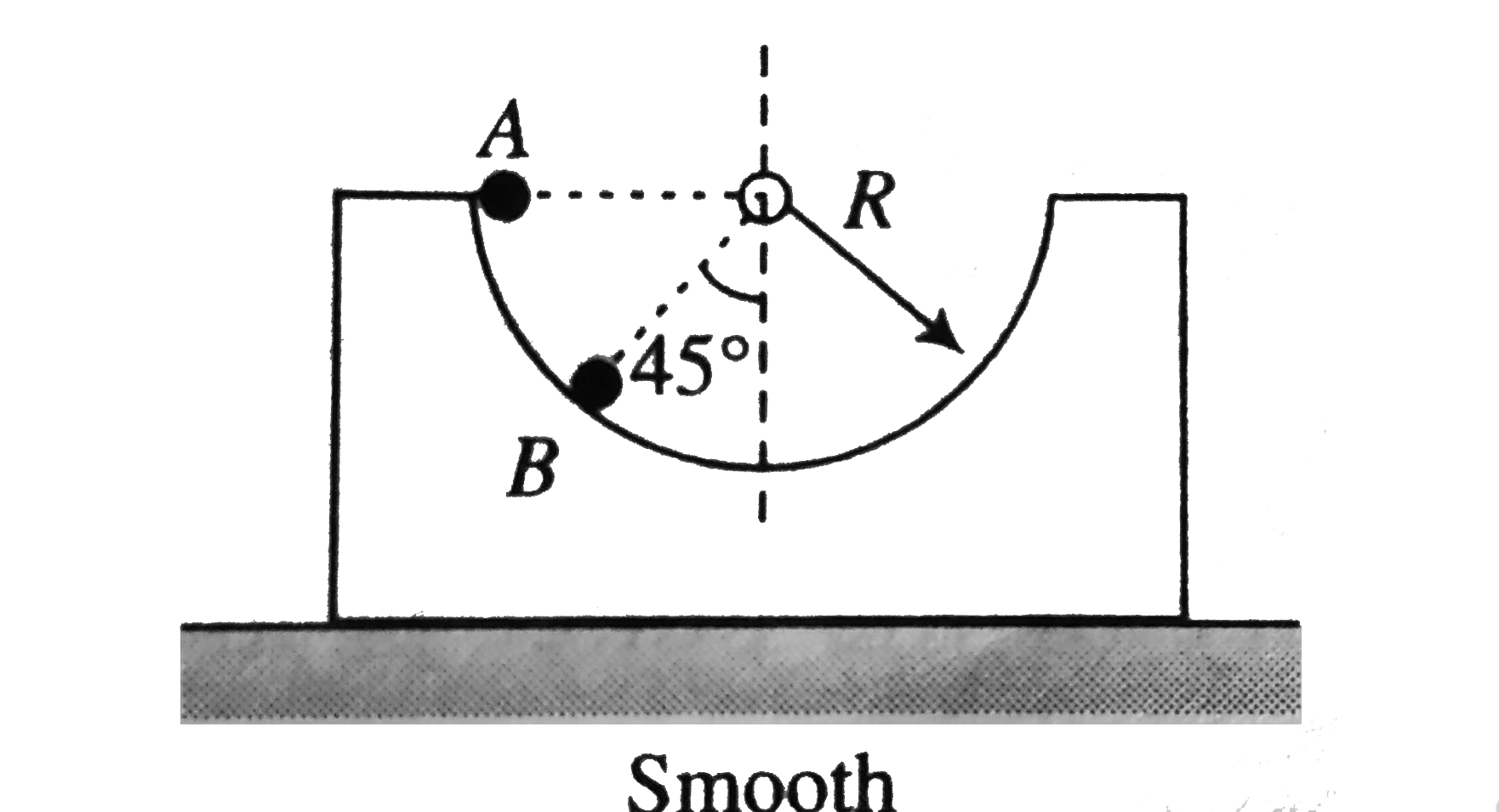
A ball of mass m is released from A insi...

A ball of mass `m` is released from A inside a smooth wedge of mass `m` as shown in figure. What is the speed of the wedge when the ball reaches point B?

Promotional Banner

Similar Questions

Explore conceptually related problems

A ball of mass m is allowed to roll down the wedge of mass M = 2m as shown in the figure. What is the displacement of wedge (in m ) when the ball reaches from A to B ? Take theta=45^(@), h=1m, d=4m

A block of mass m is released from a wedge of mass m as shown in figure . Find the time taken by the block to reach the end of the wedge.

A block of mass m is released from the top of a wedge of mass M as shown in figure. Find the displacement of wedges on the horizontal ground when the block reaches the bottom of the wedges. Neglect friction everywhere.

A block of mass m is at rest on a rought wedge as shown in figure. What is the force exerted by the wedge on the block?

A block of mass m is initially lying on a wedge of mass M with an angle of inclination theta as shown in figure. Calculate the displacement of the wedge when the block is released and reaches to the bottom of the wedge.

A block of mass m is placed on a smooth wedge of inclination theta & mass M. The whole system is slip on the wedge. Then the normal reaction on the wedge acting from the ground :

A small ball of mass m is released from rest from the position shown . All contact surface are smooth . The speed of the ball when it reaches its lowest position is

A cube of mass m is placed on top of a wedge of mass 2m, as shown in figure. There is no friction between the cube and the wedge. The minimum co - efficient of friction between the wedge and the horizontal surface, so that the wedge does not move is

A block of mass m is placed on the inclined sufrace of a wedge as shown in fig. Calculate the acceleration of the wedge and the block when the block is released. Assume all surfaces are frictionless.

A ball of mass 1 kg is released from position A inside a wedge with a hemispherical cut of radius 0.5 m as shown in figure. The force exerted by the vertical wall OM on wedge, when the ball is in position B is (neglect friction everywhere) (Take g = 10 m//s^(2) )