Home
Class 12
CHEMISTRY
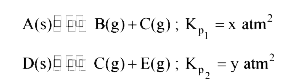
Two solids dissociates as follows . ...

Two solids dissociates as follows
.
The total pressure when both the solids dissociate simultaneously is :
1. `2 (sqrt(x+y))` atm
2. `(x+y)` atm
3. `sqrt(x+y)` atm
4. `x^2+y^2`.

A

`2 (sqrt(x+y))` atm

B

`(x+y)` atm

C

`sqrt(x+y)` atm

D

`x^2+y^2`.

Text Solution

Verified by Experts

The correct Answer is:
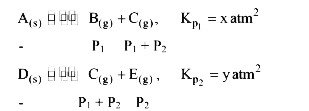
A

.
`Kp_(1)=P_(1)(P_1+P_2)=x`
`Kp_(2)=P_(2)(P_1+P_2)=y`
`therefore Kp_(1)+Kp_(2)=(P_(1)+P_(2))^2=x+y rArr P_(1)+P_(2)sqrt(x+y) rArr 2(P_1+P_2)=2sqrt(x+y)`
`therefore P_("total") =P_(B)+P_(C)+P_(E)=2(P_1+P_2)=2sqrt(x+y)`.
Promotional Banner

Topper's Solved these Questions

  • JEE MAIN REVISION TEST 8 (2020)

    VMC MODULES ENGLISH|Exercise CHEMISTRY (SECTION 2)|5 Videos
  • JEE MAIN REVISION TEST 5 (2020)

    VMC MODULES ENGLISH|Exercise CHEMISTRY (SECTION 2)|5 Videos
  • JEE MAIN REVISION TEST- 16

    VMC MODULES ENGLISH|Exercise CHEMISTRY (SECTION 2)|5 Videos

Similar Questions

Explore conceptually related problems

Two solids dissociates as follows A(s) rarr B(g) + C(g), K_(P_(1)) = x atm^(2) D(s) rarr C(g) + E(g), K_(P_(2)) = y atm^(2) The total pressure when both the solids dissociate simultaneously is :

Solve the following system of equations: 2/(sqrt(x))+3/(sqrt(y))=2,\ \ \ \ 4/(sqrt(x))-9/(sqrt(y))=-1

Show that x=2,\ \ y=1 is a solution of the system of simultaneous linear equations: 3x-2y=4;\ \ \ 2x+y=5 .

The area of the region is 1st quadrant bounded by the y-axis, y=(x)/(4), y=1 +sqrt(x), and y=(2)/(sqrt(x)) is

If sqrt(a+i b)=x+i y ,\ then possible value of sqrt(a-i b) is a. x^2+y^2 b. sqrt(x^2+y^2) c. x+i y d. x-i y e. sqrt(x^2-y^2)

If y= sqrt ( x) + (1)/( sqrtx ) , prove that 2x (dy)/( dx ) + y=2 sqrt (x ) .

(v) Solve for x and y if (sqrt2 x+sqrt 3 y)=0 and (sqrt3 x- sqrt8 y)=0

At 600^(@)C,K_(P) for the following reaction is 1 atm. X(g) rarr Y(g) + Z(g) At equilibrium, 50% of X (g) is dissociated. The total pressure of the equilibrium system is p atm. What is the partial pressure (in atm) of gases at equilibrium ?

The ellipse 4x^2+9y^2=36 and the hyperbola a^2x^2-y^2=4 intersect at right angles. Then the equation of the circle through the points of intersection of two conics is (a) x^2+y^2=5 (b) sqrt(5)(x^2+y^2)-3x-4y=0 (c) sqrt(5)(x^2+y^2)+3x+4y=0 (d) x^2+y^2=25

An equilateral triangle whose two vertices are (-2, 0) and (2, 0) and which lies in the first and second quadrants only is circumscribed by a circle whose equation is : (A) sqrt(3)x^2 + sqrt(3)y^2 - 4x +4 sqrt(3)y = 0 (B) sqrt(3)x^2 + sqrt(3)y^2 - 4x - 4 sqrt(3)y = 0 (C) sqrt(3)x^2 + sqrt(3)y^2 - 4y + 4 sqrt(3)y = 0 (D) sqrt(3)x^2 + sqrt(3)y^2 - 4y - 4 sqrt(3) = 0

