

Home
Class 12
CHEMISTRY
Heating of 2-chloro-1-phenylbutane with ...

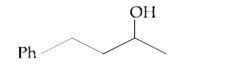
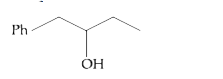
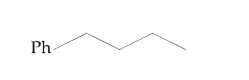
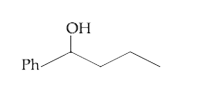
Heating of 2-chloro-1-phenylbutane with EtOK/EtOH gives X as the major product. Reaction of X with `Hg(PAc)_(2)//H_(2)O` followed by gives Y as the major product. Y is :

A

B

C

D

Text Solution

AI Generated Solution

The correct Answer is:
To solve the problem step by step, we will analyze the reactions involved and identify the major products formed. ### Step 1: Identify the starting compound The starting compound is 2-chloro-1-phenylbutane. This compound has a chlorine atom attached to the second carbon of the butane chain, which is also connected to a phenyl group. ### Step 2: Reaction with EtOK/EtOH When 2-chloro-1-phenylbutane is heated with potassium ethoxide (EtOK) in ethanol (EtOH), it undergoes an elimination reaction (E2 mechanism). In this reaction, the chlorine atom (a good leaving group) is removed along with a hydrogen atom from an adjacent carbon, leading to the formation of a double bond. - **Elimination Reaction**: - The chlorine atom leaves, and a hydrogen atom is removed from the adjacent carbon (C-3). - This results in the formation of an alkene. The major product (X) of this elimination reaction is **1-phenylbut-2-ene**. ### Step 3: Reaction of X with Hg(OAc)₂/H₂O Next, we take the alkene (1-phenylbut-2-ene) and react it with mercuric acetate (Hg(OAc)₂) in the presence of water (H₂O). This reaction is known as oxymercuration, which adds a hydroxyl group (OH) across the double bond. - **Oxymercuration**: - The alkene reacts with mercuric acetate to form a mercurial intermediate. - Water then attacks the more substituted carbon of the double bond, leading to the formation of an alcohol. After the reaction, the product (Y) is **1-phenylbutan-2-ol**, which is an alcohol. ### Step 4: Final product Thus, the final product Y is **1-phenylbutan-2-ol**. ### Summary of Products - **X (major product from elimination)**: 1-phenylbut-2-ene - **Y (major product from oxymercuration)**: 1-phenylbutan-2-ol ### Final Answer Y is **1-phenylbutan-2-ol**. ---

To solve the problem step by step, we will analyze the reactions involved and identify the major products formed. ### Step 1: Identify the starting compound The starting compound is 2-chloro-1-phenylbutane. This compound has a chlorine atom attached to the second carbon of the butane chain, which is also connected to a phenyl group. ### Step 2: Reaction with EtOK/EtOH When 2-chloro-1-phenylbutane is heated with potassium ethoxide (EtOK) in ethanol (EtOH), it undergoes an elimination reaction (E2 mechanism). In this reaction, the chlorine atom (a good leaving group) is removed along with a hydrogen atom from an adjacent carbon, leading to the formation of a double bond. ...
Promotional Banner

Topper's Solved these Questions

  • QUIZ

    VMC MODULES ENGLISH|Exercise CHEMISTRY|30 Videos
  • REVISION TEST-2 JEE

    VMC MODULES ENGLISH|Exercise CHEMISTRY|25 Videos

Similar Questions

Explore conceptually related problems

Treatment of benzene with CO/HCl in the presence of anhydrous "AlCl"_(3)//"CuCl" followed by reaction with Ac_(2)"O"//"NaOAc" gives compound X as the major product. Compound X upon reaction with Br_(2)//Na_(2)CO_(3) , followed by heating at 473 K with moist KOH furnishes Y as the major product. Reaction of X with H_(2)//Pd-C , followed by H_(3)PO_(4) treatment gives Z as the major product. The compound Y is

Treatment of benzene with CO/HCl in the presence of anhydrous "AlCl"_(3)//"CuCl" followed by reaction with Ac_(2)"O"//"NaOAc" gives compound X as the major product. Compound X upon reaction with Br_(2)//Na_(2)CO_(3) , followed by heating at 473 K with moist KOH furnishes Y as the major product. Reaction of X with H_(2)//Pd-C , followed by H_(3)PO_(4) treatment gives Z as the major product. The compound Z is

2-Chloro-2-methylpropane on reaction with aqueous KOH gives X as the major product. X is

Reaction of alkyl halides with alcoholic KOH gives alcohols as the major product.

In the given reaction : Major product [X] is :

3 -Phenylpropene on reaction with HBr gives (as major product)

Which of the following give ether as a major product -

Give the major product of the following reaction

Give the major product of the folliwng reaction.

VMC MODULES ENGLISH-REVISION TEST-15 JEE - 2020-CHEMISTRY
  1. The compound used in the treatment of lead poisoning is :

    Text Solution

    |

  2. Among the following, the INCORRECT statement about colloids is :

    Text Solution

    |

  3. Assertion: Vinyl halides do not undergo substitution reaction. Reaso...

    Text Solution

    |

  4. In the following skew conformatioin of ethane, H'-C-C-H'' dihedral a...

    Text Solution

    |

  5. C-C bond length is maximum in

    Text Solution

    |

  6. A solution is prepared by dissolving 0.6 g of urea (molar mass =60 g"m...

    Text Solution

    |

  7. Heating of 2-chloro-1-phenylbutane with EtOK/EtOH gives X as the major...

    Text Solution

    |

  8. In comparison to B, Be has

    Text Solution

    |

  9. The decreasing order of electrical conductivity of the following aqueo...

    Text Solution

    |

  10. Benzene diazonium chloride on reaction with aniline in the presence of...

    Text Solution

    |

  11. Which one of the following is likely to give a precipitate with AgNO(3...

    Text Solution

    |

  12. The correct statement is :

    Text Solution

    |

  13. The temporary hardness of a water sample is due to compound X. Boiling...

    Text Solution

    |

  14. The INCORRECT statement is :

    Text Solution

    |

  15. Which of the given statements is INCORRECT about glycogen ?

    Text Solution

    |

  16. The molar solubility of Cd(OH)(2) is 1.84xx10^(-5)M in water. The expe...

    Text Solution

    |

  17. NO(2) required for a reaction is produced by the decomposition of N(2)...

    Text Solution

    |

  18. 25 g of an unknown hydrocarbon contains 24 g of carbon. 25 g of this h...

    Text Solution

    |

  19. The coordination numbers of Co in [Co(Cl)(en)(2)]Cl is. (en=ethane-1...

    Text Solution

    |

  20. The ratio of number of atoms present in a simple cubic, body centered ...

    Text Solution

    |