Home
Class 12
CHEMISTRY
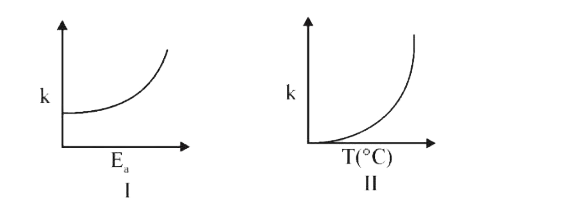
Consider the given plots for a reaction ...

Consider the given plots for a reaction obeying Arrhenius equation (k and `E_a` are rate constant and activation energy, respectively)

Choose the correct option:

A

Both I and II are correct

B

I is wrong but II is right

C

I is right but II is wrong

D

Both I and II are wrong

Text Solution

Verified by Experts

The correct Answer is:

D

`k = Ae^(- (Ea)/(RT) )`
With increase of Ea, k decreases
With increase of temperature, k increases exponentially but the graph must have y – intercept
` therefore` Both I and II are wrong
Promotional Banner

Topper's Solved these Questions

  • JEE MAIN REVISION TEST - 18

    VMC MODULES ENGLISH|Exercise CHEMISTRY - SECTION 2|5 Videos
  • JEE MAIN REVISION TEST - 22 JEE - 2020

    VMC MODULES ENGLISH|Exercise CHEMISTRY|25 Videos

Similar Questions

Explore conceptually related problems

Consider the given plots for a reaction obeying Arrhenius equation (0^(@)CltTlt300^(@)C) : (k and E_(a) are rate constant and activation energy, respectively)

Consider the given plots for a reaction obeying Arrhenius equation (0^(@)C lt T lt 300^(@)C) : (k and E_(a) are rate constant and activation energy, respectively) Choose the correct option :

What is the relation between rate constant and activation energy of a reaction?

In the Arrhenius equation: k = A exp(-E_(a)//RT) , the rate constant

The correct expression for Arrhenius equation is (where K is rate constant)

In Arrhenius equation , k=Ae^(E_a/(RT)) , A may be termed as rate constant .

State and explain Arrhenius equation. How can we determine the activation energy of a reaction using this equation?

Consider the diagram given below and choose the correct option.

How is the activation energy of a reaction related to its rate constant ?

The Arrhenius equation expressing the effect of temperature on the rate constant of a reaction is given as

VMC MODULES ENGLISH-JEE MAIN REVISION TEST - 19-CHEMISTRY
  1. The major product 'x' formed in the following reaction is:

    Text Solution

    |

  2. A mixture of 200 mmol of Ca(OH)2 and 3g of sodium sulphate was diss...

    Text Solution

    |

  3. Consider the given plots for a reaction obeying Arrhenius equation (k ...

    Text Solution

    |

  4. Give reasons for the following: Aluminium is used in flash bulbs.

    Text Solution

    |

  5. The decreasing order of the pKa values of the following compounds is:

    Text Solution

    |

  6. Which dicarboxylic acid in presence of a dehydrating agent is least re...

    Text Solution

    |

  7. The total number of isotopes of hydrogen and number of radioactive iso...

    Text Solution

    |

  8. Which of the graphs shown below does not represent the relationship be...

    Text Solution

    |

  9. K(1) and K(2) are equilibrium constants for reaction (i) and (ii) N(...

    Text Solution

    |

  10. Ziegler-Natta catalyst is

    Text Solution

    |

  11. Two pi and half sigma bonds are present in :

    Text Solution

    |

  12. The decreasing order of ease of alkaline hydrolysis for the following ...

    Text Solution

    |

  13. The effect of lanthanoid contraction in the lanthanoid series of eleme...

    Text Solution

    |

  14. Which of the following is an example of homogeneous catalytic reaction...

    Text Solution

    |

  15. The major product of the following reaction is :

    Text Solution

    |

  16. The type of hybridisation and number of lone pair(s) of electrons of X...

    Text Solution

    |

  17. Castner kellner process is given by:

    Text Solution

    |

  18. The major product formed in the reaction given below will be:

    Text Solution

    |

  19. Consider the following reduction processes : Zn^(2+)+2e^(-)toZn(s), ...

    Text Solution

    |

  20. The reducing power of the metal decreases in the order:

    Text Solution

    |
