Home
Class 12
PHYSICS
A motor cyclist moving with a velosity o...

A motor cyclist moving with a velosity of `72 km h^(-1)` on a flat road takes a turn on the road at a point where the radius of curvature of the road is 20km. The acceleration due to gravity is `10 ms^(-2)`. IN order to avoid skidding , he must not bend with respesct to the vertical plane by an angle greater then

A

`theta=tan^(-1) 6`

B

`theta=tan^(-1)2`

C

`theta=tan^(-1)(25.92)`

D

`theta=tan^(-1)4`

Text Solution

Verified by Experts

The correct Answer is:
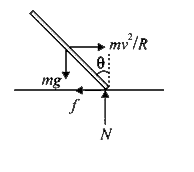
B

`mg L/2 "sin" theta = (mv^2)/R L/2 "cos" theta`
`tan theta=v^2/(gR)`
Promotional Banner

Topper's Solved these Questions

  • JEE MAIN REVISION TEST- 24

    VMC MODULES ENGLISH|Exercise PHYSICS ( SECTION - 2)|5 Videos
  • JEE MAIN REVISION TEST-3

    VMC MODULES ENGLISH|Exercise PHYSICS (SECTION 1)|3 Videos

Similar Questions

Explore conceptually related problems

A motor cyclist moving with a velocity of 72 km/hour on a flat road takes a turn on the road at a point where the radius of curvature of the road is 20 meters . The acceleration due to gravity is 10m//sec^(2) . In order to avoid skidding, he must not bend with respect to the vertical plane by an angle greater than

A body is project at t= 0 with a velocity 10 ms^-1 at an angle of 60 ^(@) with the horizontal .The radius of curvature of its trajectory at t=1s is R. Neglecting air resitance and taking acceleration due to gravity g= 10 ms^-2 , the value of R is :

A cyclist is riding with a speed of 27 km h^(-1) . As he approaches a circular turn on the road of radius 80 m, he applies brakes and reduces his speed at the constant rate 0.5 ms^(-2) . What is the magnitude and direction of the net acceleration of the cyclist on the circular turn ?

A cyclist is riding with a speed of 27 km h^(-1) . As he approaches a circular turn on the road of radius 80 m, he applies brakes and reduces his speed at the constant rate 0.5 ms^(-1) . What is the magnitude and direction of the net acceleration of the cyclist on the circular turn ?

Check by dimensions whether the equation tan theta=(rg)/(v^(2)) is correct. Here, r = radius of curvature of path, g = acceleration due to gravity v = velocity of body moving on the curved path, theta = angle of banking of the road

A cylclist is riding with a speed of 27 km h^-1 . As he approaches a circular turn on the road of radius 80 m , he applies brakes and reduces his speed at the constant rate of 0.5 ms^-2 . What is the magnitude and direction of the net acceleration of the cyclist on the circular turn ?

A car is moving on a circular level road of curvature 300m . If the coefficient of friction is 0.3 and acceleration due to gravity is 10m//s^(2) , the maximum speed of the car be a) 90 km/h b) 81 km/h c) 108 km/h d) 162 km/h

If the banking angle of curved road is given by tan^(-1)((3)/(5)) and the radius of curvature of the road is 6 m, then the safe driving speed should not exceed (take, g=10ms^(-2) )

A cyclist is riding with a speed of 18kmk^(-1) . As he approaches a circular turn on the road of radius 25sqrt2m , he applies brakes and reduces his speed at the constant rate of 0.5ms^(-1) every second. Determine the magnitude and direction of the net acceleration of the cyclist on the circular turn.

A cyclist speeding at 18 km// h on a level road takes a sharp circular turn of radius 3 m without reducing the speed . The coefficient of static friction between the tyres and the road is 0.1 Will the cyclist slip while taking the turn ?

VMC MODULES ENGLISH-JEE Main Revision Test-20 | JEE-2020 -PHYSICS
  1. The de Broglie wavelength of an electron in the nth Bohr orbit is rela...

    Text Solution

    |

  2. A motor cyclist moving with a velosity of 72 km h^(-1) on a flat road ...

    Text Solution

    |

  3. A carrier frequency of 1 MHz and peak value of 10 V is amplitude modul...

    Text Solution

    |

  4. A ball is dropped from a bridge at a height of 176.4 m over a river. A...

    Text Solution

    |

  5. Coefficient of thermal conductivity has the dimensions:

    Text Solution

    |

  6. A charges Q is placed at each of the two opposite corners of a square....

    Text Solution

    |

  7. A positively charged particle of charge 'q' enters in a uniform magne...

    Text Solution

    |

  8. A block of mass 2kg is free to move along the x-axis. It is at rest an...

    Text Solution

    |

  9. Five moles of hydrogen (gamma = 7//5), initially at STP, is compressed...

    Text Solution

    |

  10. A kettle with 2 litre water at 27^@C is heated by operating coil heate...

    Text Solution

    |

  11. Four small objects each of mass m are fixed at the corners of a rectan...

    Text Solution

    |

  12. A satellite is revolving round the earth with orbital speed v(o). If i...

    Text Solution

    |

  13. A very long conductor and an isosceles triangular conductor lie in a p...

    Text Solution

    |

  14. In a plane electromagnetic wave, the electric field oscillates sinusoi...

    Text Solution

    |

  15. 200W and 100W bulbs, both meant for operation at 220V are connec...

    Text Solution

    |

  16. In the circuit shown, the key is inserted at t=0. Charge which passes...

    Text Solution

    |

  17. In first figure a meter stick, half of which is wood and the other hal...

    Text Solution

    |

  18. A ray of light is incident on one face of a transparent glass slab of ...

    Text Solution

    |

  19. A body executes SHM under the influence of one force and has a period ...

    Text Solution

    |

  20. A convex lens of focal length f is placed some, where in between an ob...

    Text Solution

    |

