Home
Class 12
CHEMISTRY
Consider the following reactions : ...

Consider the following reactions :
(a) ` ( CH _ 3) _ 3 CCH ( OH ) CH_ 3 overset ( conc. H_ 2 SO _ 4) to `
(b) ` ( CH _ 3) _ 2CHCH (Br) CH _ 3 ( alc. KOH) to `
(c ) ` ( CH _ 3 ) _ 2 CH CH ( Br ) CH _ 3 ( (CH _ 3) _ 3 ) O^(Theta) K (o+)) to `
(d) `(CH _ 3) _ 2 underset(OH) underset(|) C - CH _ 2 - CHO overset ( Delta ) to `
Which of these reaction (s) will not produce Saytzeff product ?

A

1,3 and 4

B

4 only

C

2 and 4

D

3 only

Text Solution

Verified by Experts

The correct Answer is:
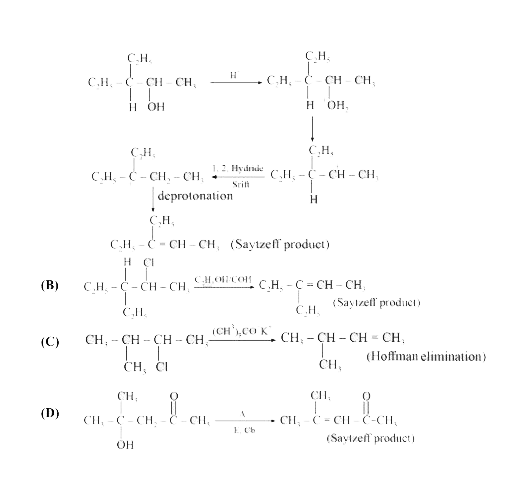
D

Promotional Banner

Topper's Solved these Questions

  • JEE Main Revision Test-9 | JEE-2020

    VMC MODULES ENGLISH|Exercise CHEMISTRY SECTION 2|5 Videos
  • LIQUID SOLUTION

    VMC MODULES ENGLISH|Exercise IMPECCABLE|100 Videos

Similar Questions

Explore conceptually related problems

Consider the following reactions (1) (CH_3)_3"CC"H(OH)CH_3overset("conc".H_2SO_4)rarr (2) (CH_3)_2"CHCH(Br)CH_(3)overset(conc.KOH)rarr (3) (CH_3)_2"CHCH(Br)CH_(3)overset((CH_3)_3CO^(-) Koplus)rarr (4) (CH_3)_2underset( "OH ")underset(" | ")(C-CH_2)-CHOoverset(Delta)rarr Which of these reaction(s) will produce Saytzeff product?

The product of the reaction of (CH_3)_3 "CCH"(OH)CH_3 with conc. H_2SO_4 is

The main product of the following reaction is C_(6)H_(5)CH_(2)(OH)CH(CH_(3))_(2)overset(Conc.H_(2)SO_(4))rarr ?

Product formed in the following reaction is CH_3CH_2CH(OH)CH_3overset(H_2SO_4)rarr

Consider the following reaction CH_3-CH=CH_2overset(Br_2//NaCl)rarr Product of the reaction will be

In this reaction , (CH_(3))_(3) C - CH_(2)OH overset("Conc." H_(2)SO_(4))underset(170^(@)C)(to) X X is

The major product formed in the following reaction is : CH_3CH = CHCH(CH_3)_2 overset(HBr)(to)

Write the mechanism of the following reaction : 2CH_(3) CH_(2) OH underset("413K")overset("Conc. "H_(2)So_(4))rarr CH_(3) CH_(2) - O - CH_(2) - CH_(3)

Consider the following reactions I. II. (CH_(3))_(2) underset(OH)underset(|)(C ) - CH_(2) - CHO overset(Delta)(to) III. (CH_(3))_(2) CHCH_(2) - underset(F)underset(|)(C )H - CH_(3) underset(Delta)overset(CH_(3)O^(-)Na^(+))(to) IV. (CH_(3))_(2) CH - underset(Br)underset(|)(C )H - CH_(3) overset((CH_(3))_(3) CO^(-) k^(+))(to) Which of these reaction will not produce Hoffmann product?

VMC MODULES ENGLISH-JEE MAIN REVISON TEST-23-CHEMISTRY (SECTION 1)
  1. Text Solution

    |

  2. A solution of Benzyl chloride, Benzoic acid and Aniline was extracted ...

    Text Solution

    |

  3. The number of orbitals associated with quantum numbers n =4 and m (8) ...

    Text Solution

    |

  4. Oxidation number of manganese in KMnO(4). MnO (2), K(2) MnO (4). respe...

    Text Solution

    |

  5. Consider the following reactions : (a) ( CH 3) 3 CCH ( O...

    Text Solution

    |

  6. Atomic radius of Ag is similar to

    Text Solution

    |

  7. In zeolites & synthetic resin method which will be more efficient...

    Text Solution

    |

  8. The impurest form of iron is:

    Text Solution

    |

  9. The dipole moments of CH(3)Cl , CH(2)Cl(2), CHCl(3) are in the order

    Text Solution

    |

  10. The electron gain enthalpy ( in kJ//mol ) of fluorine, chlorine,...

    Text Solution

    |

  11. What is the product of the following reactions? Me - overset(Me) ov...

    Text Solution

    |

  12. The relative strength of interionic / intermolecular forces in d...

    Text Solution

    |

  13. In the reaction : the product E is

    Text Solution

    |

  14. The increasing order of K (b) for the following compounds will be: H...

    Text Solution

    |

  15. Ligands are broadly classified into two classes classical and non-clas...

    Text Solution

    |

  16. The number of chiral carbons in Ibuprofen "."

    Text Solution

    |

  17. 1 mL of 0.1 N HCl is added to 999 mL solution of NaCl. The pH of the r...

    Text Solution

    |

  18. Strontium 90 is one of the harmful nuclides resulting from nuclear fis...

    Text Solution

    |

  19. For the reaction, 2A (s) + 2B (g)to C (g) + D(s) at 298K Delta U ^(@...

    Text Solution

    |

  20. Chlorine reacts with hot and conc. Ba (OH)(2) and produces compound X,...

    Text Solution

    |

