Home
Class 12
CHEMISTRY
1-methyl-1-phenyl ethylene oxide when tr...

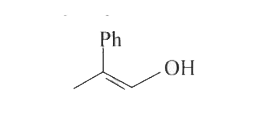
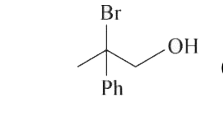
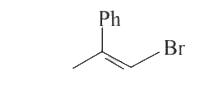
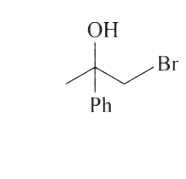
1-methyl-1-phenyl ethylene oxide when treated with HBr produce

A

B

C

D

Text Solution

AI Generated Solution

The correct Answer is:

To solve the problem of what 1-methyl-1-phenyl ethylene oxide produces when treated with HBr, we can follow these steps: ### Step 1: Identify the Structure 1. **Draw the structure of 1-methyl-1-phenyl ethylene oxide.** - Ethylene oxide is a cyclic ether (an epoxide) with the formula C2H4O. - The compound has a methyl (–CH3) and a phenyl (–C6H5) group attached to the first carbon of the ethylene oxide. - The structure can be represented as follows: ``` O / \ CH3 C6H5 ``` ### Step 2: Reaction with HBr 2. **Understand the reaction mechanism with HBr.** - When 1-methyl-1-phenyl ethylene oxide reacts with HBr, the oxygen atom in the epoxide ring has a lone pair that can attack the hydrogen (H+) from HBr. - This leads to the formation of a protonated epoxide, where the oxygen becomes positively charged (O+). ### Step 3: Formation of Carbocations 3. **Determine the possible carbocations formed.** - The protonation of the oxygen leads to a transition state where the epoxide ring can open. - There are two possible sites for the ring to open: - If the bond between the oxygen and the carbon attached to the phenyl group breaks, it leads to a tertiary carbocation. - If the bond between the oxygen and the carbon attached to the methyl group breaks, it leads to a primary carbocation. - The tertiary carbocation is more stable due to hyperconjugation and resonance stabilization from the phenyl group. ### Step 4: Nucleophilic Attack 4. **Nucleophilic attack by bromide (Br-).** - The bromide ion (Br-) present in the solution will attack the more stable carbocation (the one formed from the phenyl group). - This results in the formation of the final product. ### Step 5: Final Product Structure 5. **Draw the final product.** - The final product will have a bromine atom (Br) attached to the carbon that was part of the carbocation, and the hydroxyl group (OH) will be on the other carbon. - The structure of the final product can be represented as: ``` OH / \ CH3 C6H5 \ Br ``` ### Conclusion The major product formed when 1-methyl-1-phenyl ethylene oxide is treated with HBr is a compound containing a bromine atom, a hydroxyl group, a methyl group, and a phenyl group.

To solve the problem of what 1-methyl-1-phenyl ethylene oxide produces when treated with HBr, we can follow these steps: ### Step 1: Identify the Structure 1. **Draw the structure of 1-methyl-1-phenyl ethylene oxide.** - Ethylene oxide is a cyclic ether (an epoxide) with the formula C2H4O. - The compound has a methyl (–CH3) and a phenyl (–C6H5) group attached to the first carbon of the ethylene oxide. - The structure can be represented as follows: ``` ...
Promotional Banner

Topper's Solved these Questions

  • JEE MAIN REVISION TEST- 24

    VMC MODULES ENGLISH|Exercise CHEMISTRY (SECTION - 2)|5 Videos
  • JEE MAIN REVISION TEST- 16

    VMC MODULES ENGLISH|Exercise CHEMISTRY (SECTION 2)|5 Videos
  • JEE Main Revision Test-20 | JEE-2020

    VMC MODULES ENGLISH|Exercise CHEMISTRY|25 Videos

Similar Questions

Explore conceptually related problems

Styrene when treated with HBr produces :

The ether when treated with HI produces

The ether when treated with HI produces:

1, 1-dimethyl ethylene oxide when treated with water in presence of acid catalyst produces –

Ethylene oxide when treated with Grignard reagent yields

Ethylene oxide when treated with Grignard reagent yields

Ethylene oxide when treated with Grignard reagent yields

1-Ethyl-2-methyl oxirane when treated with C_2 H_5 MgBr , followed by hydrolysis gives :

Ethylene oxide when treated with phenyl magnesium bromide followed by hydrolysis ylelds

The heating of phenyl-methyl ethers with HI produces
