Home
Class 12
CHEMISTRY
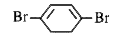
What is the final product of the followi...

What is the final product of the following reaction sequence?
cyclohexanol ` overset((i) conc. H_2 SO_4//Delta ) overset((ii) NB S//C Cl_4 //hv)underset((iv) Br_2//40^@ C) underset((iii) Alc KOH//Delta ) to `

A

B

C

D

Text Solution

AI Generated Solution

The correct Answer is:

To determine the final product of the reaction sequence involving cyclohexanol, we will break down each step of the reaction. ### Step 1: Dehydration of Cyclohexanol - **Reaction**: Cyclohexanol reacts with concentrated H₂SO₄ and heat (Δ). - **Mechanism**: 1. The hydroxyl group (-OH) of cyclohexanol is protonated by H₂SO₄, forming a better leaving group (water). 2. Water leaves, forming a carbocation. 3. A double bond forms as a hydrogen atom from an adjacent carbon atom is eliminated, resulting in the formation of cyclohexene. **Product after Step 1**: Cyclohexene ### Step 2: Bromination using NBS - **Reaction**: Cyclohexene reacts with NBS (N-Bromosuccinimide) in the presence of CCl₄ and light (hv). - **Mechanism**: 1. NBS generates a bromine radical. 2. The bromine radical abstracts a hydrogen from the cyclohexene, forming a cyclohexyl radical. 3. The cyclohexyl radical then reacts with another bromine radical, resulting in the formation of bromocyclohexane. **Product after Step 2**: Bromocyclohexane ### Step 3: Elimination using Alcoholic KOH - **Reaction**: Bromocyclohexane reacts with alcoholic KOH and heat (Δ). - **Mechanism**: 1. The alcoholic KOH acts as a base, abstracting a hydrogen atom from the carbon adjacent to the bromine. 2. This leads to the elimination of bromine and the formation of a double bond, resulting in the formation of a conjugated diene. **Product after Step 3**: 1,3-Cyclohexadiene ### Step 4: Bromination of the Diene - **Reaction**: 1,3-Cyclohexadiene reacts with Br₂ at 40°C. - **Mechanism**: 1. The diene acts as a nucleophile and attacks the bromine molecule, forming a cyclic bromonium ion. 2. The bromide ion then attacks the more substituted carbon, leading to the formation of a dibrominated product. **Final Product**: 1,4-Dibromocyclohexane ### Summary of the Reaction Sequence: 1. Cyclohexanol → Cyclohexene (dehydration) 2. Cyclohexene → Bromocyclohexane (bromination) 3. Bromocyclohexane → 1,3-Cyclohexadiene (elimination) 4. 1,3-Cyclohexadiene → 1,4-Dibromocyclohexane (bromination) ### Final Answer: The final product of the reaction sequence is **1,4-Dibromocyclohexane**. ---

To determine the final product of the reaction sequence involving cyclohexanol, we will break down each step of the reaction. ### Step 1: Dehydration of Cyclohexanol - **Reaction**: Cyclohexanol reacts with concentrated H₂SO₄ and heat (Δ). - **Mechanism**: 1. The hydroxyl group (-OH) of cyclohexanol is protonated by H₂SO₄, forming a better leaving group (water). 2. Water leaves, forming a carbocation. 3. A double bond forms as a hydrogen atom from an adjacent carbon atom is eliminated, resulting in the formation of cyclohexene. ...
Promotional Banner

Topper's Solved these Questions

  • JEE MAIN PAPER CHEMISTRY

    VMC MODULES ENGLISH|Exercise MULTIPLE CHOICE QUESTIONS |26 Videos
  • JEE MAIN REVISION TEST - 1 (2020)

    VMC MODULES ENGLISH|Exercise CHEMISTRY - SECTION 2|5 Videos

Similar Questions

Explore conceptually related problems

What will be the final product in the following reaction sequence? CH_3CH_2CN overset(H^(+)//H_2O)to A underset(Delta)overset(NH_3)to B overset(NaOBr)to C

A,B and C , in the following reaction sequence C_6 H_6 underset( " conc" H_2 SO_4) overset( 60 ^@ C,"conc " HNO_3 )to

Identify final product In the following reaction CH_(3)-underset(OH)underset(|)(C)H-COOH overset(Delta)to product

Complete the following reactions : C_2H_5Br + KOH(alc) overset(Delta) rarr

The major product (Y)in the following reaction sequency is : CH_(3) - overset( CH_(3))overset(|)(C)H - CH= CH_(2) overset( Br_(2) //H_(2)O)(rarr) X overset("conc."H_(2)SO_(4)//Delta)(rarr)Y

The final product (X) in the following reaction is overset((i)conc.H_2SO_4)rarroverset(conc.HNO_3)rarroverset(Delta)rarroverset(H_2"O"//"OH"^(-))rarr(X)

What is the product of the following reactions? Me - overset(Me) overset(|)underset(Me ) underset(|) C-C=CHoverset({:((i)H_(2)SO_(4//HgSO_(4))), ((ii) NaBH_(4)):})underset({:((iii) Conc. H _(2) SO_(4)), ((iv) O _(3) ZnH_(2) O ):})to

The major product [R] in the following sequence of reactions is : overset((i)HgSO_(4)//H_(2)SO_(4))underset((ii)NaBH_(4))rarr [Q]overset("Conc. "H_(2)SO_(4))underset(Delta)rarr[R]

In the reaction sequence Cyclohexane overset(hv//Cl_2)(rarr)(A)overset(alk.KOH//Delta)(rarr)(B)underset((ii)Zn//H_2O)overset((i)O_3)(rarr) . 'C' will be

VMC MODULES ENGLISH-JEE MAIN REVISION TEST - 30 | JEE -2020-CHEMISTRY
  1. 1, 1-dimethyl ethylene oxide when treated with water in presence of ac...

    Text Solution

    |

  2. Among the following the one that gives positive iodoform test upon rea...

    Text Solution

    |

  3. The shortest wavelength spectral line in the brackett series of the sp...

    Text Solution

    |

  4. Oxidation number of Cr in K 2 Cr 2 O 7, CrO 5 and Cr 2 (SO 4 ...

    Text Solution

    |

  5. When 1-butyne undergoes oxymercuraction with the help of HgSO(4)+H(2)S...

    Text Solution

    |

  6. Atomic radius of Fe is closest to

    Text Solution

    |

  7. Ti and Zr are purified by

    Text Solution

    |

  8. Zeolite or permutit has the formula

    Text Solution

    |

  9. The dipolemoment of are in order

    Text Solution

    |

  10. The correct order of electron gain enthalpy (in kJ/mole) is

    Text Solution

    |

  11. What is the final product of the following reaction sequence? cyclo...

    Text Solution

    |

  12. The relative strength of intermolecular forces in bond decreasing orde...

    Text Solution

    |

  13. What is Hinsberg reagent?

    Text Solution

    |

  14. The decreasing order of Acidity for the following compound will be

    Text Solution

    |

  15. Which of the following does not have a metal-carbon bond?

    Text Solution

    |

  16. The number of chiral carbon in testosterone hormone?

    Text Solution

    |

  17. 100 mL of 0.1 M Na2 CO 3 solution is titrated with 0.1 M ...

    Text Solution

    |

  18. A first order reaction takes 69.3 minutes for 50% completion. How much...

    Text Solution

    |

  19. Work done during isothermal expansion of one mole of an ideal gas form...

    Text Solution

    |

  20. Write chemical equation for thermal decomposition of ammonium dichroma...

    Text Solution

    |
