Home
Class 12
CHEMISTRY
Among the following, the compound that u...

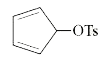
Among the following, the compound that undergoes the fastest `S_N1` reaction is:

A

B

C

D

`CH_(3)CH_(2)-OTs`

Text Solution

AI Generated Solution

The correct Answer is:

To determine which compound undergoes the fastest \( S_N1 \) reaction, we need to analyze the stability of the carbocations formed from the given compounds. The \( S_N1 \) reaction mechanism involves the formation of a carbocation intermediate, and the rate of the reaction is influenced by the stability of this carbocation. Here's a step-by-step solution: ### Step 1: Identify the Compounds We have four compounds with different structures. Each compound has a leaving group (OTs) that will depart to form a carbocation. ### Step 2: Determine the Carbocation Formed For each compound, we need to draw the carbocation that will be formed after the leaving group departs. 1. **Compound A**: When the OTs group leaves, it forms a primary carbocation. 2. **Compound B**: The leaving of the OTs group results in a secondary carbocation. 3. **Compound C**: The OTs group leaves, forming a tertiary carbocation. 4. **Compound D**: The leaving of the OTs group leads to a resonance-stabilized carbocation. ### Step 3: Analyze Carbocation Stability The stability of carbocations can be ranked as follows: - Tertiary (3°) > Secondary (2°) > Primary (1°) > Methyl (0°) Additionally, resonance stabilization can significantly enhance carbocation stability. - **Compound A**: Primary carbocation (least stable). - **Compound B**: Secondary carbocation (more stable than primary). - **Compound C**: Tertiary carbocation (most stable). - **Compound D**: Resonance-stabilized carbocation (can be very stable depending on the structure). ### Step 4: Compare the Stability From the analysis: - Compound C has the most stable carbocation (tertiary). - Compound D may also be stable due to resonance, but the stability of a tertiary carbocation generally surpasses that of a resonance-stabilized carbocation unless the resonance is exceptionally strong. ### Conclusion Based on the stability of the carbocations formed, **Compound C** undergoes the fastest \( S_N1 \) reaction because it forms the most stable tertiary carbocation. ### Final Answer The compound that undergoes the fastest \( S_N1 \) reaction is **Compound C**. ---

To determine which compound undergoes the fastest \( S_N1 \) reaction, we need to analyze the stability of the carbocations formed from the given compounds. The \( S_N1 \) reaction mechanism involves the formation of a carbocation intermediate, and the rate of the reaction is influenced by the stability of this carbocation. Here's a step-by-step solution: ### Step 1: Identify the Compounds We have four compounds with different structures. Each compound has a leaving group (OTs) that will depart to form a carbocation. ### Step 2: Determine the Carbocation Formed ...
Promotional Banner

Topper's Solved these Questions

  • JEE MAIN REVISION TEST - 18

    VMC MODULES ENGLISH|Exercise CHEMISTRY - SECTION 2|5 Videos
  • JEE MAIN REVISION TEST - 13

    VMC MODULES ENGLISH|Exercise CHEMISTRY (SECTION 2)|5 Videos
  • JEE MAIN REVISION TEST - 19

    VMC MODULES ENGLISH|Exercise CHEMISTRY|26 Videos

Similar Questions

Explore conceptually related problems

Which of the following alkyl halides undergoes the fastest S_(N^(1)) reaction ?

Which one of the following compounds undergoes predominantly S_N^2 reaction with aqueous NaOH in a polar aprotic solvent ?

The compound which undergoes fastest reaction with aq. NaOH solution is :

Which among the following compounds wil be most reactive for S_(N^(1)) reaction ?

Which compound in the following pair undergoes faster S_N1 reaction?

In the following pairs of halogen compounds, which compound undergoes faster S_(N)1 reaction?

Arrange the following compounds in order of: Decreasing S_(N)1 reaction rate:

In the following pairs of halogen compounds, which compounds undergoes faster S_(N^1) reaction?
