Home
Class 12
CHEMISTRY
Consider the Bohr's model of a one-elect...

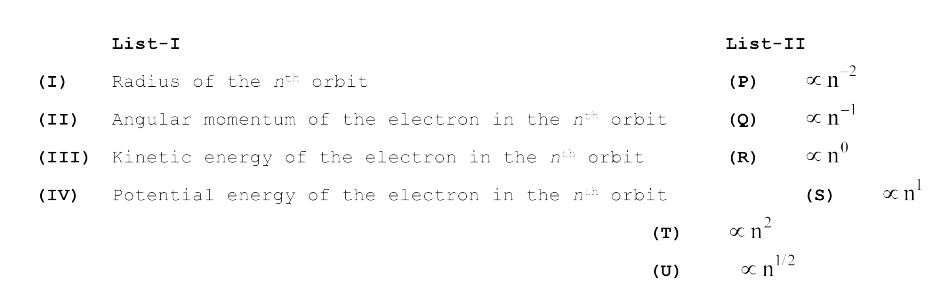
Consider the Bohr's model of a one-electron atom where the electron moves around the nucleus. In the following, List-I contains some quantities for the `n^("th")` orbit of the atom and List-II contains options showing how they depend on n.

Which of the following options has the correct combination considering List-I and List-II?

A

(IV), (U)

B

(IV), (Q)

C

(III), (P)

D

(III), (S)

Text Solution

Verified by Experts

The correct Answer is:

B
Promotional Banner

Topper's Solved these Questions

  • ATOMIC STRUCTURE

    VMC MODULES ENGLISH|Exercise JEE Main (Archive)|39 Videos
  • AMINES

    VMC MODULES ENGLISH|Exercise IN CHAPTER EXERCISE H|10 Videos
  • CHEMICAL BONDING & CHEMICAL STRUCTURE

    VMC MODULES ENGLISH|Exercise IMPECCABLE|50 Videos

Similar Questions

Explore conceptually related problems

The quadratic equation ax^(2) + bx + c = 0 has two roots then match the following lists. Find the correct match from List-I to List-II.

E_(n)=-(2,18times10^(-18))(Z^(2))/(n^(2)) Electrons follow paths, called orbits around the nucleus of an atom. According to the Bohr model, the energy in joules of an atom's nth orbit containing a single electron is given by the formula shown above, where Z is the atomic number of the atom and n is the orbit number. Which of the following equations gives the atomic number of an atom given the energy of its nth orbit (assuming there is a single electron is that orbit)?

In Bohr model of the hydrogen atom, let R,v and E represent the radius of the orbit, speed of the electron and the total energy respectively. Which of the following quantities are directly proportional to the quantum number n?

In Bohr model of the hydrogen atom, let R,v and E represent the radius of the orbit, speed of the electron and the total energy respectively. Which of the following quantities are directly proportional to the quantum number n?

Suppose an electron is attracted toward the origin by a force (k)/(r ) where k is a constant and r is the distance of the electron from the origin .By applying Bohr model to this system the radius of the n^(th) orbital of the electron is found to be r_(n) and the kinetic energy of the electron to be T_(n) , Then which of the following is true ?

Suppose an electron is attracted toward the origin by a force (k)/(r ) where k is a constant and r is the distance of the electron from the origin .By applying Bohr model to this system the radius of the n^(th) orbital of the electron is found to be r_(n) and the kinetic energy of the electron to be T_(n) , Then which of the following is true ?

A person in a lift is holding a water jar, which has a small hole at the lower end its side. When the lift is at rest, the water jet coming out of the hole hits the floor of the lift at a distance d of 1.2 m from the person. In the following, state of the lift’s motion is given in Column I and the distance where the water jet hits the floor of the lift is given in Column II. Match the statements from list I with those in list II and select the correct answer using the code given below the lists.

The energy required to pull the most loosely bound electron form an atom is known as ionizatino potential it is expressed in electron volts. The value of ionization potntial depends on three factors: (i) the charge on the nucleus (ii) the atomic radius and (iii) the screening effect of inner electron shells. Q. Which of the following elements has the least ionization potential?

The energy required to pull the most loosely bound electron form an atom is known as ionizatino potential it is expressed in electron volts. The value of ionization potntial depends on three factors: (i) the charge on the nucleus (ii) the atomic radius and (iii) the screening effect of inner electron shells. Q. Which of the following elements has the least ionization potential?

Match List I of the nuclear processes with List II containing parent nucleus and one of the end produces of each process and then select the correct answer using the codes gives below the list:

VMC MODULES ENGLISH-ATOMIC STRUCTURE-JEE Advanced (Archive )
  1. The number of nodal planes in a p(x) orbital is :

    Text Solution

    |

  2. The electronic configuration of an element is 1s^2 2s^2 2p^6 3s^2 3p^6...

    Text Solution

    |

  3. The wavelength associated with a golf ball weighing 200 g and moving a...

    Text Solution

    |

  4. The quantum number + 1//2 and -1//2 for the electron spin represent

    Text Solution

    |

  5. Rutherfords experiments , which established the nuclear model of atom ...

    Text Solution

    |

  6. If the nitrogen atom has electronic configuration 1s^(7), it would hav...

    Text Solution

    |

  7. The radius of which of the following orbit is the same as that of the ...

    Text Solution

    |

  8. The numbers of radial nodes of 3s and 2p orbitals are respectively:

    Text Solution

    |

  9. According to Bohr’s theory E(n)= Total energy, K(n)= Kinetic energy...

    Text Solution

    |

  10. Match the entries in column I with the correctly related quantum numbe...

    Text Solution

    |

  11. The hydrogen -like species Li^(2+) is in a spherically symmetric stat...

    Text Solution

    |

  12. The hydrogen-like species Li^(2+) is in a spherically symmetric stat...

    Text Solution

    |

  13. The hydrogen-like species Li^(2+) is in a spherically symmetric stat...

    Text Solution

    |

  14. The kinetic energy of an electron in the second Bohr orbit of a hydrog...

    Text Solution

    |

  15. P is the probability of finding the 1s electron of hydrogen atom in a ...

    Text Solution

    |

  16. The wave function, Psi("n, l, m(l)) is a mathematical function whose...

    Text Solution

    |

  17. The wave function, Psi("n, l, m(l)) is a mathematical function whose...

    Text Solution

    |

  18. The wave function, Psi("n, l, m(l)) is a mathematical function whose...

    Text Solution

    |

  19. Consider the Bohr's model of a one-electron atom where the electron mo...

    Text Solution

    |

  20. The ground state energy of hydrogen atom is -13.6 eV. Consider an elec...

    Text Solution

    |
