Home
Class 12
PHYSICS
An insect craws up a hemispherical surfa...

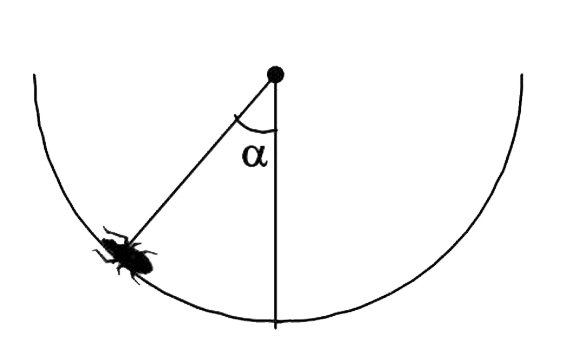
An insect craws up a hemispherical surface very slowly (see fig.). The coefficient of friction between the insect and the surface is `1//3`. If the line joining the center of the hemispherical surface to the insect makes an angle `alpha` with the vertical, the maximum possible value of `alpha` is given by

A

(a)`cot alpha =3`

B

`tan alpha =3`

C

`sec alpha =3`

D

`cosec alpha =3`

Text Solution

Verified by Experts

The correct Answer is:
a

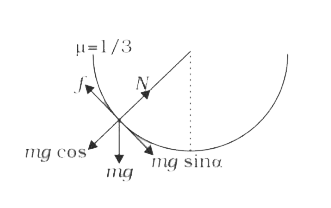
The three forces acting on the insect are mg, N and friction f. Let us resolve mg into two components: `m g cos alpha` balance N
`m g sin alpha` is balanced by the frictional force
`N=m g cos alpha f =m g sin alpha` but `f=muN =mu m g cos alpha`
`rarr cot alpha=1 / mu rarr cot alpha =3`
Promotional Banner

Topper's Solved these Questions

  • INTRODUCTION TO VECTORS & FORCES

    VMC MODULES ENGLISH|Exercise JEE Main ( ARCHIVE ) ( LEVEL-1)|12 Videos
  • GRAVITATION

    VMC MODULES ENGLISH|Exercise JEE Advance (Archive) TRUE/FALSE|1 Videos
  • JEE MAIN - 5

    VMC MODULES ENGLISH|Exercise PART I : PHYSICS (SECTION - 2)|5 Videos

Similar Questions

Explore conceptually related problems

An insect crawls up a hemispherical surface as shown (see the figure) the coefficient offriction between the insect and the surface is 1/3. If the line joining the centre of the hemisperical surface to the insect makes an angle theta with the vertical, the maximum possible value of theta is given by

An insect of mass m, starts moving on a rough inclined surface from point A. As the surface is vert sticky, the corfficient of fricion between the insect and the incline is mu=1 . Assume that it can move in any direction, up the incline or down the incline then

An insect of mass m, starts moving on a rough inclined surface from point A. As the surface is vert sticky, the corfficient of fricion between the insect and the incline is mu=1 . Assume that it can move in any direction, up the incline or down the incline then

A particle is placed at rest inside a hollow hemisphere of radius R . The coefficient of friction between the particle and the hemisphere is mu = (1)/sqrt(3) . The maximum height up to which the particle can remain stationary is

A ball of mass m is attached to a cord of length L , pivoted at point O , as shown in Fig. The ball is released from rest at point A, swings down and makes an inelastic collision with a block of mass 2m kept on a rough horizontal floor. The coefficient of restitution of collision is e = 2//3 and coefficient of friction between block and surface is After collision, the ball comes momentarily to rest at C when cord makes an angle of theta with the vertical and block moves a distance of 3L//2 on rough horizontal floor before stopping. The values of mu and theta are, respectively,

A body of mass m is moved up (slowly) the plane of verying slope by a tangential force upto height h . The coefficient of friction between the surface and the block is mu . Select correct option(s)

A body of mass m is moved up (slowly) the plane of verying slope by a tangential force upto height h . The coefficient of friction between the surface and the block is mu . Select correct option(s)

The block A in the given figure is of mass 10sqrt(3) kg The coefficient of friction between the block and the surface on which it rests is 0.5. Find maximum mass of block B possible such that the system will be in equilibrium is.

A rectangular box lies on a rough inclined surface . The coefficient of friction between the surface and the box is mu . Let the mass of the box be m . (a) At what angle of inclination theta of the plane to the horizontal will the box just start to slide down the plane ? (b) What is the force acting on the box down the plane , if the angle of inclination of the plane is increased to alpha gt theta ? (c) What is the force needed to be applied upwards along the plane to make the box either remain stationary or just move up with uniform speed ? (d) What is the force needed to be applied upwards along the plane to make the box move up the plane with acceleration a ?

An arrangement is shown in the figure . The mass of the wedge is 4 kg and that of the block is 1 kg . There is no friction between wedge and ground , but coefficient of friction between vertical surface of the wedge and to the block is mu= 0.1. . (Assume ideal pulley and string) (g = 10 m//s^(2)) and assuming the pulley to be massless and friction. calucalate the maximum possible values of force upto while bock remain stationary relative to wedge.

