Home
Class 12
PHYSICS
What is the maximum value of the force F...

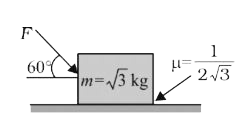
What is the maximum value of the force F such that the block shown in the figure does not move?

A

(a)20 N

B

(b)10 N

C

(c)12 N along OE

D

(d)15 N

Text Solution

Verified by Experts

The correct Answer is:
a

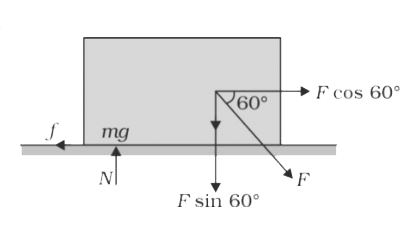
The forces acting on the block are shown. Since the block is not moving forward for the maximum force F applied
`f cos 60^(@)=f=muN`
and `F sin 60^(f@) + mg =N`
form (i) and (ii) `f cos 60^(@)=mu[F sin 60^(@)+mg]`
`rarr f=(mu mg)/(cos 60^(@)-mu sin 60^(@))=(1)/(2sqrt(3)xxsqrt(3)xx10)(1/2)-(1)/(2sqrt(3))xx(sqrt(3)/(2))=5/1/4=20 N`
Promotional Banner

Topper's Solved these Questions

  • INTRODUCTION TO VECTORS & FORCES

    VMC MODULES ENGLISH|Exercise JEE Main ( ARCHIVE ) ( LEVEL-1)|12 Videos
  • GRAVITATION

    VMC MODULES ENGLISH|Exercise JEE Advance (Archive) TRUE/FALSE|1 Videos
  • JEE MAIN - 5

    VMC MODULES ENGLISH|Exercise PART I : PHYSICS (SECTION - 2)|5 Videos

Similar Questions

Explore conceptually related problems

What is the maximum value of the force F such that the block shown in the arrangement, does not move?

What is the maximum value of the force F such that the block shown in the arrangement, does not move:

What is the maximum value of force, so that both the blocks will move together ?

A block of mass 10 kg is kept on a rough inclined plane as shown in the figure. A force of 3 N is applied on the block. The coefficient of static friction between the plane and the block is 0.6 What should be the minimum value of force P, such that the block doesnot move downward? (take g=10ms^(-2) )

A block of mass 10 kg is kept on a rough inclined plane as shown in the figure. A force of 3 N is applied on the block. The coefficient of static friction between the plane and the block is 0.6 What should be the minimum value of force P, such that the block doesnot move downward? (take g=10ms^(-2) )

Four block are arranged on a smooth horizontal surface as shown in figure .The masses of the blocks are given (see the fig ) The coefficient of static friction between the top and the bottom blocks is mu_(s) What is the maximum value of the horizontal force F applied to one of the bottom blocks as shown that makes all four block with the same acceleration ?

A block of mass m collides with another block of mass 3m completely inelastically as shown in figure. What is the maximum value of v ( in m//s) for which the block B does not move. Assume that initially spring is in natural length and blocks A and B are at rest. (K//m=100 S.I. unit )

Two block of same mass'm' are joined with an dideal spring of spring constant k and sept on a rough surface as shown in figure. The spring is initially unstretched and coefficient of friction between the blocks and horizontal surface is mu and 2 mu respectively. What should be the maximum speed of block 'A' such that the block 'B' does not move ?

In the sitution shown in figure there is no friction between 2 kg and ground. a. For what maximum value of force F can all three blocks move together? b. Find the value of force F at which sliding starts at other rough surfaces. c. Find acceleration of all blocks, nature and value of friction force for the following values of force F (i) 10N (ii) N and (iii) 25 N

Find the force of friction acting between both the blocks shown in the figure.

