Home
Class 12
PHYSICS
A mass of 2kg is suspended with thread A...

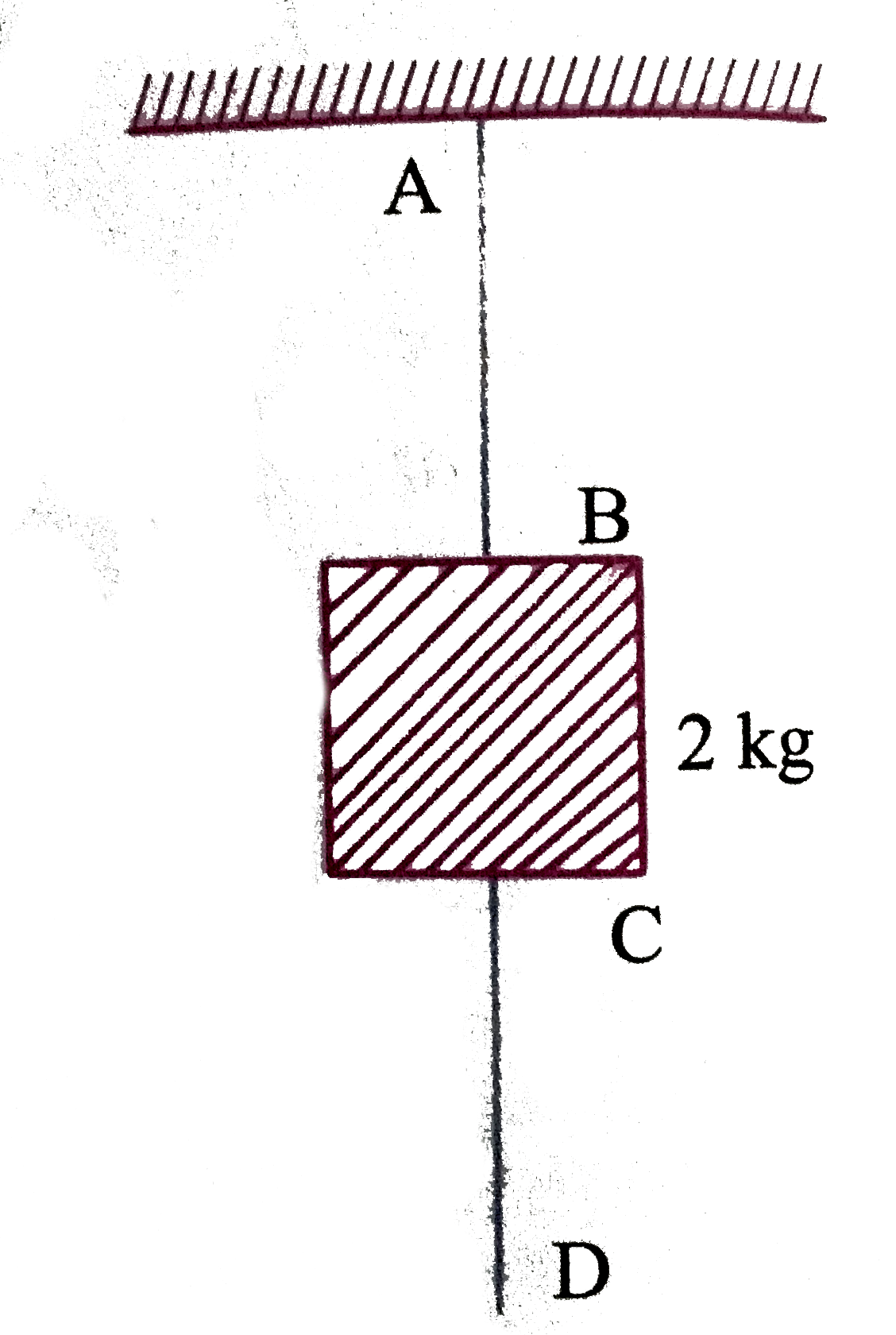
A mass of `2kg` is suspended with thread `AB` (figure) Thread `CD` of the same type is attached to the other end of `2kg` mass. Lower thread is pulled gradually, harder and harder in the downward direction so as to apply force on `AB`. which of the threads will break and why?

Text Solution

Verified by Experts

The thread AB will break earlier than the thread CD. This is because force acting on thread CD = applied force and force acting on thread AB = (applied force + weight of 2 kg mass). Hence, force acting on thread AB is larger than the force on thread CD.
Promotional Banner

Topper's Solved these Questions

  • DYNAMICS OF A PARTICLE

    VMC MODULES ENGLISH|Exercise LEVEL 0 (SHORT ANSWER TYPE - ii)|11 Videos
  • DYNAMICS OF A PARTICLE

    VMC MODULES ENGLISH|Exercise LEVEL 0 (LONG ANSWER TYPE)|4 Videos
  • DYNAMICS OF A PARTICLE

    VMC MODULES ENGLISH|Exercise JEE Advance (Archive) Level - II (SINGLE OPTION CORRECT TYPE )|31 Videos
  • DC CIRCUIT

    VMC MODULES ENGLISH|Exercise JEE ADVANCED ARCHIVE|68 Videos
  • ELECTROMAGNETIC INDUCTION & ALTERNATING CURRENT

    VMC MODULES ENGLISH|Exercise IN-CHAPTER EXERCISE-G|10 Videos

Similar Questions

Explore conceptually related problems

A mass of 2kg is suspended with thread AB (figure) Thread CD of the same type is attached to the other end of 2kg mass. Lower thread is pulled gradually, harder and harder in the downward gradually, harder and harder in the downward direction so as to apply force on AB . which of the threads will break and why?

A shell of mass 1kg is projected with velocity 20m//s at an angle 60^@ with horizontal. It collides inelastically with a ball of mass 1kg which is suspended through a thread of length 1m . The other end of the thread is attached to the ceiling of a trolley of mass 4/3kg as shown in figure. Initially the trolley is stationary and it is free to move along horizontal rails wihtout any friction. What is the maximum deflection of the thread with vertical? String does not slack. Take g=10m//s^2 .

In the figure at the free end a force F is applied to keep the suspended mass of 18 kg at rest. The value of F is :

Two masses of 10kg and 5kg are suspended from a rigid support as shown in figure. The system is pulled down with a force of 150N attached to the lower mass. The string attached to the support breaks and the system accelerates downwards In case the force continues to act. what will be the tension acting between the two masses ? .

Two masses of 10kg and 5kg are suspended from a rigid support as shown in figure. The system is pulled down with a force of 150N attached to the lower mass. The string attached to the support breaks and the system accelerates downwards In case the force continues to act. what will be the tension acting between the two masses ? .

A rope AB of length 5 m and mass 2kg is atteched to a 6kg block kept on a smooth surface ad is pulled by a force of 40N. Find the acceleration of block .

A pulley fixed to the ceiling carried a thread with bodies of masses m_(1) and m_(2) attached to its ends. The mases of the pulley and the thread are negligible and friction is absent. Find the acceleration of the centre of mass of this system.

A rope AB of length 5 m and mass 2kg is atteched to a 6kg block kept on a smooth surface ad is pulled by a force of 40N. Find the force applied by the rope on the block

A mass of 1 kg is suspended by means of a thread. The system is (i) lifted up with an acceleration of 4.9ms^(2) (ii) lowered with an acceleration of 4.9ms^(-2) . The ratio of tension in the first and second case is

Two masses of 5 kg and 10 kg are suspended from a fixed support as shown in the figure. The system is pulled downwards with a force of 150 N applied to the lower mass. The string attached to the support breaks and the system accelerates downwards. If the downward force continues to act, the acceleration of the center of mass of the system is :
