Home
Class 12
PHYSICS
Two adiabatic expansions of n mole of sa...

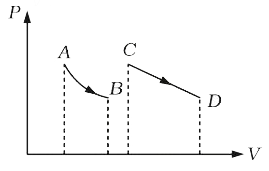
Two adiabatic expansions of n mole of same gas are shown. If `V_B/V_A = V_D / (V_C)xx1/2` then `T_C//T_D` is :

A

`2^(0.4) T_A/T_B`

B

`2^(1.4) T_A/T_B`

C

`T_A/T_B 1/(""_(2)(0.4))`

D

`T_A/T_B`

Text Solution

Verified by Experts

The correct Answer is:

A

`T_A V_A^(gamma -1) = T_B V_B^(gamma-1) rArr T_A //T_B = ((V_B)/(V_A))^(gamma-1)`
and `T_C V_C^(gamma - 1) = T_D V_D^(gamma -1) rArr T_C //T_D = ((V_D)/(V_C))^(gamma - 1)rArrT_C/T_D = ((2V_B)/V_A)^(gamma-1)= 2gamma-1(T_A)/(T_B) rArr Delta T = (16/5 -1)1/R K = 11/(5R)K``Delta Q = Delta U + W`, Here, Q : U and W all different forms of energy.For isothermal process, `pV` = constant `rArr` slope ` = (dp)/(dV) = (-P)/V`
& for adiabatic process, `P v^(gamma)` = constant `rArr (dp)/(dV) = (- gamma p)/(V) rArr x = gamma`
Promotional Banner

Topper's Solved these Questions

  • GASEOUS STATE & THERMODYNAMICS

    VMC MODULES ENGLISH|Exercise Level - 2|40 Videos
  • GASEOUS STATE & THERMODYNAMICS

    VMC MODULES ENGLISH|Exercise JEE MAIN (ARCHIVE )|81 Videos
  • GASEOUS STATE & THERMODYNAMICS

    VMC MODULES ENGLISH|Exercise level-0 Short Answer Type – II|24 Videos
  • ENERGY & MOMENTUM

    VMC MODULES ENGLISH|Exercise JEE ADVANCE (ARCHIVE) - TRUE/FALSE TYPE|1 Videos
  • GRAVITATION

    VMC MODULES ENGLISH|Exercise JEE Advance (Archive) TRUE/FALSE|1 Videos

Similar Questions

Explore conceptually related problems

One mole of a diatomic ideal gas (gamma=1.4) is taken through a cyclic process starting from point A. The process AtoB is an adiabatic compression, BtoC is isobaric expansion, CtoD is an adiabatic expansion, and DtoA is isochoric. The volume ratios are V_A//V_B=16 and V_C//V_B=2 and the temperature at A is T_A=300K . Calculate the temperature of the gas at the points B and D and find the efficiency of the cycle.

Draw the P-T and V-T diagrams for an isobabaric process of expansion, corresponding to n moles of an ideal gas at pressure P_(0) from V_(0) to 2 V_(0)

Two different adiabatic parts for the same gas intersect two isothermals at T_(1) "and" ^ T_2 as shown in P-V diagram . Then the ratio of (V_(a))/(V_(b)) will be

The temperature of an ideal gas undergoing adiabatic expansion varies with volume as T prop V^(-(3)/(4)) , then the value of (C_(P))/(C_(V)) for the gas is

A monotomic ideal gas of two metal is taken through a cyclic process straining from A as shown V_(B)//V_(A)=2 and V_(D)//V_(A)=4 Temperature T_(A) is 27^(@)C The work done during the process C to D is

Two capacitors C_(1) and C_(2) in a circuit are joined as shown. If V_(A)=V_(1),V_(B)=V_(2) , the potential of point P is

The magnitude of ethalphy changes for reversible adiabatic expansion of a gas from volume V_(1) to V_(2) (in L) is DeltaH_(1) and for irreversible adiabatic expansion for the same expansion is DeltaH_(2) . Then when DeltaU_(1) and DeltaU_(2) are the changes in magnitudes for the internal energy of gas in the two expansions.

One mole of a monatomic ideal gas is taken through the cycle shown in the figure: A to B adiabatic expansion B to C: cooling at constant volume C to D adiabatic compression D to C: heating at constant volume. The pressure and temperature at P_A, P_B etc. T_A , T_B etc. are denoted etc. respectively. Given that T_A = 1000 K, P_B =(2 //3)P_A and P_C = (t //3)P_A Calculate the following quantities. The heat lost by the gas in process B to C (in J)

One mole of a monoatomic ideal gas is taken through the cycle shown in figure The pressure and temperature at A, B etc are denoted by P_A,P_B - , T_A, T_B - , etc respectively A to B adiabatic expansion B to C cooling at constant volume C to D adiabatic compression D to A heating at constant volume Given that : T_A =1000 K, P_B=2/3P_A and P_C=1/3P_A the heat lost by the gas in process B to C

Two different adiabatic curves for the same gas intersect two isothermals at T_(1), and T_(2) as shown in P-V diagram, (figure). How does the ratio (V_(a)//V_(d)) compare with the ratio (V_(b)//V_(c)) ?

VMC MODULES ENGLISH-GASEOUS STATE & THERMODYNAMICS-Level - 1
  1. 30 litre of a gas at STP is isothermally compressed to 6 litre. Amount...

    Text Solution

    |

  2. Four curves A, B, C and D are drawn in Fig. for a given amount of gas....

    Text Solution

    |

  3. Two adiabatic expansions of n mole of same gas are shown. If VB/VA = V...

    Text Solution

    |

  4. Ideal mono-atomic gas is taken through process such that dQ = 3dU. The...

    Text Solution

    |

  5. When an ideal gas at pressure P, temperature T and volume V is isother...

    Text Solution

    |

  6. During adiabatic process, pressure P and density equation is:

    Text Solution

    |

  7. For a gas of molecular weight M specific heat capacity at constatn pre...

    Text Solution

    |

  8. p-V diagram of a diatomic gas is a straight line passing through origi...

    Text Solution

    |

  9. One mole of an ideal gas (mono-atomic) at temperature T0 expands slow...

    Text Solution

    |

  10. A mono-atomic gas is taken along path AB as shown. Calculate change in...

    Text Solution

    |

  11. A gas is compressed adiabatically till its pressure becomes 27 times i...

    Text Solution

    |

  12. The volume of one mole of ideal gas with adiabatic exponent is varie...

    Text Solution

    |

  13. In a cyclic process shown in the figure an ideal gas is adiabatically ...

    Text Solution

    |

  14. A gas is taken through a cyclic process ABCA as shown in, if 2.4 cal o...

    Text Solution

    |

  15. A carnot engine has the same efficiency (i) between 100 K and 500 K an...

    Text Solution

    |

  16. If a system undergoes an adiabatic change from state 1 to state 2, the...

    Text Solution

    |

  17. Two different ideal diatomic gases A and B are initially in the same s...

    Text Solution

    |

  18. A Carnot refrigerator works between two temperatures of 300 K & 600 K....

    Text Solution

    |

  19. In the following P-V diagram two adiabatics cut two isothermals at tem...

    Text Solution

    |

  20. During the process A-B of an ideal gas

    Text Solution

    |
