Home
Class 12
PHYSICS
A particle is in linear S.H.M. between t...

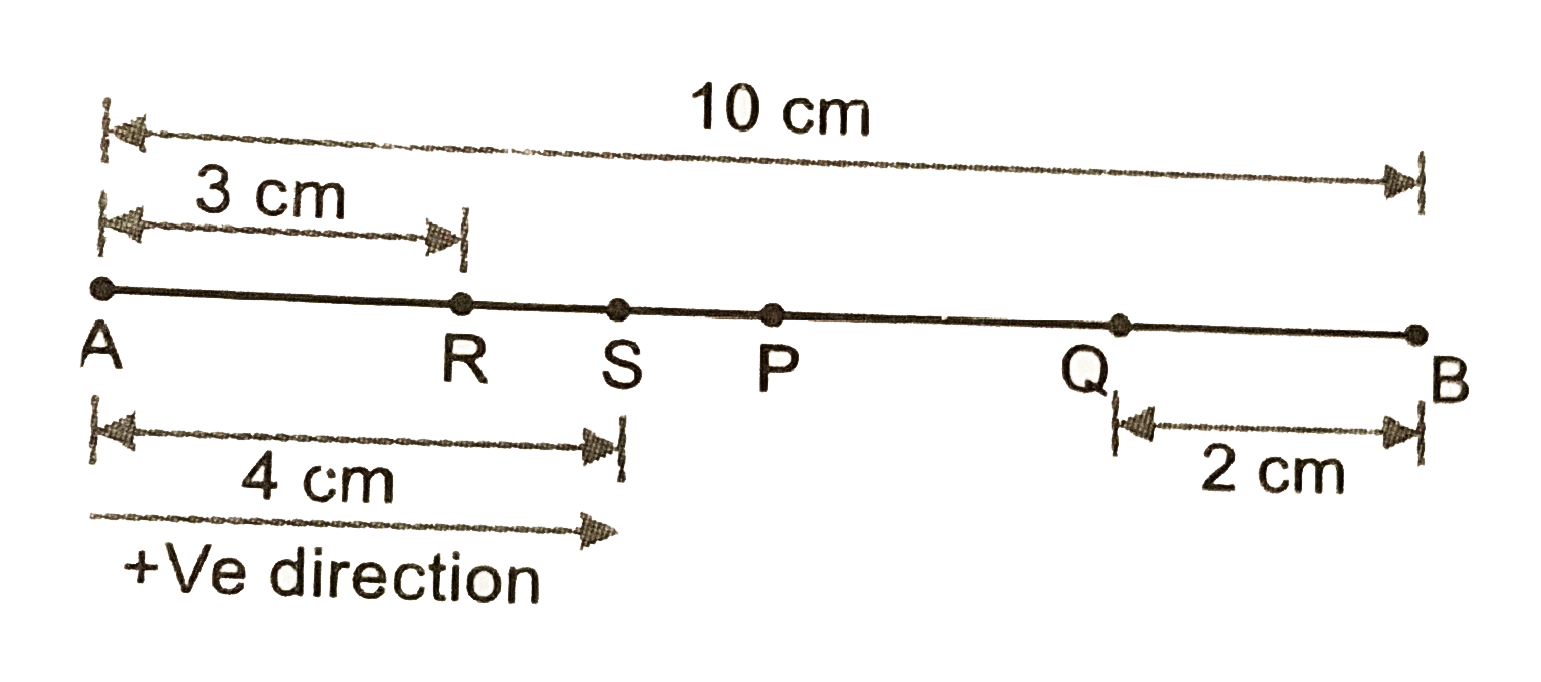
A particle is in linear S.H.M. between two points A and B, 10 cm apart. Take the direction from A to B as the positive direction and give the signs of velocity, acceleration and force on the particle when it is.
(a) at the end A
(b) at the end B,
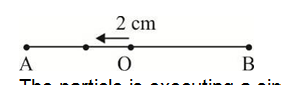
(c) at the mid point of AB going towards A,
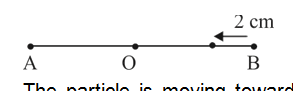
(d) at 2 cm away from B going towards A,
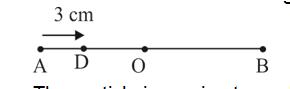
(e) at 3 cm away from A goiing towards B, and
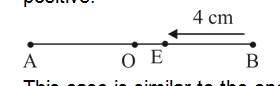
(f) at 4 cm away from A going towards A.

Text Solution

Verified by Experts
(i)Zero, Positive, Positive
(ii)Zero, Negative, Negative
(iii)Negative, Zero, Zero
(iv)Negative, Negative, Negative
(v)Positive, Positive, Positive
(vi)Negative, Negative, Negative
Explanation:
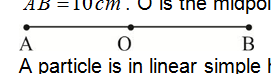
(i & ii) The given situation is shown in the following figure. Points A and B are the two end points, with . O is the midpoint of the path.

A particle is in linear simple harmonic motion between the end pointsAt the extreme point A, the particle is at rest momentarily. Hence, its velocity is zero at this point.
Its acceleration is positive as it is directed along AO.
Force is also positive in this case as the particle is directed rightward.
At the extreme point B, the particle is at rest momentarily. Hence, its velocity is zero at this point.
Its acceleration is negative as it is directed along B.
Force is also negative in this case as the particle is directed leftward.

(iii)The particle is executing a simple harmonic motion. O is the mean position of the particle. Its velocity at the mean position O is the maximum. The v alue for velocity is negative as the particle is directed leftward. The acceleration and force of a particle executing SHM is zero at the mean position

(iv)The particle is moving toward point O from the end B. This direction of motion is opposite to the conventional positive direction, which is form A to B. Hence, the particle's velocity and acceleration, and the force on it are all negative

(v)The particle is moving toward point O from the end A. This direction of motion is from A to B, which is the conventional positive direction. Hence, the values for velocity, acceleration, and force are all positive.

(vi)This case is similar to the one given in (d).
Promotional Banner

Topper's Solved these Questions

  • SIMPLE HARMONIC MOTION

    VMC MODULES ENGLISH|Exercise LEVEL 0 SHORT ANSWER TYPE - II|12 Videos
  • SIMPLE HARMONIC MOTION

    VMC MODULES ENGLISH|Exercise LEVEL 0 LONG ANSWER TYPE|2 Videos
  • SIMPLE HARMONIC MOTION

    VMC MODULES ENGLISH|Exercise 7-previous year question|46 Videos
  • ROTATIONAL MOTION

    VMC MODULES ENGLISH|Exercise JEE Advanced (Archive) (True/False Type)|3 Videos
  • SYSTEM OF A PARTICLES & ROTATIONAL MOTION

    VMC MODULES ENGLISH|Exercise IN-CHAPTER EXERCISE F|10 Videos

Similar Questions

Explore conceptually related problems

A particle is in linear simple harmonic motion between two points. A and B, 10 cm apart (figure.) take direction from A to B as the positive direction and choose the correct statements. AO= OB= 5cm BC=8cm

Two particles A and B are projected from the same point in different direction in such a manner that their velocity vectors are shown in the diagram :- .

Velocity of a particle is in negative direction with constant acceleration in positive direction. Then match the following:

Give examples for the particle where (a) the velocity is in opposite direction to the acceleration (b)the velocity of the particle is zero but is acceleration is not zero.

A particle is moving with constant speed v along x - axis in positive direction. Find the angular velocity of the particle about the point (0, b), when position of the particle is (a, 0).

A particle of mass m is released from point A as shown in the gigure. Would it loop the loop if H=4r? What is the force on the circular track when it is at point (a) B, (b) C?

A point moving with constant acceleration from A to B in the straight line AB has velocities u and v at A and B respectively. Find its velocity at C, the mid point of AB. Also show that if the time from A to C is twice that from C to B, then v =7 u .

A particle moving along a straight line with uniform acceleration has velocities 7 m//s at A and 17 m//s at C. B is the mid point of AC. Then :-

A particle performs linear S.H.M. At a particular instant, velocity of the particle is u and acceleration is alpha while at another instant, velocity is v and acceleration beta (0ltalphaltbeta) . The distance between the two position is

A particle is moving in a conservative force field from point A to point B.U_(A) and U_(B) are the potential energies of the particle at point A and B and W_(C) is the work done by conservative forces in the process of taking the particle from A and B, which of the following is true?