Home
Class 12
PHYSICS
A block of mass m compresses a spring io...

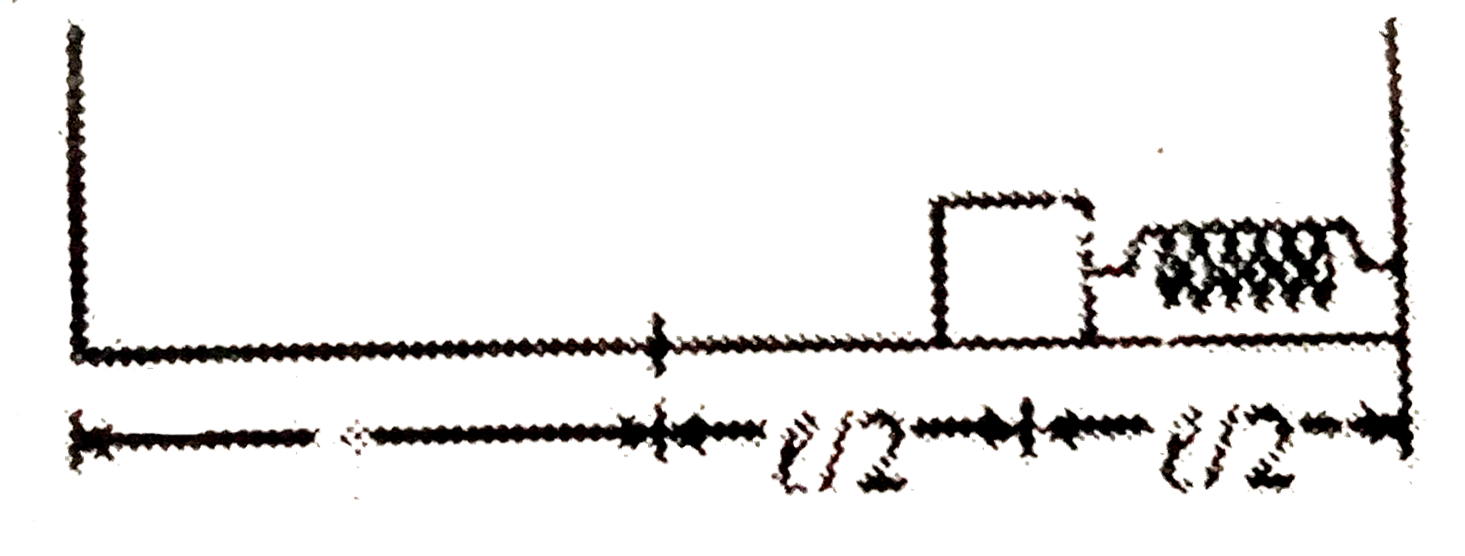
A block of mass m compresses a spring iof stifffness k through a distacne `l//2` as shown in the figure .If the block is not fixed to the spring the period of motion of the block is

A

(a)`2pisqrt(m)/(k)`

B

(b)`(pi+4)sqrt(m)/(k)`

C

(c)`(1+pi)sqrt(m)/(k)`

D

(d)None of these

Text Solution

Verified by Experts

The correct Answer is:

B

`(1)/(2)k((I)/(2))^(2)=(1)/(2)mv^(2)`.`V=sqrt((k)/(m)) (I)/(2)`, `T=(2I)/(V)+(1)/(2)(2pisqrt((m)/(k)))=(4+pi)sqrt((m)/(k))`
Promotional Banner

Topper's Solved these Questions

  • SIMPLE HARMONIC MOTION

    VMC MODULES ENGLISH|Exercise LEVEL (2)|40 Videos
  • SIMPLE HARMONIC MOTION

    VMC MODULES ENGLISH|Exercise 6-previous year question|56 Videos
  • SIMPLE HARMONIC MOTION

    VMC MODULES ENGLISH|Exercise LEVEL 0 LONG ANSWER TYPE|2 Videos
  • ROTATIONAL MOTION

    VMC MODULES ENGLISH|Exercise JEE Advanced (Archive) (True/False Type)|3 Videos
  • SYSTEM OF A PARTICLES & ROTATIONAL MOTION

    VMC MODULES ENGLISH|Exercise IN-CHAPTER EXERCISE F|10 Videos

Similar Questions

Explore conceptually related problems

A block of mass m is attached to a cart of mass 4m through spring of spring constant k as shown in the figure. Friction is absent everywhere. The time period of oscillations of the system, when spring is compressed and then released, is

A block of mass m is released from rest onto a spring. A having stiffness k_A=mg//2h as shown in figure. If the block compresses spring B through a distance h, find the: a. stiffness of the spring B b. equilibrium position of the block c. maximum velocity of the block d. maximum acceleration of the block

A block of mass m is released from rest onto a spring. A having stiffness k_A=mg//2h as shown in figure. If the block compresses spring B through a distance h, find the: a. stiffness of the spring B b. equilibrium position of the block c. maximum velocity of the block d. maximum acceleration of the block

A block of mass m, lying on a smooth horizontal surface, is attached to a spring (of negligible mass) of spring constant k. The other end of the spring is fixed, as shown in the figure. The block is initally at rest in its equilibrium position. If now the block is pulled withe a constant force F, the maximum speed of the block is :

Two springs are in a series combination and are attached to a block of mass 'm' which is in equilibrium. The spring constants and extension in the springs are as shown in the figure. Then the force exerted by the spring on the block is :

A block of mass m moving at a speed 'v' compresses as spring through a distance 'x' before its speed is halved. Find the spring constant of the spring.

A block of mass 100 g attached to a spring of stiffness 100 N//m is lying on a frictionless floor as shown. The block is moved to compress the spring by 10 cm and released. If the collision with the wall is elastic then find the time period of oscillations.

A block of mass m held touching the upper end of a light spring of force constant K as shown in figure. Find the maximum potential energy stored in the spring if the block is released suddenly on the spring.

A block of mass m is pressed against a wall by a spring as shown in the figure. The spring has natural length , l (l gt L) , and the coefficient of friction between the block and the wall is mu . The minimum spring constant K necessary for equilibrium is:

Two blocks of masses m_(1) and m_(2) are kept on a smooth horizontal table as shown in figure. Block of mass m_(1) (but not m_(2) is fastened to the spring. If now both the blocks are pushed to the left so that the spring is compressed a distance d. The amplitude of oscillatin of block of mass m_(1) after the system is released is

VMC MODULES ENGLISH-SIMPLE HARMONIC MOTION -LEVEL (1)
  1. A block is kept on a rough horizontal plank. The coefficient of fricti...

    Text Solution

    |

  2. A thin bar of mass M and length L is free to rotate about a fixed hori...

    Text Solution

    |

  3. A block of mass m compresses a spring iof stifffness k through a dista...

    Text Solution

    |

  4. One end of an ideal spring is fixed to a wall at origin O and axis of ...

    Text Solution

    |

  5. One end of an ideal spring is fixed to a wall at origin O and the axis...

    Text Solution

    |

  6. One end of an ideal spring is fixed to a wall at origin O and the axis...

    Text Solution

    |

  7. Amplitude of a swing decreases to 0.5 times its original magnitude in ...

    Text Solution

    |

  8. The amplitude of a simple pendulum, oscillating in air with a small sp...

    Text Solution

    |

  9. A pendulum with time period of 1s is losing energy due to damping. At ...

    Text Solution

    |

  10. The angular frequency of the damped oscillator is given by omega=sqrt(...

    Text Solution

    |

  11. A particle of mass 0.10 kg has its velocity varying according to the r...

    Text Solution

    |

  12. A plank with a bar placed on it performs horizontal harmonic oscillati...

    Text Solution

    |

  13. A tiny mass performs S.H.M along a straight line with a time period of...

    Text Solution

    |

  14. The velocity-time diagram of a harmonic oscillator is shown in adjoinn...

    Text Solution

    |

  15. A cubical block of mass M vibrates horizontally with amplitude of 4.0 ...

    Text Solution

    |

  16. A mass hangs in equilibrium from a spring of constant K=2N//cmAnothe...

    Text Solution

    |

  17. The acceleration and velocity maximum of simple harmonically oscillati...

    Text Solution

    |

  18. A body of mass 36 g moves with S.H.M. of amplitude A = 13 cm and time ...

    Text Solution

    |

  19. The tension along a string at its mean position is 1% more than its we...

    Text Solution

    |

  20. The amplitude of a lightly damped oscillator decreases by 4.0% during ...

    Text Solution

    |
