Home
Class 12
PHYSICS
m1 & m2 are connected with a light ine...

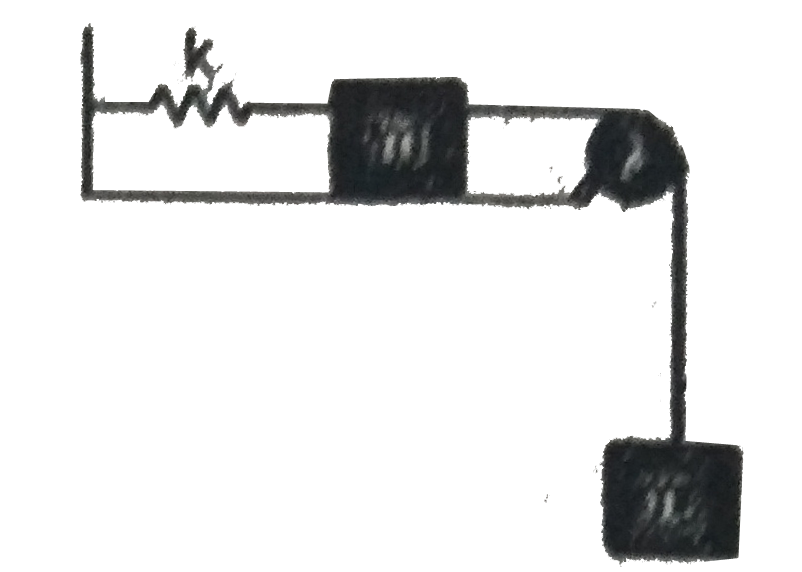
`m_1 ` & `m_2` are connected with a light inextensible string with `m_1` lying on smooth table and `m_2` hanging as shown in figure. `m_1` is also connected to a light spring which is initially unstretched an the system is released from rest.

A

system performs SHM with angular frequency given by `sqrt((K(m_(1)+m_(2)))/(m_(1)m_(2)))`

B

system performs SHM with angular frequency given by `sqrt((K)/(m_(1)+m_(2)))`

C

tension in string will be 0 when the system is released

D

maximum displacement of `m_(1)` will be `(m_(2)g)/(K)`

Text Solution

Verified by Experts

The correct Answer is:
B

After the system is released, `m_(2)` moves down . The extension in the spring becomes:
`(m_(2)g)/(k)(m_(2)g=kx_(0))`,
which is the new equilibrium position of the system. For small `x`: restoring force on the system is F=kx
`Rightarrow a=(kx)/(m_(1)+m_(2)) `(For ` (m_(1)+m_(2)+`spring)system)
`T=2pisqrt((x)/(a))=2pisqrt((x(m_(1)+m_(2))/(kx))=2pisqrt((m_(1)+m_(2))/(k))`
`Rightarrow` Angular frequency =`omega=(2pi)/(T)=sqrt((k)/(m_(1)+m_(2)))`
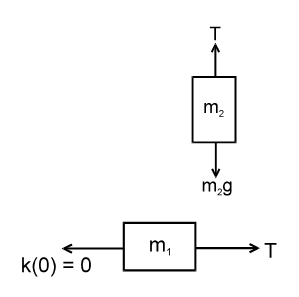
F.B.D.of `m_(1)` and `m_(2)`just after the system is released :
From above: `T=(m_(1)+m_(2))/(m_(1)+m_(2))g`
Hence (c) is incorret.
After `x=(m_(2)g)/(k)`:`m_(1)` moves towards right till the total kinetic energy acquired does not converted to potential energy.
Hence(D) is also incorrect.
Hence (B)is the answer.
Promotional Banner

Topper's Solved these Questions

  • SIMPLE HARMONIC MOTION

    VMC MODULES ENGLISH|Exercise 6-previous year question|56 Videos
  • SIMPLE HARMONIC MOTION

    VMC MODULES ENGLISH|Exercise 7-previous year question|46 Videos
  • SIMPLE HARMONIC MOTION

    VMC MODULES ENGLISH|Exercise LEVEL (1)|75 Videos
  • ROTATIONAL MOTION

    VMC MODULES ENGLISH|Exercise JEE Advanced (Archive) (True/False Type)|3 Videos
  • SYSTEM OF A PARTICLES & ROTATIONAL MOTION

    VMC MODULES ENGLISH|Exercise IN-CHAPTER EXERCISE F|10 Videos

Similar Questions

Explore conceptually related problems

Two blocks of mass m_(1) and m_(2) (m_(1) lt m_(2)) are connected with an ideal spring on a smooth horizontal surface as shown in figure. At t = 0 m_(1) is at rest and m_(2) is given a velocity v towards right. At this moment, spring is in its natural length. Then choose the correct alternative :

Two blocks of mass m_(1) and m_(2) (m_(1) lt m_(2)) are connected with an ideal spring on a smooth horizontal surface as shown in figure. At t = 0 m_(1) is at rest and m_(2) is given a velocity v towards right. At this moment, spring is in its natural length. Then choose the correct alternative :

In the arrangement shown in the figure (m_(A))/(m_(B))=(2)/(3) and the ratio of density of block B and the liquid is 2:1 The system is released from rest. Then

Consider the case of two bodies of masses m_(1) and m_(2) which are connected by light inextensible string passing over a light smooth pulley as shown in the figure. The expression for acceleration of the system and tension of the string are expressed below under different situations : ( i ) when m_(1) gt m_(2) . In this case a=((m_(1)-m_(2))/(m_(1)+m_(2)))g and T=((2m_(1)m_(2))/(m_(1)+m_(2)))g ( ii ) when m_(2) gt m_(1) . In this case a=((m_(2)-m_(1))/(m_(1)+m_(2)))g and T=((2m_(1)m_(2))/(m_(1)+m_(2)))g ( iii ) When m_(1)=m_(2)=m . In this case a=0 , T=mg If m_(1)=10kg , m_(2)=6kg and g=10m//s^(2) What is the tension in the string ?

Consider the case of two bodies of masses m_(1) and m_(2) which are connected by light inextensible string passing over a light smooth pulley as shown in the figure. The expression for acceleration of the system and tension of the string are expressed below under different situations : ( i ) when m_(1) gt m_(2) . In this case a=((m_(1)-m_(2))/(m_(1)+m_(2)))g and T=((2m_(1)m_(2))/(m_(1)+m_(2)))g ( ii ) when m_(2) gt m_(1) . In this case a=((m_(2)-m_(1))/(m_(1)+m_(2)))g and T=((2m_(1)m_(2))/(m_(1)+m_(2)))g ( iii ) When m_(1)=m_(2)=m . In this case a=0 , T=mg If m_(1)=10kg , m_(2)=6kg and g=10m//s^(2) If the pulley is pulled upward with acceleration equal to the acceleration due to gravity, what will be the tension in the string

Consider the case of two bodies of masses m_(1) and m_(2) which are connected by light inextensible string passing over a light smooth pulley as shown in the figure. The expression for acceleration of the system and tension of the string are expressed below under different situations : ( i ) when m_(1) gt m_(2) . In this case a=((m_(1)-m_(2))/(m_(1)+m_(2)))g and T=((2m_(1)m_(2))/(m_(1)+m_(2)))g ( ii ) when m_(2) gt m_(1) . In this case a=((m_(2)-m_(1))/(m_(1)+m_(2)))g and T=((2m_(1)m_(2))/(m_(1)+m_(2)))g ( iii ) When m_(1)=m_(2)=m . In this case a=0 , T=mg If m_(1)=10kg , m_(2)=6kg and g=10m//s^(2) then what is the acceleration of masses ?

Two masses m_1 = 1 kg and m_2 = 2 kg are connected by a light inextensible string and suspended by means of a weightness pulley as shown in the figure. Assuming that both the masses start from rest, the distance travelled by the centre of mass in two seconds is (Take g = 10 ms^-2 . .

A block of mass m_(1)=2 kg is kept on a smooth horizontal table. Another block of mass m_(2)=1 kg is connected to m_(1) by a light inextensible string passing over a smooth pulley as shown in the figure. If the blocks are released, what will be the (a) acceleration of each block (b) tension in the string?

Two blocks of masses m and M connected by a light spring of stiffness k, are kept on a smooth horizontal surface as shown in figure. What should be the initial compression of the spring so that the system will be about to break off the surface, after releasing the block m_1 ?

Two blocks of masses m_(1) = 2kg and m_(2) = 4kg are attached to two ends of a light ideal spring of force constant k = 1000 N // m. The system is kept on a smooth inclined plane inclined at 30^(@) with horizontal. The block m_(2) is attached to a light string whose other end is connected to a mass m_(3) = 1 kg . A force F = 15N is applied on m_(1) and the system is released from rest. Assume initially the spring is at relaxed position and the system is released from rest. Find the (a) maximum extension of the spring. (

VMC MODULES ENGLISH-SIMPLE HARMONIC MOTION -LEVEL (2)
  1. A particle executes simple harmonic motion of period T and amplitude l...

    Text Solution

    |

  2. A constant force produces maximum velocity V on the block connected to...

    Text Solution

    |

  3. m1 & m2 are connected with a light inextensible string with m1 lying...

    Text Solution

    |

  4. Figure shows three systems in which a block of mass m can execute S.H....

    Text Solution

    |

  5. A particle of mass m is attached to three identical springs. A, B and ...

    Text Solution

    |

  6. The system shown in the figure can move on a smooth surface. The sprin...

    Text Solution

    |

  7. A block of mass m is connected to a spring constant k and is at rest i...

    Text Solution

    |

  8. A block of mass m is connected to a spring constant k and is at rest i...

    Text Solution

    |

  9. A block of mass m is connected to a spring constant k and is at rest i...

    Text Solution

    |

  10. A simple pendulum of length l is suspended in a car that is travelling...

    Text Solution

    |

  11. If the length of a simple pendulum is equal to the radius of the earth...

    Text Solution

    |

  12. A uniform dics of mass m and radius R=(80)/(23pi^2)m is pivoted smooth...

    Text Solution

    |

  13. What is the period of oscillation of a liquid contained in a U - tube ...

    Text Solution

    |

  14. A disc of mass M = 4 kg, radius R = 1 m is attached with two blocks A ...

    Text Solution

    |

  15. Consider the situation in which one end of a massless spring of spring...

    Text Solution

    |

  16. A solid cylinder of mass m is attached to a horizontal spring with for...

    Text Solution

    |

  17. Consider the situation in which one end of a massless spring of spring...

    Text Solution

    |

  18. In the Column I, a system is described in each option and correspondin...

    Text Solution

    |

  19. A uniform disc of mass m and radius R is pivoted smoothly at its centr...

    Text Solution

    |

  20. The angular frequency of a spring block system is omega(0). This syste...

    Text Solution

    |

