Home
Class 12
PHYSICS
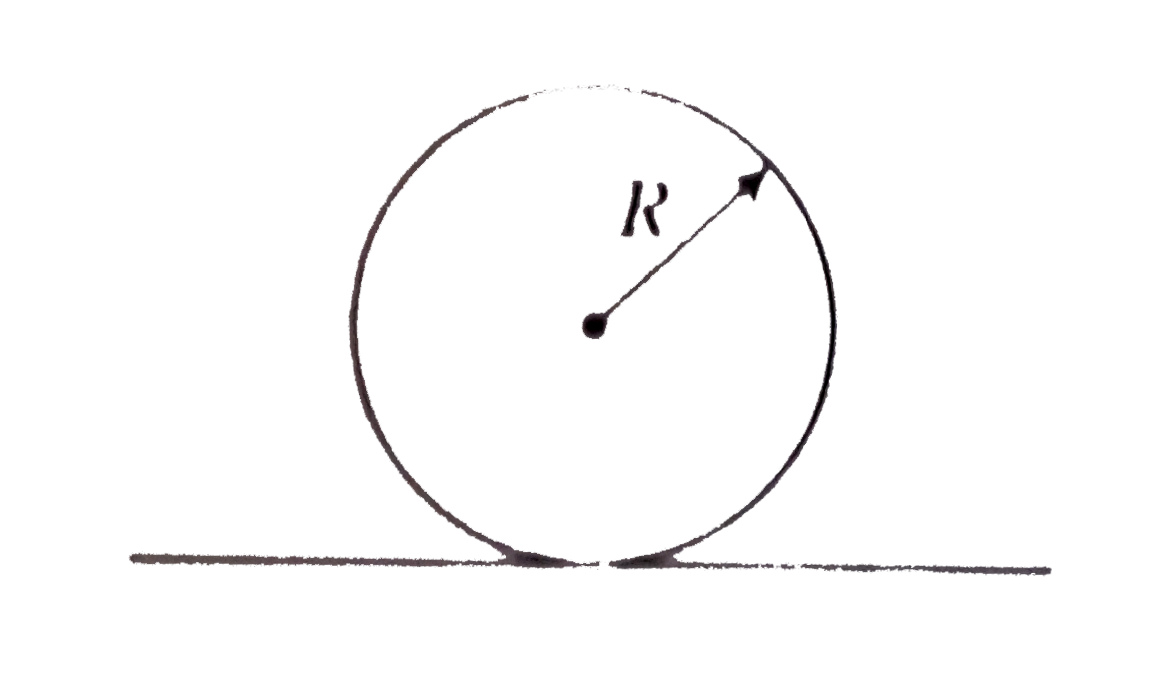
If linear charge density of a wire as sh...

If linear charge density of a wire as shown in the figure is `lambda`

Text Solution

Verified by Experts

The correct Answer is:

A-P;B-R;C-SD-Q

(A) Buoyant force = Mg = constant `=V_(sub)=(Mg)/(rho_(l)g)` . Volume of displace fluid = constant `therefore` density of fluid must be constant.
(B) `(V_("solid")-V_("sub"))="constant"rArr(V_("solid")-(M_("solid"))/(rho_("liquid")))="constant"Vxx3alphaxxDeltaT=(MgammaDeltaT)/(d)rArr3alpha(d)/(rho)`
(C ) `Ah_("in")d_("lquid")=A(h_("in") +h_("out"))rho_("solid")=M`(mass of soild)
`h_("out")=-(M)/(Arho_("soild")),h_("in")=(M)/(Arho_("soild"))-(M)/(Ad_("liquid"))=`constant
`(M(1+3alphaDeltaT))/(A(1+2alphaDeltaT)rho)-(M(1+gammaDeltaT))/(A(1+2alphaDeltaT)d)=(M)/(Arho)-(M)/(Ad),gamma=2alpha+alpha(d)/(rho)`
(D) `Ah_("in")d_("liquid")g=` Buoyant force = constant = Mg
`A_(0)(1+2alphaDeltaT)h_("in ")(d)/(1+gammaDeltaT)"constant",h_("in")=(M)/(A_(0)d)(1+(gamma-2alpha)DeltaT)gamma=2alpha`
Promotional Banner

Topper's Solved these Questions

  • PROPERTIES OF MATTER

    VMC MODULES ENGLISH|Exercise JEE Main (Archive) Level - 1|48 Videos
  • PROPERTIES OF MATTER

    VMC MODULES ENGLISH|Exercise JEE Advanced(Archive) Level - 2|1 Videos
  • PROPERTIES OF MATTER

    VMC MODULES ENGLISH|Exercise Level -1|90 Videos
  • MOVING CHARGES & MAGNETISM

    VMC MODULES ENGLISH|Exercise IN-CHAPTER EXERCISE-K|10 Videos
  • QUIZ

    VMC MODULES ENGLISH|Exercise PHYSICS|30 Videos

Similar Questions

Explore conceptually related problems

An infinitely long line of linear charge density lambda is shown in the figure. The potential difference V_(A)-V_(B) between the two points A and B is

A nonconducting ring of uniform mass m, radius b and uniform linear charge density lambda is suspended as shown in figure in a gravity free space. There is uniform coaxial magnetic field B_0 , pointing up in a circular region of radius 'a' (lt b) . Now if this field is switched off, then:-

An infinte wire having linear charge density lambda is arranged as shown in fig. A charge particle of mass m and charge q is released charged q is released from point P. Find the initial acceleration of the particle just after the particle is released.

Two semicircular rings lying in same plane, of uniform linear charge density lambda have radius r and 2r. They are joined using two straight uniformly charged wires of linear charge density lambda and length r as shown in figure. The magnitude of electric field at common centre of semi circular rings is -

Two semicircular rings lying in same plane, of uniform linear charge density lambda have radius r and 2r. They are joined using two straight uniformly charged wires of linear charge density lambda and length r as shown in figure. The magnitude of electric field at common centre of semi circular rings is -

A tiny electric dipole of dipole moment p is palced at a distance r from an infinitely long wire, with its vecp normal to the wire. If the linear charge density of the wire is lambda , the electrostatic force acting on the dipole is equal to

A very long uniformly charged wire oriented along the axis of a circular ring of radius R rests on its centre with one of the ends (as shown in figure). The linear charge density on the wire is lambda . Evalute the flux of the vector vecE across the circle area.

The linear charge density on a ring of radius R is lambda=lambda_0 sin (theta) where lambda_0 is a constant and theta is angle of radius vector of any point on the ring with x-axis. The electric potential at centre of ring is

The linear mass density , i.e mass per unit length of the rope as shown in figure , varies 0 to lambda from one end to another . The acceleration of the combined system of figure will be

Two semicircle wires ABC, and ADC, each of radius R are lying on xy and xz planes, respectively as shown in fig. if the linear charge density of the semicircle parts and straight parts and straight parts is lambda , Find the electric field entensity vec(E) at the origin .

VMC MODULES ENGLISH-PROPERTIES OF MATTER-Level -2
  1. When the temperature of a copper coin is raised by 80^@C, its diameter...

    Text Solution

    |

  2. A vessel is partly filled with liquid. When the vessel is cooled to a ...

    Text Solution

    |

  3. If linear charge density of a wire as shown in the figure is lambda

    Text Solution

    |

  4. Two vessels connected at the bottom by a thin pipe with a sliding plug...

    Text Solution

    |

  5. A room at 20^@C is heated by a heater of resistence 20 ohm connected t...

    Text Solution

    |

  6. A rod of length l and cross-section area A has a variable thermal con...

    Text Solution

    |

  7. A planet radiates heat at a rate proportional to the fourth power of i...

    Text Solution

    |

  8. Assuming the sun to have a spherical outer surface of radius r, radiat...

    Text Solution

    |

  9. A circular ring (centre O) of radius a, and of uniform cross section i...

    Text Solution

    |

  10. Assume that the thermal conductivity of copper is twice that of alumin...

    Text Solution

    |

  11. Assume that the thermal conductivity of copper is twice that of alumin...

    Text Solution

    |

  12. Assume that the thermal conductivity of copper is twice that of alumin...

    Text Solution

    |

  13. A copper rod (initially at room temperature 20^(@)C) of non-uniform cr...

    Text Solution

    |

  14. A wall is made of equally thick layers A and B of different matierals...

    Text Solution

    |

  15. A long solid cylinder is radiating power. It is remolded into a number...

    Text Solution

    |

  16. Energy of radiation emitted by a black body at temperature 3000 K is u...

    Text Solution

    |

  17. A sphere and a cube of same material and same total surface area are p...

    Text Solution

    |

  18. Gibbs-Helmoholtz equation relates the free energy change to the enthal...

    Text Solution

    |

  19. A body with an initial temperature theta(1) is allowed to cool in a su...

    Text Solution

    |

  20. Solar constant is 1370 W//m^(2) . 70% of the light incident on the e...

    Text Solution

    |
