Home
Class 12
PHYSICS
A planet radiates heat at a rate proport...

A planet radiates heat at a rate proportional to the fourth power of its surface temperature T. If such a steady temperature of the planet is due to an exactly equal amount of heat received from the sun then which of the following statement is true?

A

(a)The planet’s surface temperature varies inversely as the distance of the sun

B

(b)The planet’s surface temperature varies directly as the square of its distance from the sun

C

(c)The planet’s surface temperature varies inversely as the square root of its distance from the sun

D

(d)The planet’s surface temperature is proportional to the fourth power of distance from the sun

Text Solution

Verified by Experts

The correct Answer is:
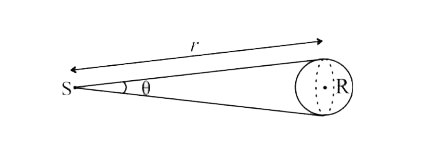
C

Total energy received per second
`P_("sun")/(4pir^(2))(piR^(2)),(esigma)4piR^(2)T^(4)=(ppiR^(2))/(4pir^(2))a`
or `T^(4)=K(R^(2))/(r^(2)),Talpha(1)/(sqrt(r))`
Promotional Banner

Topper's Solved these Questions

  • PROPERTIES OF MATTER

    VMC MODULES ENGLISH|Exercise JEE Main (Archive) Level - 1|48 Videos
  • PROPERTIES OF MATTER

    VMC MODULES ENGLISH|Exercise JEE Advanced(Archive) Level - 2|1 Videos
  • PROPERTIES OF MATTER

    VMC MODULES ENGLISH|Exercise Level -1|90 Videos
  • MOVING CHARGES & MAGNETISM

    VMC MODULES ENGLISH|Exercise IN-CHAPTER EXERCISE-K|10 Videos
  • QUIZ

    VMC MODULES ENGLISH|Exercise PHYSICS|30 Videos

Similar Questions

Explore conceptually related problems

The temperature change versus heat supplied curve is given for 1 kg of a solid block. Then, which of the following statement is/are correct ?

The thermal radiation emitted by a body is proportional to T^(n) where T is its absolute temperature. The value of n is exactly 4 for

A block of metal is heated to a temperature much higher than the room temperature and allowed to cool in a room free from air currents. Which of the following curves correctly represents the rate of cooling

A well insulated substance in solid state is heated at a constant rate until it vaporizes completely. The temperature-time graph of the substance is shown below . Which of the following statements is//are true?

Assertion : First law of thermodynamics does not forbid flow of heat from lower temperature to higher temperature. Reason : Heat supplied to a system always equal to the increase in its internal energy.

The rays of the sun are focused on a piece of ice through a lens of diameter 5 cm , as a result of which 10g ice melts in 10 minutes. The amount of heat received from the sun per unit area per minute is

The solar constant for a planet is sum . The surface temperature of the sun is T K. if the sun subtends an angle theta at the planet, then

A cylindrical rod of heat capacity 120 J//K in a room temperature 27^(@)C is heated internally by heater of power 250W , The steady state temperature attained by the rod is 37^(@)C . Fin the following: (a) The initial rate of increse in temperature (b) The steady state rate of emission of radiant heat. If the heater is switched off, find (c) The initial rate of decrease is temperature (d) The rate of decrease in temperature of the cylinder when its temperature falls to 31^(@)C and (e) The maximum amount of heat lost by the cylinder

The amount of heat energy radiated by a metal at temperature T is E. When the temperature is increased to 3T, energy radiated is

VMC MODULES ENGLISH-PROPERTIES OF MATTER-Level -2
  1. A room at 20^@C is heated by a heater of resistence 20 ohm connected t...

    Text Solution

    |

  2. A rod of length l and cross-section area A has a variable thermal con...

    Text Solution

    |

  3. A planet radiates heat at a rate proportional to the fourth power of i...

    Text Solution

    |

  4. Assuming the sun to have a spherical outer surface of radius r, radiat...

    Text Solution

    |

  5. A circular ring (centre O) of radius a, and of uniform cross section i...

    Text Solution

    |

  6. Assume that the thermal conductivity of copper is twice that of alumin...

    Text Solution

    |

  7. Assume that the thermal conductivity of copper is twice that of alumin...

    Text Solution

    |

  8. Assume that the thermal conductivity of copper is twice that of alumin...

    Text Solution

    |

  9. A copper rod (initially at room temperature 20^(@)C) of non-uniform cr...

    Text Solution

    |

  10. A wall is made of equally thick layers A and B of different matierals...

    Text Solution

    |

  11. A long solid cylinder is radiating power. It is remolded into a number...

    Text Solution

    |

  12. Energy of radiation emitted by a black body at temperature 3000 K is u...

    Text Solution

    |

  13. A sphere and a cube of same material and same total surface area are p...

    Text Solution

    |

  14. Gibbs-Helmoholtz equation relates the free energy change to the enthal...

    Text Solution

    |

  15. A body with an initial temperature theta(1) is allowed to cool in a su...

    Text Solution

    |

  16. Solar constant is 1370 W//m^(2) . 70% of the light incident on the e...

    Text Solution

    |

  17. A thin copper rod of uniform cross section A square metres and of leng...

    Text Solution

    |

  18. The thermal conductivity of a rod depends on :

    Text Solution

    |

  19. Two identical objects A and B are at temperatures TA and TB. Respectiv...

    Text Solution

    |

  20. A heated body emits radiation which has maximum intensity at frequency...

    Text Solution

    |

