Home
Class 12
PHYSICS
A particle of mass m and charge q, movin...

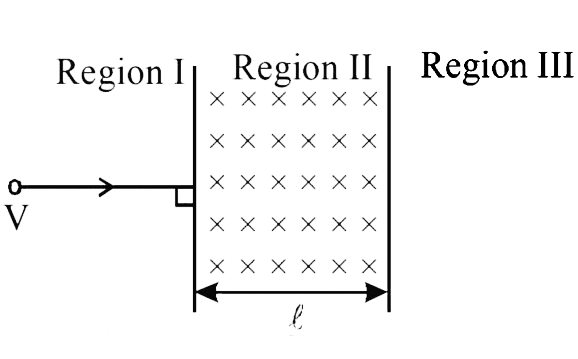
A particle of mass m and charge q, moving with velocity v enters region II normal to the boundary as shown in the figure. Region II has a uniform magnetic field B perpendicular to plane of the paper. The length of the Region II is l.. Choose the correct choice (s):

A

The particle centers Region III only if its velocity `v gt(qIB)/m`

B

The particle enters Region III only if its velocity `v lt (qIB)/m`

C

Path length of the particle in Region II is maximum when velocity `v=qIB//m`

D

Time spent in Region II is same for any velocity v as long as the particle returns to Region I

Text Solution

Verified by Experts

The correct Answer is:
A, C, D

`v_|_B` in region II. Therfore path of particle is circle in region II.
Particle enters in region III. If radius of circular patn `r gt l` or `(mv)/(Bq)gt1` or `v gt(Bql)/m`
If `v(Bq1)/m, r(mv)/(Bq)=1`, particle will turn back and path length will be maximum
If particle returns to region I, time spent in region II will be `t=T/2=(pim)/(Bq)`,
which is independent of v `:.` Correct.
Promotional Banner

Topper's Solved these Questions

  • MAGNETIC EFFECTS OF CURRENT

    VMC MODULES ENGLISH|Exercise JEE Main (Archive)|75 Videos
  • LIQUIDS

    VMC MODULES ENGLISH|Exercise JEE ADVANCED (LEVEL -2)|55 Videos
  • MOCK TEST 1

    VMC MODULES ENGLISH|Exercise PART I : PHYSICS (SECTION-2)|10 Videos

Similar Questions

Explore conceptually related problems

A particle of mass m and charge q , moving with velocity v enters Region II normal to the boundary as shown in the figure. Region II has a uniform magnetic field B perpendicular to the plane of the paper . The length of the region II is l . Choose the correct choice(s).

A particle of mass m and charge Q moving with a velocity v enters a region on uniform field of induction B Then its path in the region is s

A charge particle of mass m and charge q enters in a region of uniform magnetic field as shown in figure.The magnitude of change in linear momentum due to magnetic field will be

A particle with mass m and charge q moving with a velocity v , enters a region of uniform magnetic field B , shown, in the figure above. The particle strikes the wall at a distance d from the entance slit. If the paticle's velocity stays the same but its charge to mass ratio is doubled, distance frm the entrance slit where the particle strike the wall is d/n , then find n

A particle with mass m and charge q moving with a velocity v , enters a region of uniform magnetic field B , shown, in the figure above. The particle strikes the wall at a distance d from the entance slit. If the paticle's velocity stays the same but its charge to mass ratio is doubled, distance frm the entrance slit where the particle strike the wall is d/n , then find n

A particle of mass m carrying charge q is accelerated by a potential difference V. It enters perpendicularly in a region of uniform magnetic field B and executes circular arc of radius R, then q/m equals

A particle of mass m and charge q moves with a constant velocity v along the positive x- direction. It enters a region containing a uniform magnetic field B directed along the negative z direction, extending from x=a to x=b . The minimum value of v required so that the particle can just enter the region xgtb is

A particle of charge q and mass m moving with a velocity v along the x-axis enters the region xgt0 with uniform magnetic field B along the hatk direction. The particle will penetrate in this region in the x -direction upto a distance d equal to

A particle having charge q moves with a velocity v through a region in which both an electric field vecE and a magnetic field B are present. The force on the particle is

A charged particle ( mass m and charge q) moves along X axis with velocity V_0 . When it passes through the origin it enters a region having uniform electric field vecE=-E hatj which extends upto x=d . Equation of path of electron in the region . x gt d is :

VMC MODULES ENGLISH-MAGNETIC EFFECTS OF CURRENT -JEE Advanced (Archive)
  1. H^(+), He^(+) and O^(2+) ions having same kinetic energy pass through ...

    Text Solution

    |

  2. Which of the following statement is (are) correct in the given figure ...

    Text Solution

    |

  3. A particle of mass m and charge q, moving with velocity v enters regio...

    Text Solution

    |

  4. An electron and a proton are moving on straight parallel paths with sa...

    Text Solution

    |

  5. Consider the motion of a positive point charge in a region where there...

    Text Solution

    |

  6. A particle of mass m and charge q moves with a constant velocity v alo...

    Text Solution

    |

  7. Magnetic field at a distance r from an infinitely long straight conduc...

    Text Solution

    |

  8. A conductor (shown in the figure) carrying constant current I is kept ...

    Text Solution

    |

  9. A uniform magnetic field B exists in the region between x=0 and x=(3R...

    Text Solution

    |

  10. Two infinitely long straight wires lie in the xy-plane along the line...

    Text Solution

    |

  11. Two wire each carrying a steady current I are shown in four configurat...

    Text Solution

    |

  12. Six point charges , each of the same magnitude q, are arranged in dif...

    Text Solution

    |

  13. Match the statement in Column I to the appropriate statement(s) from C...

    Text Solution

    |

  14. In a certain region, uniform electric field E=-E0hatk and magnetic fie...

    Text Solution

    |

  15. A charge q moves in a region where electric field as well as magnetic ...

    Text Solution

    |

  16. A uniform electric field of strength E exists in region. A electron ...

    Text Solution

    |

  17. A potential difference of 600 V is applied across the plates of a para...

    Text Solution

    |

  18. Two long straight parallel wieres are 2m apart, perpendicular to the p...

    Text Solution

    |

  19. A wire loop carrying a current I is placed in the xy-plane as shown in...

    Text Solution

    |

  20. A long horizontal wire AB,which is free to move in a vertical plane an...

    Text Solution

    |

