Home
Class 12
CHEMISTRY
The Cl-C-Cl angle is 1,1,2,2-tetrachloro...

The Cl-C-Cl angle is 1,1,2,2-tetrachloroethene and tetrachloromethane respectively will be about

A

`120^(@) and 109.5^(@)`

B

`90^(@) and 109.5^(@)`

C

`109^(@) and 90^(@)`

D

`109.5^(@) and 120^(@)`

Text Solution

Verified by Experts

The correct Answer is:
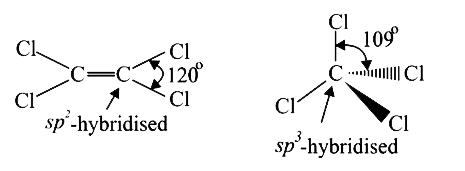
A

Promotional Banner

Topper's Solved these Questions

  • CHEMICAL BONDING-I & II

    VMC MODULES ENGLISH|Exercise JEE Main (Archive)|62 Videos
  • CHEMICAL BONDING & MOLECULAR STRUCTURE

    VMC MODULES ENGLISH|Exercise IN-CHAPTER EXERCISE-L|9 Videos
  • CHEMICAL EQUILIBRIUM

    VMC MODULES ENGLISH|Exercise IN-CHAPTER EXERCISE - G|10 Videos

Similar Questions

Explore conceptually related problems

The CI - C - CI angle in 1, 1, 2, 2 , tetrachloroethone and tetrachloromethane respectively will be about:

In the following questions, a statement of assertion (A) is followed by a statement of reason (R ) A : Both methane and tetrachloromethane are nonpolar. R : C-Cl bond is polar bond.

Cl-P-Cl bond angles in PCl_5 molecule are

The bond angle of Cl_(2)O is:

In the reaction Cl_2 + OH^(-) to ClO_3^(-) + Cl^(-) + H_2O the stoichiometric coefficient of Cl_2 and Cl^- respectively are

The oxidation number of C atom in CH_2Cl_2 and C Cl_4 are respectively

The d electron configuration of [Ru (en)_3]Cl_2 and [Fe(H_2O)_6]Cl_2 , respectively are :

Identify the oxidant and the reductant respectively in the following reaction. Cl_(2)(g) + 2Br^(-)(aq) to 2Cl^(-)(aq) + Br_(2)(aq)

The standard reduction potential for the half-cell reaction, Cl_2 + 2e^(-) to 2Cl^(-) will be (Pt^(2+)+2Cl^(-)to Pt + Cl_2 , E_"cell"^@=-0.15 V , Pt^(2+) + 2e^(-) to Pt, E^@=1.20 V)

Balance the followings equations and choose the quantity which is the sum of the coeffficients of reactants and products : .......CS_2 + .........Cl_2 \to C Cl_4 + ...... S_2Cl_2

VMC MODULES ENGLISH-CHEMICAL BONDING-I & II-JEE Advanced (Archive)
  1. sp^(3) hybrid orbitals have equal s and p characters .

    Text Solution

    |

  2. In benzene, carbon uses all the three p-orbitals for hybridisation .

    Text Solution

    |

  3. The Cl-C-Cl angle is 1,1,2,2-tetrachloroethene and tetrachloromethane ...

    Text Solution

    |

  4. The molecule that has linear structure is

    Text Solution

    |

  5. The species in which the central atom uses sp^(2) hybrid orbitals in i...

    Text Solution

    |

  6. The molecule which has pyramidal shape is

    Text Solution

    |

  7. Which of the following is paramagnetic ?

    Text Solution

    |

  8. The molecule which has zero dipole momnet is .

    Text Solution

    |

  9. The valence atomic orbital on C in silver acetylide is ……………hybridised...

    Text Solution

    |

  10. Between Na^(+) and Ag^(+) , which is stronger Lewis acid and why?

    Text Solution

    |

  11. The shape of [CH(3)]^(o+) is .

    Text Solution

    |

  12. The presnce of polar bonds in a polyatomic molecule suggests that the ...

    Text Solution

    |

  13. What effect should the following resonance of vinyl chloride have on i...

    Text Solution

    |

  14. Arrange the following as stated Increasing strength of hydrogen bond...

    Text Solution

    |

  15. In the reaction I^(-) +I(2) rarr I(3)^(-), the Lewis acid is ……….. .

    Text Solution

    |

  16. The linear structure is assumed by .

    Text Solution

    |

  17. Arrange the following ions in order of their increasing size: Li^(+), ...

    Text Solution

    |

  18. The maximum number of H-bonds a water molecule can form are

    Text Solution

    |

  19. The type of hybrid orbitals used by chlorine atom in ClO(2)^(-) is

    Text Solution

    |

  20. Which of the folowing have identical bond orders ? .

    Text Solution

    |

