Home
Class 12
CHEMISTRY
Among the following species identify the...

Among the following species identify the isostructural pairs `NH_(3), NO_(3)^(Theta) ,BF_(3) ,H_(3) O^(o+) , N_(3) H` .

A

`[NF_(3), NO_(3)^(-)] and [BF_(3), H_(3)O^(+)]`

B

`NF_(3), N_(3)H]and [NO_(3)^(-), BF_(3)]`

C

`[NF_(3), H_(3)O^(+)] and [NO_(3)^(-), BF_(3)]`

D

`[NF_(3), H_(3)O^(+)] and [N_(3)H, BF_(3)]`

Text Solution

Verified by Experts

The correct Answer is:
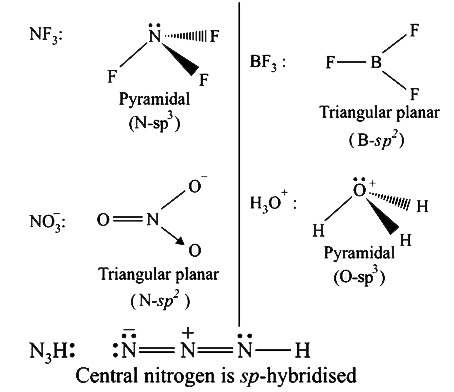
C


Therefore, `NF_(3), H_(3)O^(+)` and `BF_(3), NO_(3)^(-)` pairs have same shape.
Promotional Banner

Topper's Solved these Questions

  • CHEMICAL BONDING-I & II

    VMC MODULES ENGLISH|Exercise JEE Main (Archive)|62 Videos
  • CHEMICAL BONDING & MOLECULAR STRUCTURE

    VMC MODULES ENGLISH|Exercise IN-CHAPTER EXERCISE-L|9 Videos
  • CHEMICAL EQUILIBRIUM

    VMC MODULES ENGLISH|Exercise IN-CHAPTER EXERCISE - G|10 Videos

Similar Questions

Explore conceptually related problems

Among the following species, identify the isostuctural pairs NF_(3). NO_(3)^(-), BF_(3), H_(3)O, HN_(3)

Among the following species, identify the isostructural pairs NF_3 , NO_3^- , BF_3 , H_3O^+ ,

Arrange the following gases in order of their critical temperature. NH_(3),H_(2)O,CO_(2),O_(2)

Out of the following species, group them having similar structures CH_(4),CO_(3)^(2-), CO_(2), overset(o+)NH_(4), NO_(3)^(Θ), N_(3)^(Θ), BF_(4)^(Θ),SO_(2),NO_(2)^(Θ) .

Which of the following has larger bond angle in the following pairs ? (a)NH_(3),PH_(3)(b)BeF_(2),BF_(3)(c )H_(2)O,CO_(2)(d)H_(2)O,H_(2)S(e)C CL_(4),C_(2)H_(2) ?

NH_(4)NO_(3) overset(Delta) to N_(2)O+H_(2)O

NH_(4)NO_(3) overset(Delta) to N_(2)O+H_(2)O

Which of the following species has tetrahedral geometry? A BH_(4)^(-) B NH_(2)^(-) C CO_(3)^(2-) D H_(3)O^(+)

In which of the following pairs, the two species are iso-structural ? {:((a)SO_(4)^(2-)and NO_(3)^(-),(b),BF_(3)andNF_(3)),((c )BrO_(3)^(-)and XeO_(3),(d),SF_(4)and XeF_(4)):}

Arrange the following in order of decreasing bond angles (i) CH_(4), NH_(3), H_(2)O, BF_(3), C_(2)H_(2)" "(ii) NH_(3), NH_(2)^(-), NH_(4)^(+)

VMC MODULES ENGLISH-CHEMICAL BONDING-I & II-JEE Advanced (Archive)
  1. All molecules with polar bonds have dipole moment.

    Text Solution

    |

  2. Explain the difference in the nature of bonding in LiF and LiI .

    Text Solution

    |

  3. Among the following species identify the isostructural pairs NH(3), NO...

    Text Solution

    |

  4. Which of the following molecules is planar ? .

    Text Solution

    |

  5. The number and type of bonds between two carbon atoms in C(2) are:

    Text Solution

    |

  6. Fill in the blanks by chossing the appropriate word/words from those g...

    Text Solution

    |

  7. Among N(2)O,SO(2),I(3)^(o+) and I(3)^(Theta) the linear species are an...

    Text Solution

    |

  8. Which one of the following compounds has sp^(2) hybridisation ? .

    Text Solution

    |

  9. Among KO(2) , AlO(2)^(+) , BaO(2) and NO(2)^(+) unpaired electron is p...

    Text Solution

    |

  10. CN^(Theta) and N(2) are isoelectronic But in contrast to CN^(Theta),N(...

    Text Solution

    |

  11. Which contains both polar and non-polar bonds ? .

    Text Solution

    |

  12. Assertion (A) : LiCl is predominantly a covalent compound. Reason (R...

    Text Solution

    |

  13. Statement I: The electronic structure of O(3) is : Statement II...

    Text Solution

    |

  14. Explain the non-linear shape of H(2)S and non-planar shape of PCl(3) u...

    Text Solution

    |

  15. Using the VSEPR theory, identify the type of hybridization and draw th...

    Text Solution

    |

  16. The geometry and the type of hybrid orbital present about the central ...

    Text Solution

    |

  17. In compounds of type ECl(3), where E=B,P. As or Bi, the angles Cl-E-Cl...

    Text Solution

    |

  18. The corrrect order of C-O bond length among CO, CO3^(2-), CO2 is

    Text Solution

    |

  19. In overset(1)CH(2)=overset(2)CH-overset(3)CH(2)-overset(4)C-=overset(5...

    Text Solution

    |

  20. The geometry of H2S and its dipole moment are

    Text Solution

    |

