Home
Class 12
CHEMISTRY
Match each of the diatomic molecules in ...

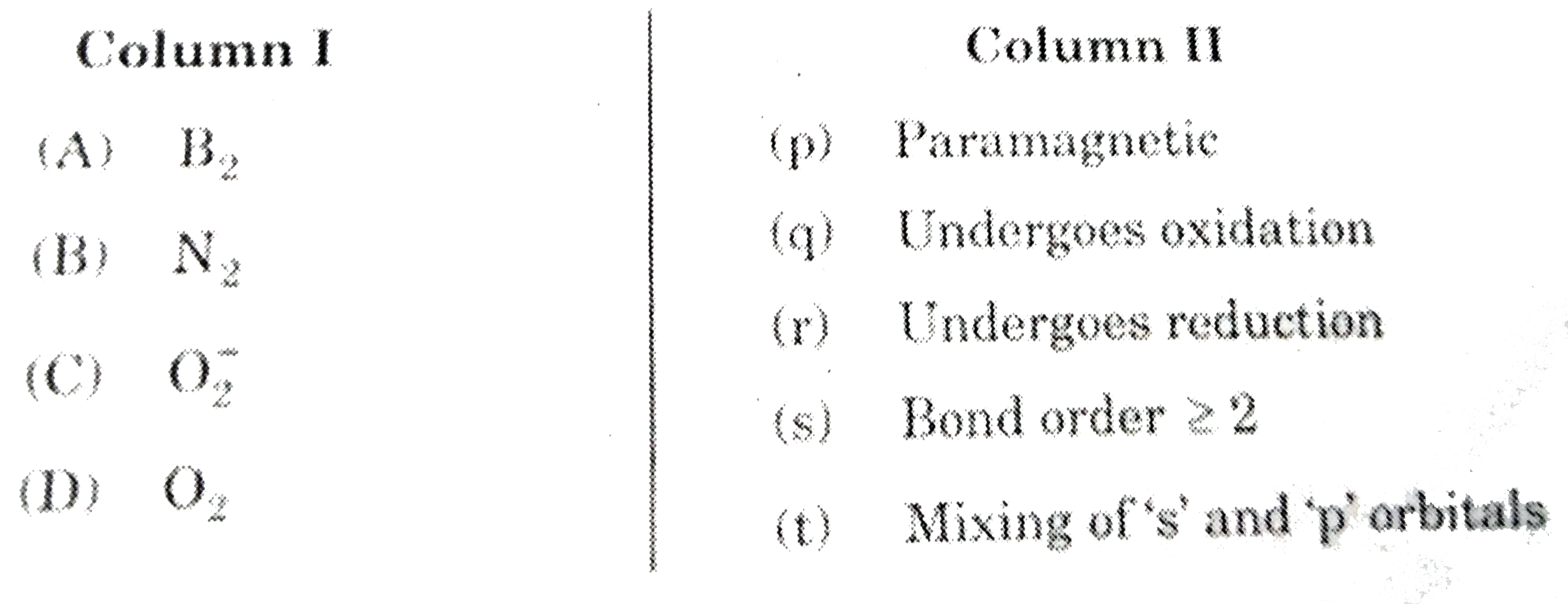
Match each of the diatomic molecules in Column I with its property/properties in Column II.

Text Solution

Verified by Experts

The correct Answer is:

`A to p, q, r, t; B to q, r, s, t; C to p, q, r; A to p, q, r, s`

(A) `B_(2) : sigma1s^(2)overset(***)sigma1s^(2)sigma2s^(2)overset(***)sigma2s^(2)|(pi2p_(y)^(1)),(pi2p_(z)^(1))|` paramagnetic. Bond order `=(6-4)/(2)=1`
Bond is formed by mixing of s and p orbitals. `B_(2)` undergoes both oxidation & reduction as
`B_(2)+O_(2) overset("Heat")to B_(2)O_(3)" (Oxidation) "B_(2)+H_(2) to B_(2)H_(6) ` (Reduction)
(B) `N_(2) : sigma1s^(2)overset(***)sigma1s^(2)sigma2s^(2)overset(***)sigma2s^(2)sigma2p_(x)^(2)|(pi2p_(y)^(2)),(pi2p_(z)^(2))|` diamagnetic. Bond order `=(10-4)/(2)=3 gt 2`
`N_(2)` undergoes both oxidation and reduction as
`N_(2)+O_(2) overset(Delta)to NO , N_(2) +3H_(2) overset("Catalyst") to NH_(3)`
In `N_(2)`, bonds are formed by mixing of s and p orbitals.
(C) `O_(2)^(-) : sigma1s^(2)overset(***)sigma1s^(2)sigma2s^(2)overset(***)sigma2s^(2)sigma2p_(x)^(2)|(pi2p_(y)^(2)),(pi2p_(z)^(2))||(overset(***)pi2p_(y)^(2)),(overset(***)pi2p_(z)^(1))|overset(***)sigma2p_(x)^(0)`
Paramagnetic with bond order `=1.5.O_(2)^(-)` undergoes both oxidation and reduction
(D) `O_(2) : sigma1s^(2)overset(***)sigma1s^(2)sigma2s^(2)overset(***)sigma2s^(2)sigma2p_(x)^(2)|(pi2p_(y)^(2)),(pi2p_(z)^(2))||(overset(***)pi2p_(y)^(1)),(overset(***)pi2p_(z)^(1))|overset(***)sigma2p_(x)^(0)`
Paramagnetic with bond order = 2. `O_(2)` undergoes reduction and oxidation
Promotional Banner

Topper's Solved these Questions

  • CHEMICAL BONDING-I & II

    VMC MODULES ENGLISH|Exercise JEE Main (Archive)|62 Videos
  • CHEMICAL BONDING & MOLECULAR STRUCTURE

    VMC MODULES ENGLISH|Exercise IN-CHAPTER EXERCISE-L|9 Videos
  • CHEMICAL EQUILIBRIUM

    VMC MODULES ENGLISH|Exercise IN-CHAPTER EXERCISE - G|10 Videos

Similar Questions

Explore conceptually related problems

Match the shape of molecules in Column I with the type of hybridisation in Column II.

Match the functions in Column I with the properties Column II.

Match the complexes in Column-I with their properties listed in Column-II

Match the following elements of column I with their property given in column II.

Match the property given in Column I with the element given in Column II.

Match the items in Column-I with its main use listed in Column-II :

Match the properties given in Column I with the metals given in Column II

Match the properties given in Column I with the metals given in Column II.

Match the thermodynamic property given in column I with its correct cxpression given in column II Select the correct answer:

Column I lists some properties of waves and Column II lists the factors on which they depend . Match the entries in Column I with those in Column II.

VMC MODULES ENGLISH-CHEMICAL BONDING-I & II-JEE Advanced (Archive)
  1. Draw the shape of XeF(4) and OSF(4) according to VSEPR theory Show the...

    Text Solution

    |

  2. According to MO theory .

    Text Solution

    |

  3. Predict whether the following molecules are isostructural or not Justi...

    Text Solution

    |

  4. Which species has the maximum number of lone pair of electrons on th...

    Text Solution

    |

  5. Among the following the paramagnetic compound is

    Text Solution

    |

  6. The species having bond order differnet from that in CO is .

    Text Solution

    |

  7. Match each of the diatomic molecules in Column I with its property/pro...

    Text Solution

    |

  8. Assuming that Hund’s rule is violated, the bond order and magnetic nat...

    Text Solution

    |

  9. Based on VSEPR theory the number of 90^(@) F -Br -F angles in a molecu...

    Text Solution

    |

  10. The species having pyramidal shape is

    Text Solution

    |

  11. Which one of the following molecules is expected to exhibit diamagneti...

    Text Solution

    |

  12. Assuming 2s-2p mixing is NOT operative, the paramagnetic species among...

    Text Solution

    |

  13. Hydrogen bonding plays a central role in the following phenomena .

    Text Solution

    |

  14. Match the orbital overlap figure in List I with the description given ...

    Text Solution

    |

  15. Among the triatomic molecules/ions, BeCI(2), N(3)^(Theta) ,N(2)O , ...

    Text Solution

    |

  16. The compound(s) with two lone pairs of electron on the central atom is...

    Text Solution

    |

  17. According to Molecular Orbital Theory,

    Text Solution

    |

  18. The sum of the number of lone pair of electrons on each central atom i...

    Text Solution

    |

  19. Among H(2), He(2)^(+), Li(2), Be(2), B(2), C(2), N(2), O(2)^(-) and F(...

    Text Solution

    |

  20. Each of the following options contains a set of four molecules. Identi...

    Text Solution

    |
