Home
Class 12
CHEMISTRY
Based on VSEPR theory the number of 90^(...

Based on `VSEPR` theory the number of `90^(@) F -Br -F` angles in a molecules of `BrF_(5)` is_____.

Text Solution

Verified by Experts

The correct Answer is:
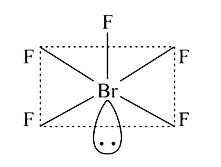
0


Lone pair would push the `Br–F` bond pairs in upward direction and all `Br^(-)F` bond angles will contract.
Promotional Banner

Topper's Solved these Questions

  • CHEMICAL BONDING-I & II

    VMC MODULES ENGLISH|Exercise JEE Main (Archive)|62 Videos
  • CHEMICAL BONDING & MOLECULAR STRUCTURE

    VMC MODULES ENGLISH|Exercise IN-CHAPTER EXERCISE-L|9 Videos
  • CHEMICAL EQUILIBRIUM

    VMC MODULES ENGLISH|Exercise IN-CHAPTER EXERCISE - G|10 Videos

Similar Questions

Explore conceptually related problems

BrF_3 is a liquid which considerably undergoes self ionization to form cationic and anionic species.Based on VSEPR theory, number of 90 degree F-Br-F bond angles is ……. In anionic species. 2BrF_3 hArr [BrF_2]^+ + [BrF_4]^(-)

ICI_3 is an orange colored solid that dimerizes in solid state as I_2Cl_6 Based on VSEPR theory , number of 90 degree Cl-l-Cl bond angles is …….. In the dimeric species.

Using VSEPR theory draw the shape of PCI_(5) and BrF_(5) ?.

Using VSEPR theory draw the shape of PCI_(5) and BrF_(5) ?.

Total number of F-l-F bond angles which are 90^(@) present in lF_(7) is

On the basis of VSEPR theory, predict the shapes of the following molecules : Hg Br_2

The bond order in F_2 molecule is :

On the basis of VSEPR theory predict the bond angles in the following molecules. BeCl_2 , PH_3 ,OF_2 ,BF_3 ,SiH_4

On the basis of VSEPR theory, prefict the shapes of the following molecules ions : (i)ClF_(3)" "(ii)BrF_(5)" "(iii)IF_(7)" "(iv)H_(3)O^(+)ion.

On the basis of VSEPR theory, predict the shapes of the following molecules : H_2 S

VMC MODULES ENGLISH-CHEMICAL BONDING-I & II-JEE Advanced (Archive)
  1. Draw the shape of XeF(4) and OSF(4) according to VSEPR theory Show the...

    Text Solution

    |

  2. According to MO theory .

    Text Solution

    |

  3. Predict whether the following molecules are isostructural or not Justi...

    Text Solution

    |

  4. Which species has the maximum number of lone pair of electrons on th...

    Text Solution

    |

  5. Among the following the paramagnetic compound is

    Text Solution

    |

  6. The species having bond order differnet from that in CO is .

    Text Solution

    |

  7. Match each of the diatomic molecules in Column I with its property/pro...

    Text Solution

    |

  8. Assuming that Hund’s rule is violated, the bond order and magnetic nat...

    Text Solution

    |

  9. Based on VSEPR theory the number of 90^(@) F -Br -F angles in a molecu...

    Text Solution

    |

  10. The species having pyramidal shape is

    Text Solution

    |

  11. Which one of the following molecules is expected to exhibit diamagneti...

    Text Solution

    |

  12. Assuming 2s-2p mixing is NOT operative, the paramagnetic species among...

    Text Solution

    |

  13. Hydrogen bonding plays a central role in the following phenomena .

    Text Solution

    |

  14. Match the orbital overlap figure in List I with the description given ...

    Text Solution

    |

  15. Among the triatomic molecules/ions, BeCI(2), N(3)^(Theta) ,N(2)O , ...

    Text Solution

    |

  16. The compound(s) with two lone pairs of electron on the central atom is...

    Text Solution

    |

  17. According to Molecular Orbital Theory,

    Text Solution

    |

  18. The sum of the number of lone pair of electrons on each central atom i...

    Text Solution

    |

  19. Among H(2), He(2)^(+), Li(2), Be(2), B(2), C(2), N(2), O(2)^(-) and F(...

    Text Solution

    |

  20. Each of the following options contains a set of four molecules. Identi...

    Text Solution

    |

