Home
Class 12
CHEMISTRY
Match the orbital overlap figure in List...

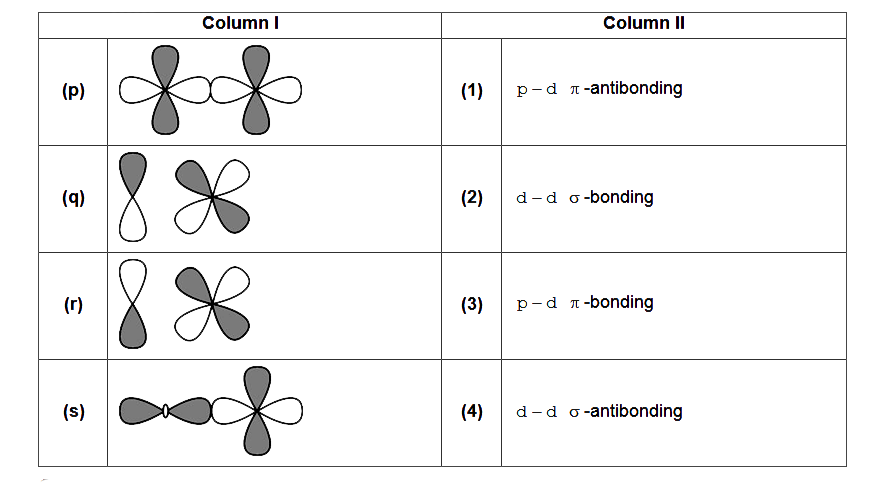
Match the orbital overlap figure in List I with the description given in List II and select the correct answer using the code given below the lists.

A

`{:(p,q,r,s),(2,1,3,4):}`

B

`{:(p,q,r,s),(4,3,1,2):}`

C

`{:(p,q,r,s),(2,3,1,4):}`

D

`{:(p,q,r,s),(4,1,3,2):}`

Text Solution

Verified by Experts

The correct Answer is:
C

This problem includes basic concept of bonding. It can be solved by using the concept of molecular orbital theory

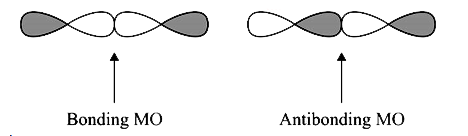
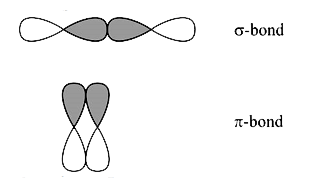
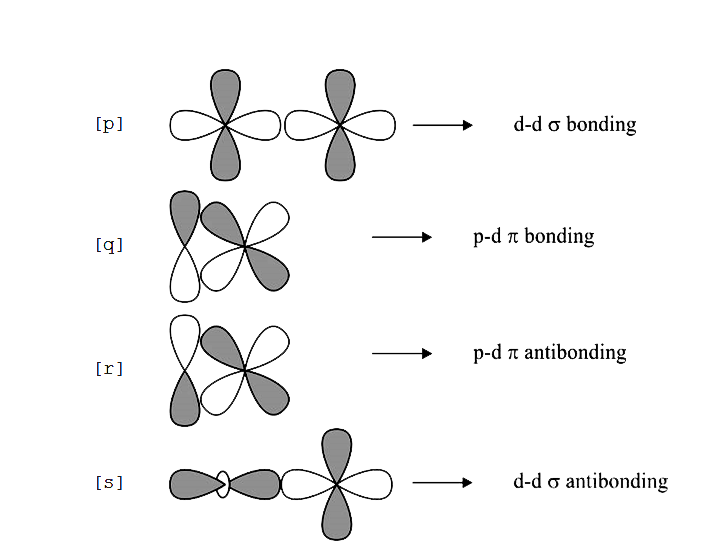
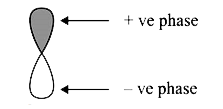
Any orbitals has two phase +ve and –ve. In the following diagram, +ve phase is shown by darkening the lobes and –ve by without darkening the lobes.

When two same phase overlap with each other, it forms bonding molecular orbital otherwise antibonding.

On the basis of above two concepts, correct matching can be done as shown below:

Hence, (C) is the correct option.
Promotional Banner

Topper's Solved these Questions

  • CHEMICAL BONDING-I & II

    VMC MODULES ENGLISH|Exercise JEE Main (Archive)|62 Videos
  • CHEMICAL BONDING & MOLECULAR STRUCTURE

    VMC MODULES ENGLISH|Exercise IN-CHAPTER EXERCISE-L|9 Videos
  • CHEMICAL EQUILIBRIUM

    VMC MODULES ENGLISH|Exercise IN-CHAPTER EXERCISE - G|10 Videos

Similar Questions

Explore conceptually related problems

Match list -I List-II and select the correct answer using the codes given below the lists

Match List I with List II and select the correct answer using the codes given below the lists

Match list I with list II and select the correct answer using the codes given below the list

Match List I with List II and select the correct answer using the codes given below the lists :

Match List I with List II and select the correct answer using codes given below the lists.

Match list I with list II and select the correct answer using the codes given below the lists.

Match list I with list II and select the correct answer using the codes given below the lists.

Match List I with List II and select the correct answer using the codes given below the lists:

Match list I with list II and select the correct answer using the codes given below the lists.

Match List I with List II and select the correct answer using the codes given below the lists:

VMC MODULES ENGLISH-CHEMICAL BONDING-I & II-JEE Advanced (Archive)
  1. Draw the shape of XeF(4) and OSF(4) according to VSEPR theory Show the...

    Text Solution

    |

  2. According to MO theory .

    Text Solution

    |

  3. Predict whether the following molecules are isostructural or not Justi...

    Text Solution

    |

  4. Which species has the maximum number of lone pair of electrons on th...

    Text Solution

    |

  5. Among the following the paramagnetic compound is

    Text Solution

    |

  6. The species having bond order differnet from that in CO is .

    Text Solution

    |

  7. Match each of the diatomic molecules in Column I with its property/pro...

    Text Solution

    |

  8. Assuming that Hund’s rule is violated, the bond order and magnetic nat...

    Text Solution

    |

  9. Based on VSEPR theory the number of 90^(@) F -Br -F angles in a molecu...

    Text Solution

    |

  10. The species having pyramidal shape is

    Text Solution

    |

  11. Which one of the following molecules is expected to exhibit diamagneti...

    Text Solution

    |

  12. Assuming 2s-2p mixing is NOT operative, the paramagnetic species among...

    Text Solution

    |

  13. Hydrogen bonding plays a central role in the following phenomena .

    Text Solution

    |

  14. Match the orbital overlap figure in List I with the description given ...

    Text Solution

    |

  15. Among the triatomic molecules/ions, BeCI(2), N(3)^(Theta) ,N(2)O , ...

    Text Solution

    |

  16. The compound(s) with two lone pairs of electron on the central atom is...

    Text Solution

    |

  17. According to Molecular Orbital Theory,

    Text Solution

    |

  18. The sum of the number of lone pair of electrons on each central atom i...

    Text Solution

    |

  19. Among H(2), He(2)^(+), Li(2), Be(2), B(2), C(2), N(2), O(2)^(-) and F(...

    Text Solution

    |

  20. Each of the following options contains a set of four molecules. Identi...

    Text Solution

    |