Home
Class 12
CHEMISTRY
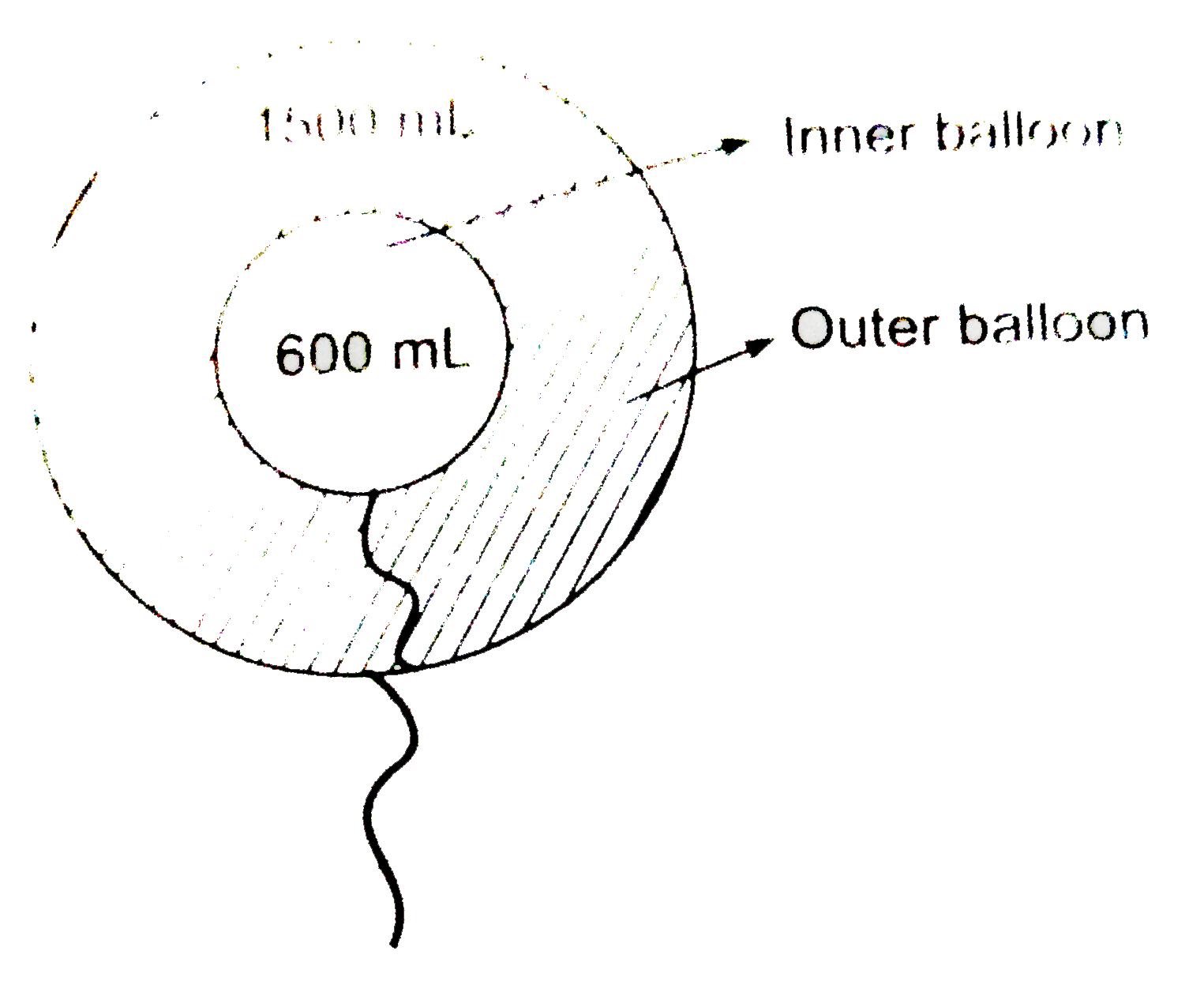
Two inflated ballons I and II (thin skin...

Two inflated ballons I and II (thin skin) having volume 600 mL and 1500 mL at 300 K are taken as shown in diagram. If maximum volume of inner and outer balloons are 800 mL and 1800 mL respectively then find the balloon which will burst first on gradual heating.

A

inner balloon

B

outer balloon

C

both simultaneously

D

unpredictable

Text Solution

Verified by Experts

The correct Answer is:

B

Case I – Suppose inner balloon bursts first `(600)/(300) = (800)/(T_(2)) rArr T_(2) = 400K`
Case II – Suppose outer balloon bursts first `(1500)/(300) = (1800)/(T_(2)), T_(2) = 360K`
Promotional Banner

Topper's Solved these Questions

  • STATES OF MATTER

    VMC MODULES ENGLISH|Exercise Level-2 (NUMBERICAL VALUE TYPE FOR JEE MAIN|15 Videos
  • STATES OF MATTER

    VMC MODULES ENGLISH|Exercise JEE-Main ( ARCHIVE )|17 Videos
  • STATES OF MATTER

    VMC MODULES ENGLISH|Exercise Level-1|75 Videos
  • STATES OF MATTER

    VMC MODULES ENGLISH|Exercise IMPECCABLE|50 Videos
  • STOICHIOMETRY - I

    VMC MODULES ENGLISH|Exercise JEE Advanced (Archive)|31 Videos

Similar Questions

Explore conceptually related problems

The molar volumes of KCl and NaCl are 40 mL and 30 mL , respectively. Find the ratio of the unit cube edges of the two crystals. Assume both have the same packing efficiency.

A balloon blown up has a volume of 500 mL at 5^@C . The balloon is distended to 7/8th of its maximum capacity. Will it burst at 30^@C ?

A bolloon blown up has a volume of 300 mL at 27% C. The balloon is distended to (5)/(6) of its maximum stretching capacity. The maximum temperature above which it will burst is

A balloon blown up has a volume of 500 mL at 5^@C . The balloon is distended to 7/8th of its maximum capacity. Calculate the minimum temperature above which it will burst.

A gaseous system is initially characterised by 500 mL volume and 1 atm pressure at 298 K. This system is allowed to do work as In isobaric conditions it expands to 800 mL resulting a decrease in pressure and temperature to 0.6 atm and 273 K respectively. (ii) In adiabatic conditions it is allowed to expand upto 800 mL and results a decrease in pressure and temperature to 0.6 atm and 273 K respectively. If Gibbs energy change in (i) is DeltaG_(a) and in (ii) is DeltaG_(b) , then what will be the ration of (DeltaG_(a))/(DeltaG_(b)) ? (a) 0 (B) 1 (C) between 0 -1 (D) more than 1

6 litre H_(2)O is placed in a closed evacuated room of volume 8.27 litre at the temperature 300K. The density of liquid water at 300 K is 1.0 gm/ml. the vapour pressure of water at 300 K is 22.8 mm Hg. Neglect the change in volume of liquid water by vaporization. {:("List I",,"List II"),("(P) Mass of watwer vapour formed (in gm)",,"(1) 6"),("(Q) Moles of water vapour fomed",,"(2) 18"),("(R) Approx. mass of liquid water left (in kg)",,"(3) 3"),("(S) Total moles of atoms in vapour form",,"(4) 1"):}

A solid insulating sphere of radius a carries a net positive charge 3Q , uniformly distributed throughout its volume. Concentric with this sphere is a conducting spherical shell with inner radius b and outer radius c and having a net charge -Q, as shown in figure a. Consider a spherical Gaussian surface of radius rgtc, the net charge enclosed by this surface is ............. b. The direction of the electric field rgtc is ............. c. The electric field at rgtc is ............... . d. The electric field in the region with radius r, which cgtrgtb, is ............... e. Consider a spherical Gaussian surface of radius r, where cgtrgtb , the net charge enclosed by this surface is ................ . f. Consider a spherical Gaussian surface of radius r, where bgtrgta , the net charge enclosed by this surface is ................. . g. The electric field in the region bgtrgta is ................ . h. Consider a spherical Gaussian surface of radius rlta . Find an expression for the net charge Q(r) enclosed by this surface as a function of r. Note that the charge inside the surface is less than 3Q. i. The electric field in the region rlta is ................. . j. The charge on the inner surface of the conducting shell is .......... . k. The charge on the outer surface of the conducting shell is .............. . l. Make a plot of the magnitude of the electric field versus r.

A flask of 1L having NH_(3)(g) at 2.0atm and 200K is connected with the another flask of volume 800 mL having HCI(g) at 8atm and 200K through a narrow tube of negligible volume. The two gases react to form NH_(4)(CI(s) with evolution of 43kJ mol^(-1) heat. if heat capacity of HCI(g) at constant volume is 20 JK^(-1) mol^(-1) and neglecting heat capacity of flask, NH_(4)CI , and volume of solid NH_(4)CI formed, calculated in the flasks, produced, final temperature, and final pressure in the flasks. (Assume R = 0.08 L atm K^(-1) mol^(-1))

Consider the following statements each with two blanks. (i) Actually, only about overset((1))"_____" mL of air enters the lungs alveoli for the exchange of gases. The remaining fills the respiratory passage and is termed overset((2))"_____" . (ii) The amount of air which one can inhale with maximum effort and also exhale with maximum effort is termed as overset((3))"_____" . It is about overset((4))"_____" in normal adult person. (iii) During normal quiet breathing, on an average, approximately overset((5))"_____" mL of air is inspired or expired by adult human male in each breath. It is termed as overset((6))"_____" volume. Which of the following options gives the correct fill ups for the respective blanks numbers from (1) to (6) in the above statement ?

A reversible heat engine carries 1 mol of an ideal monatomic gas around the cycle ABCA , as shown in the diagram. The process BC is adiabatic. Call the processes AB, BC and CA as 1,2 and 3 and the heat ( DeltaQ)_(r) , change in internal energy (DeltaU) , and work done ( DeltaW)_(r), r=1,2,3 respectively. The temperature at A,B,C are T_(1)=300K,T_(2)=600K and T_(3)=455K . Indicate the pressure and volume at A,B and C by P_(r) and V_(r), r=1,2,3, respectively. Assume that intially pressure P_(1)=1.00atm. Which of the following represents the correct values of the quantities indicated ?

VMC MODULES ENGLISH-STATES OF MATTER-Level-2
  1. At point P and Q, the real gas deviation with respect to ideal gas is ...

    Text Solution

    |

  2. At what temperature will the molar kinetic energy of 0.3 mol of He be ...

    Text Solution

    |

  3. Two inflated ballons I and II (thin skin) having volume 600 mL and 150...

    Text Solution

    |

  4. The volume of a gas increases by a factor of 2 while the pressure dec...

    Text Solution

    |

  5. Oxygen gas generated by the decomposition of potassium chorate is coll...

    Text Solution

    |

  6. A real gas most closely approaches the behaviour of an ideal gas at:

    Text Solution

    |

  7. Which of the following statement is(are) correct?

    Text Solution

    |

  8. Which of the following statements is(are) correct for a gas X having m...

    Text Solution

    |

  9. At 47^(@)C and 16.0 atm, the molar volume of NH3 gas is about 10% less...

    Text Solution

    |

  10. A gaseous mixture (He and CH(4)) which has density (64)/(246.3) gm/lit...

    Text Solution

    |

  11. The graph of P vs V is given at different temperature The correct...

    Text Solution

    |

  12. Sketch shows the plot of Z vs P for 1 mol of a hypothetical gas at thr...

    Text Solution

    |

  13. Sketch shows the plot of Z vs P for 1 mol of a hypothetical gas at thr...

    Text Solution

    |

  14. Sketch shows the plot of Z vs P for 1 mol of a hypothetical gas at thr...

    Text Solution

    |

  15. Compressibility factor for H(2) behaving as real gas is

    Text Solution

    |

  16. A real gas obeying van der Waals equation will resemble ideal gas , if...

    Text Solution

    |

  17. If temperature and volume are same, the pressure of a gas obeying van ...

    Text Solution

    |

  18. The critical pressure P(C) and critical temperature T(C) for a gas obe...

    Text Solution

    |

  19. For non-zero value of force of attraction between gas molecular at lar...

    Text Solution

    |

  20. At Boyle's temperature the value of compressibility factro Z = (PV(m(/...

    Text Solution

    |
