Home
Class 12
CHEMISTRY
The electrophile, E^(+) attacks the benz...

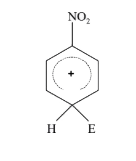
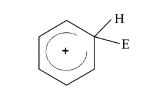
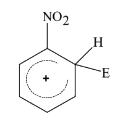
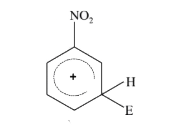
The electrophile, `E^(+)` attacks the benzene ring to generate the intermediate `sigma`-complex. Which `sigma`-complex is of lowest energy?

A

B

C

D

Text Solution

Verified by Experts

Promotional Banner

Topper's Solved these Questions

  • HYDROCARBONS

    VMC MODULES ENGLISH|Exercise JEE Main Archive|46 Videos
  • HALOALKANES AND HALOARENES

    VMC MODULES ENGLISH|Exercise IN-CHAPTER EXERCISE - F|6 Videos
  • ICONIC EQUILIBRIUM

    VMC MODULES ENGLISH|Exercise IMPECCABLE|50 Videos

Similar Questions

Explore conceptually related problems

Those groups which activate the benzene ring are generally

Which compound has least e^(-) density in benzene ring

The general electrophilic substitution reaction (replacement of H. by an electrophilic which is an electron deficient species) in aromatic ring is represented as followed. An electrophilic attacks on ortho and para positions which respect to a stronger +m group are present in benzene ring and the electrophilie attacks at meta position with respect to stronger -m group if two -m groups are present in benzene ring. What will be the product when electrophile Br^(o+) attacks on

Benzene ring contains ____ localised sigma - and ____localised pi -bonds.

The general electrophilic substitution reaction (replacement of H. by an electrophilic which is an electron deficient species) in aromatic ring is represented as followed. An electrophilic attacks on ortho and para positions which respect to a stronger +m group are present in benzene ring and the electrophilie attacks at meta position with respect to stronger -m group if two -m groups are present in benzene ring. The product of the following reaction is

Among sigma_(2s) and simga_(2s)^(*) molecular orbitals, which one is of lower energy?

In which of the following complexes the metal ion has the lowest ionic radius ?

Nitration is an example of aromatic electrophilic substitution and its rate depends upon the group already present in the benzene ring. Out of benzene and phenol, which one is more easily nitrated and why ?

Regarding brown ring complex formation, Which of the following statement is wrong ?

Which of the following statements is/are correct ? (i) In octahedral complexes , t_(2 g) orbitals possess low energy as compared to e_(g) orbitals . (ii) In tetrahedral complexes , t_(2 ) orbitals possess high energy as compared to e orbitals . (iii) In octahedral complexes , e_(g) orbitals possess low energy as compared to t_(2 g) orbitals .

VMC MODULES ENGLISH-HYDROCARBONS-JEE Advanced Archive
  1. The compound formed as a result of oxidation of ethyl benzene by KMnO(...

    Text Solution

    |

  2. In the following sequence of reactions, the alkene affords the compoun...

    Text Solution

    |

  3. The electrophile, E^(+) attacks the benzene ring to generate the inter...

    Text Solution

    |

  4. The treatment of CH3MgX with CH3C-=C-H produces

    Text Solution

    |

  5. The synthesis of 3-octyne is achieved by adding a bromoalkane into a m...

    Text Solution

    |

  6. The total number of cyclic isomers possible for a hydrocarbon with the...

    Text Solution

    |

  7. One mole of a symmetrical alkene on ozonolysis gives two moles of an a...

    Text Solution

    |

  8. The maximum number of isomers (including stereoisomers) that are possi...

    Text Solution

    |

  9. Ozonolysis of an organic compound gives formaldehyde as one of product...

    Text Solution

    |

  10. Which branched chain isomer of the hydrocarbon with molecular mass 72u...

    Text Solution

    |

  11. The number of optically active products obtained from the complete ozo...

    Text Solution

    |

  12. Isomers of hexane, based on their branching, can be divided into three...

    Text Solution

    |

  13. The major organic compound formed by the reaction of 1, 1, 1– trichlor...

    Text Solution

    |

  14. The reactivity of compound Z with different halogens under appropriate...

    Text Solution

    |

  15. Compound (S) that on hydrogenation product (S) optically inactive comp...

    Text Solution

    |

  16. In the following reaction, the major product is :

    Text Solution

    |

  17. What is the major product expected from the following reaction ? Where...

    Text Solution

    |

  18. product of above reaction is :

    Text Solution

    |

  19. Among the following reactions (s), which gives (give) tert-butyl benze...

    Text Solution

    |

  20. The reaction of propene with HOCI (CI(2)+H(2)O) proceeds through the i...

    Text Solution

    |
