Home
Class 12
PHYSICS
For the circuit shown, with R(1)=1.0Omeg...

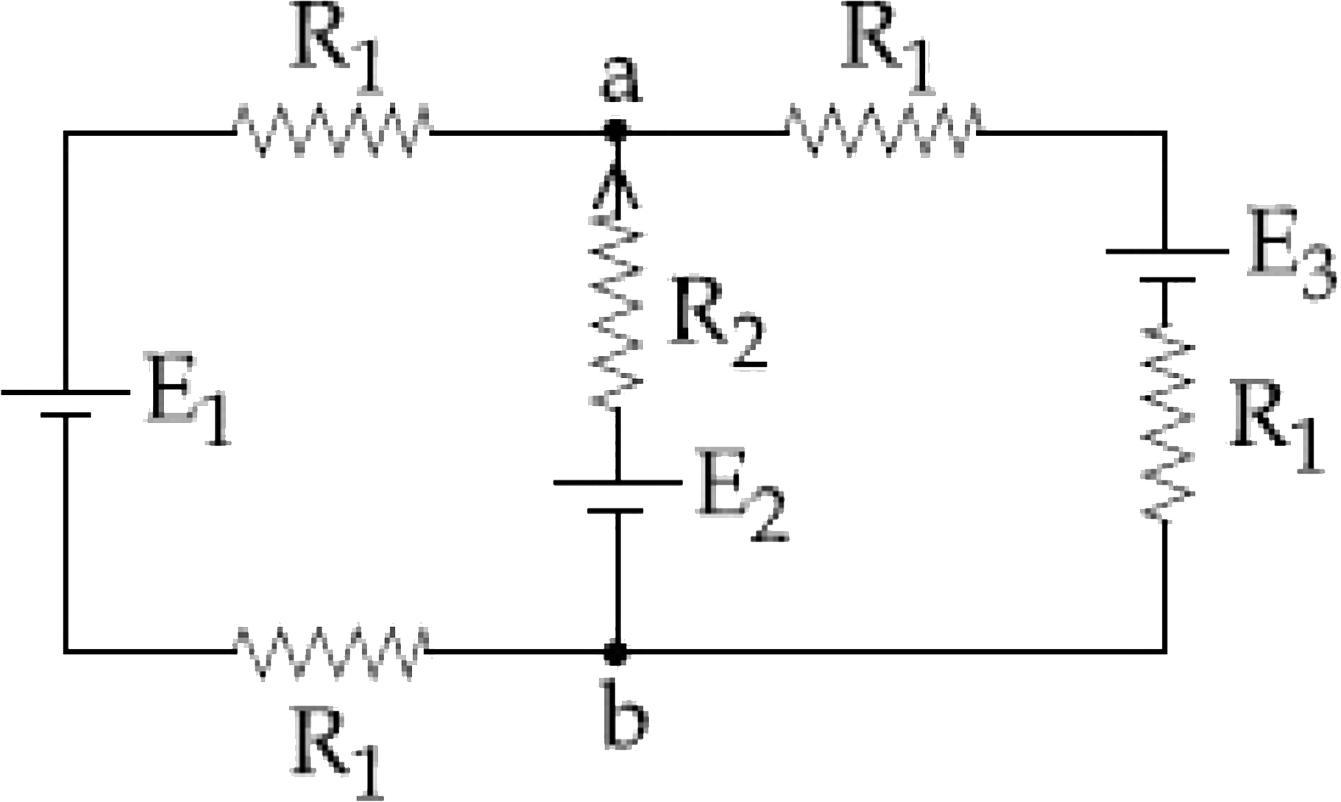
For the circuit shown, with `R_(1)=1.0Omega,R_(2)=2.0Omega,E_(1)=2V` and `E_(2)=E_(3)=4V`, the potential difference between the points `'a'` and `'b'` is approximately (in `V`):

A

3.7

B

2.7

C

3.3

D

2.3

Text Solution

Verified by Experts

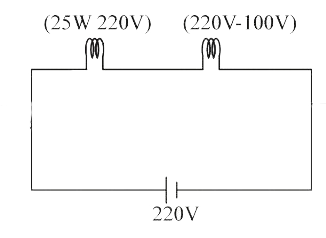
`R_1=V^2/P=(220)^2/25=1936 Omega`
`R_2=(220)^2/100=484 Omega`
`i=220/(1936+484)=220/2420=1/11 Amp`
`P_1=i^2 R_1=1/121 times 1936=16w`
`P_2=i^2 times P_2=1/121 times 484=4W`
Promotional Banner

Topper's Solved these Questions

  • DC CIRCUIT

    VMC MODULES ENGLISH|Exercise JEE ADVANCED ARCHIVE|68 Videos
  • DC CIRCUIT

    VMC MODULES ENGLISH|Exercise LEVEL-2 DAILY TUTORIAL SHEET-5|10 Videos
  • CURRENT ELECTRICITY

    VMC MODULES ENGLISH|Exercise IN-CHAPTER EXERCISE-F|10 Videos
  • DYNAMICS OF A PARTICLE

    VMC MODULES ENGLISH|Exercise JEE Advance (Archive) Level - II (SINGLE OPTION CORRECT TYPE )|31 Videos

Similar Questions

Explore conceptually related problems

In the given network of ideal cells and resistors, R_(1) = 1.0 Omega, R_(2) = 2.0 Omega, E_(1) = 2V and E_(2) = E_(3) = 4V . The potential difference between the point a and b is

In the circuit shown in fig. E_(1)=3V, E_(2)= 2V, E_(3)= 1V, R=r_(1)=r_(2)=r_(3)= 1 ohm . Find the potential difference between the points A and B and the currents through each branch.

Potential difference between points A and B (i.e. V_(A) - V_(B) ) is -----

In the circuit shown in figure , (epsilon)_(1)=3V,(epsilon)_(2)=2V,(epsilon)_(3)=1V and r_(1)=r_(2)=r_(3)=1(Omega) .Find the potential difference between the points A and B and the current through each branch.

In the circuit shown in fig. E_(1)=3" volt",E_(2)=2" volt",E_(3)=1" vole and "R=r_(1)=r_(2)=r_(3)=1 ohm. (i) Find potential difference in Volt between the points A and B with A & B unconnected. (ii) If r_(2) is short circuited and the point A is coneted to point B through a zero resistance wire, find the current through R in ampere.

In the circuit in figure E_1=3V, E_2=2V, E_3=1V and R=r_1=r_2=r_3=1Omega Find the potential differece between the points A and B and the currents through each branch.

In the circuit shown here, E_(1) = E_(2) = E_(3) = 2 V and R_(1) = R_(2) = 4 ohms . The current flowing between point A and B through battery E_(2) is

In the given circuit, R_(1) = 10Omega R_(2) = 6Omega and E = 10V, then correct statement is

In the circuit shown below E_(1) = 4.0 V, R_(1) = 2 Omega, E_(2) = 6.0 V, R_(2) = 4 Omega and R_(3) = 2 Omega . The current I_(1) is

In the circuit shown in figure E_1=10 V, E_2=4V, r_1=r_2=1Omega and R=2Omega . Find the potential difference across battery 1 and battery 2.

VMC MODULES ENGLISH-DC CIRCUIT-LEVEL-1 JEE MAIN ARCHIVE
  1. The galvanometer deflection , when key K(1) is closed but K(2) is o...

    Text Solution

    |

  2. In a meter bridge, the wire of length 1 m has a non- uniform cross...

    Text Solution

    |

  3. For the circuit shown, with R(1)=1.0Omega,R(2)=2.0Omega,E(1)=2V and E(...

    Text Solution

    |

  4. Two electric bulbs , rated at (25W,220V) and (100W,220V), are conne...

    Text Solution

    |

  5. A 200Omega resistor has a certain color code. If one replaces the red ...

    Text Solution

    |

  6. A cell of internal resistance r drivers current through an external r...

    Text Solution

    |

  7. In the circuit shown, a four-wire potentiometer is made of a 400 cm lo...

    Text Solution

    |

  8. In the figure shown, what is the current (in Ampere) drawn from the ba...

    Text Solution

    |

  9. A moving coil galvanometer has resistance 50 Omega and it indicates fu...

    Text Solution

    |

  10. A write of resistance R is bent to form a square ABCD as shown in the ...

    Text Solution

    |

  11. If in a conductor number density of electrons is 8.5xx10^(28) average ...

    Text Solution

    |

  12. A uniform wire of resistance =3Omega and length l is stretched to doub...

    Text Solution

    |

  13. The resistance of a galvanometer is 50 ohm and the maximum current whi...

    Text Solution

    |

  14. Space between tow concentric spheres of radii r(1) and r(2) such that ...

    Text Solution

    |

  15. In an experiment, the resistance of a material is plotted as a functio...

    Text Solution

    |

  16. A current of 5 A of passes through a copper conductor (resistivity =1....

    Text Solution

    |

  17. A moving coil galvanometer allows a full scale current of 10^(-4) A. A...

    Text Solution

    |

  18. In the given circuit, an ideal voltmeter connected across the 10 Omega...

    Text Solution

    |

  19. In a meter bridge experiment, the circuit diagram and the correspondin...

    Text Solution

    |

  20. A moving coil galvanometer, having a resistance G, produces full scale...

    Text Solution

    |