Home
Class 12
PHYSICS
A frame of reference that is accelerated...

A frame of reference that is accelerated with respect to an inertial frame of reference is called a non-inertial frame of reference. A coordinate system fixed on a circular disc rotating about a fixed axis with a constant angular velocity `omega` is an example of non=inertial frame of reference. The relationship between the force `vecF_(rot)` experienced by a particle of mass m moving on the rotating disc and the force `vecF_(in)` experienced by the particle in an inertial frame of reference is
`vecF_(rot)=vecF_(i n)+2m(vecv_(rot)xxvec omega)+m(vec omegaxx vec r)xxvec omega`.
where `vecv_(rot)` is the velocity of the particle in the rotating frame of reference and `vecr` is the position vector of the particle with respect to the centre of the disc.
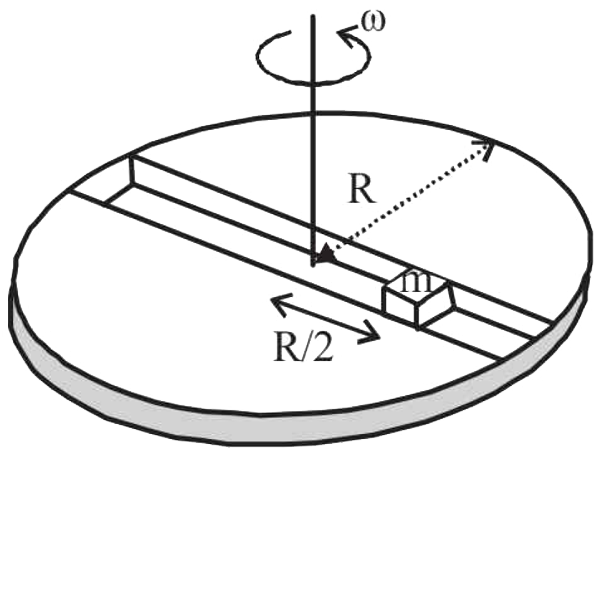
Now consider a smooth slot along a diameter fo a disc of radius R rotating counter-clockwise with a constant angular speed `omega` about its vertical axis through its center. We assign a coordinate system with the origin at the center of the disc, the x-axis along the slot, the y-axis perpendicular to the slot and the z-axis along the rotation axis `(vecomega=omegahatk)`. A small block of mass m is gently placed in the slot at `vecr(R//2)hati` at `t=0` and is constrained to move only along the slot.

The distance r of the block at time is

A

`R/2 cos 2 omegat`

B

`R/2 cos omega t`

C

`R/4(e^(omega t) + e^(-omega t))`

D

`R/4(e^(2omegat) + e^(-2 omegat))`

Text Solution

Verified by Experts

The correct Answer is:

C

In the expression `vecF_(ext) = vecF_(in) + 2m(V_(rxt) xx vecomega) + m(vecomega xx vecr) xx vecomega`
The third term is radially outward i.e., this goes towards increasing `vecV_(rxt)`.
2nd term is perpendicular to edge of slot and is cancelled of Normal reaction from edge of slot.
So, for radial direction.
`F= m omega^(2)r, (md^(2)r)(dt^(2)) = momega^(2)r`
i.e., `(d^(2)r)/(dt^(2)) = omega^(2)r`
Solution to this differential equation is `r=Ae^(omegat) + Be^(-omegat)`
Where A and B are constants.
* for detailed solution of above differential equation see the end of this solution:
At `t=0, r=R/2, R/2 = A+B`
Also, `V_(rxt) = (dr)/(dt) = A omegae^(omegat) - Bomegae^(-omegat)`
At t=0, `V_(rxt)=0`, so,
`0=(A-B)omega, therefore A=B-R/4`
So, `r=R/4(e^(omegat) + e^(-omegat))`
So, `r=R/4[e^(omegat) + e^(-omegat))]`
Hence (C) + Detailed solution of differential equation
`rArr a=omega^(2)r = v(dv)/(dr) rArr int_(0)^(v) v dv = omega^(2)int_(R//2)^(F) rdr`
`rArr v^(2)/2 = omega^(2)[r^(2)/2 -R^(2)/8] rArr v =omega sqrt(r^(2) -R^(2)/4) = (dr)/(dt)`
`rArr ln [(r+sqrt(x^(2) -R^(2)//4))/(R//2)]=omegat rArr r+sqrt(r^(2)-R^(2)//4) = R/2 e^(omega t)`
`rArr r^(2) -R^(2)/4 =[R/2 e^(omegat) -R]^(2) rArr r^(2)-R^(2)/4 =[R/2 e^(omegat+r^(2))-R.re^(omegat)]`
`rArr rR e^(omegat)=Ro^(2)/4 [1+e^(2omegat)] rArr r=R/4 [e^(omegat) + e^(-omegat)]`
Promotional Banner

Topper's Solved these Questions

  • ROTATIONAL MOTION

    VMC MODULES ENGLISH|Exercise JEE Advanced (Archive) (ASSERTION & REASON TYPE)|2 Videos
  • ROTATIONAL MOTION

    VMC MODULES ENGLISH|Exercise JEE Advanced (Archive) (MATRIX MATCH TYPE)|1 Videos
  • ROTATIONAL MOTION

    VMC MODULES ENGLISH|Exercise JEE Advanced (Archive) (MULTIPLE OPTIONS CORRECT TYPE)|17 Videos
  • REVISION TEST-2 JEE

    VMC MODULES ENGLISH|Exercise PHYSICS|25 Videos
  • SIMPLE HARMONIC MOTION

    VMC MODULES ENGLISH|Exercise 7-previous year question|46 Videos
