Home
Class 12
PHYSICS
An infinite cylinder of radius r(o), car...

An infinite cylinder of radius `r_(o),` carrying linear charge density `lamda.` The equation of the equipotential surface for the cylinder is

Text Solution

Verified by Experts
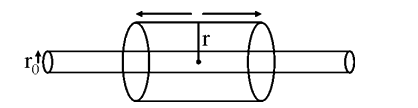
There is an infinite cylinder of radius `r_0` and having linear charge density `lamda` . Assume a Gaussian surface of radius r and length l. According of Gauss’s theorem,
`int E.ds=q/e_0`
`int E.ds =(lamda 1)/e_0 (because q=lamda 1)` (`because` Angle between E and ds is zero.)
`E int dS=E.2 pi rl= (lamda l)/e_0` [ where `(2pirl)` is area of the curved surface of the cylinder]
`E=lamda/(2pie_0r)`..........(i)
If the radius is `r_0`, to find the potential difference at distance r from the line, consider the electric field. According to the formula of potential gradient,
`V_(r)-V_(r_0)=int_(r_0)^r lamda/(2pie_0r).dr` (angle between E and dr to zero)
`=- lamda/(2pi e_0) int_(r_0)^r (dr)/r=-lamda/(2pie_0).[log_e r]_(r_0)^r=(-lamda)/(2pie_0)[log_e r-log_e r_0]=lamda/(2pi e_0).[ log_e r_0-log_e r]=lamda/(2pie_0).log r_0/r`
`log_e r_0/r=(2pir_0)/lamda[V_(r)-V_(r_0)], log_e r/r_0=-(2pie_0)/lamda[V_(r)-V_(r_0)]`
`r/r_=e^((pie_)/lamda) [V_(r)-V_(r_0)], r=r_0e^((2pie_0)/lamda) [V_(r)-V_(r_0)]`
This is the equation of required equipotential surfaces.
Promotional Banner

Topper's Solved these Questions

  • ELECTROSTATICS

    VMC MODULES ENGLISH|Exercise LEVEL - 0 (LONG ANSWER TYPE )|8 Videos
  • ELECTROSTATICS

    VMC MODULES ENGLISH|Exercise LEVEL - 1|105 Videos
  • ELECTROSTATICS

    VMC MODULES ENGLISH|Exercise JEE Advanced (Archive)|89 Videos
  • ELECTROMAGNETIC INDUCTION & ALTERNATIVE CURRENT

    VMC MODULES ENGLISH|Exercise IMPECCABLE|52 Videos
  • ENERGY & MOMENTUM

    VMC MODULES ENGLISH|Exercise JEE ADVANCE (ARCHIVE) - TRUE/FALSE TYPE|1 Videos

Similar Questions

Explore conceptually related problems

An infinite sheet of charge has surface charge density sigma . The separation between two equipotential surfaces, whose potential differ by V is:

An infinite sheet of charge has a surfaces charge density of 10^-7C/m^2 . The separation between two equipotential surfce whose potentials differ by 5 V is

Find the electric field due to an infinitely long cylindrical charge distribution of radius R and having linear charge density lambda at a distance half of the radius from its axis.

An infinite nonconducting sheet of charge has a surface charge density of 10^(7) C//m^(2) . The separation between two equipotential surfaces near the whose potential differ by 5V is

Find the moment of inertia of a solid cylinder of mass M and radius R about a line parallel to the axis of the cylinder and on the surface of the cylinder.

A coaxial cylinder made of glass is immersed in a-liquid of surface tension S. The radius of the inner and outer surface of the cylinder are R_1 and R_2 respectively . Height till which liquid will rise is (Density of liquid is rho )

A charge particle q is released at a distance R_(@) from the infinite long wire of linear charge density lambda . Then velocity will be proportional to (At distance R from the wire)

Consider an infinite line charge having uniform linear charge density and passing through the axis of a cylinder is removed.

A very long uniformly charged cylinder (radius R) has a surface charge density sigma . A very long uniformaly charged line charge( linear charge density lambda ) is placed along the ctlinder axis. If electric field intensity vector outside the cylinder is zerom then :

A solid non-conduction cylinder of radius R is charge such that volume charge density is proporation to r where r is distance from axis. The electric field E at a distance r(r lt R) well depend on r as.

VMC MODULES ENGLISH-ELECTROSTATICS-LEVEL - 0 (SHORT ANSWER TYPE )
  1. A point charge Q is placed at the point O as shown in Fig. Is the po...

    Text Solution

    |

  2. A small sphere of radius r(1) and charge q(1) is enclosed by a spheric...

    Text Solution

    |

  3. A hollow charged conductor has a tiny hole cut into its surface. Show ...

    Text Solution

    |

  4. A polythene piece rubbed with wool is found to have a negative charge ...

    Text Solution

    |

  5. Careful measurement of the electric field at the surface of a black bo...

    Text Solution

    |

  6. Careful measurement of the electric field at the surface of a black bo...

    Text Solution

    |

  7. An infinite cylinder of radius r(o), carrying linear charge density la...

    Text Solution

    |

  8. Two metal spheres, one of radius R and the other of radius 2R, both ha...

    Text Solution

    |

  9. A long charged cylinder of linear charge density lambda is surrounde...

    Text Solution

    |

  10. Consider a uniform electric field E = 3xx10^(3) hat(i) N//C. (a) What...

    Text Solution

    |

  11. Consider vec(E)=3xx10^(3) hat(i) (N//C) then what is the flux through ...

    Text Solution

    |

  12. State Gauss’s law in electrostatics. A cube with each side a is kept i...

    Text Solution

    |

  13. Two large, thin metal plates are parallel and close to each other. On ...

    Text Solution

    |

  14. Two large, thin metal plates are parallel and close to each other. On ...

    Text Solution

    |

  15. Two large, thin metal plates are parallel and close to each other. On ...

    Text Solution

    |

  16. Two charges -q each are fixed separated by distance 2d. A third charge...

    Text Solution

    |

  17. Describe schematically the equipotential surfaces corresponding to (...

    Text Solution

    |

  18. Draw 3 equipotential surfaces corresponding to a field that uniformly ...

    Text Solution

    |

  19. Describe schematically the equipotential surfaces corresponding to ...

    Text Solution

    |

  20. Geeta has dry hair. A comb ran through her dry hair attracts small bit...

    Text Solution

    |

