Home
Class 12
PHYSICS
Two charges -q each are fixed separated ...

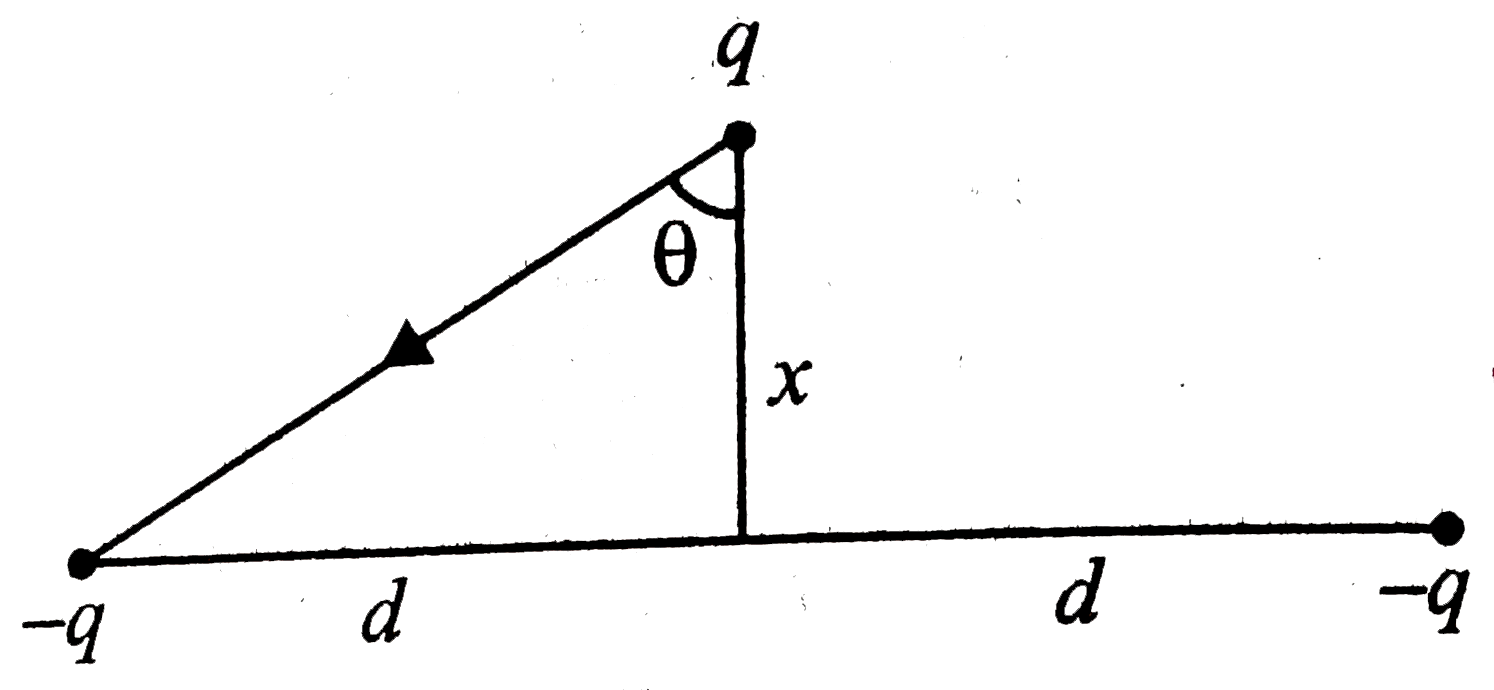
Two charges `-q` each are fixed separated by distance 2d. A third charge q of mass m placed at the mid-point is displaced slightly by `x (xltltd)` perpendicular to the line joining the two fixed charges as shown in Fig. Show that q will perform simple harmonic oscillation of time period.
`T = [(8pi^(3) in_(0) md^(3))/(q^(2))]^(1//2)`

Text Solution

Verified by Experts

`F_1=1/(4pie_0). Q^2/(d^2+x^2)^2` [along C to A]…..(i) and `F_2=1/(4pi e_0). (qq)/(BC)^2=1/(4 pi e_0).q/(d^2+x^2)`………(ii)
Now, resolve the component of .`F_1 and F_2`
SO net force on q is `F=F_1 cos theta+F_2 cos theta` ,
`F=2 F_1 cos theta=2,1/(4 pi e_0).q^2/((d^2+x^2)) . cos theta[ because F_1=F_2]`
In `Detla ACO, cos theta=x/sqrt(d^2+x^2), F=1/(4pi e_0)=.(2q^2)/(d^2+x^2)^(3//2)`
This force is attractive in nature, so `=1/(4pie_0).(2q^2.x)/(d^2+x^2)^(3//2)`
According to question `x lt lt d`, so neglect `x^2` as compared to `d^2`
`F=-1/(4pi e_0).(2q^2)/d^3.x`............(iii) Here `F prop -x or F=- omega^2x`........(iv)
So, the motion is simple harmonic, where `omega` is the angular frequency. By comparing Equations (iii) and (iv), we get :
`omega=sqrt((2q^2)/(4pi e_0 d^3m)) or omega =(2pi)/T`
Where, T is the time period of SHM of the charged particle of mass m. `T=((8pi r^3 e_0 m d^3)/q^2)`
Promotional Banner

Topper's Solved these Questions

  • ELECTROSTATICS

    VMC MODULES ENGLISH|Exercise LEVEL - 0 (LONG ANSWER TYPE )|8 Videos
  • ELECTROSTATICS

    VMC MODULES ENGLISH|Exercise LEVEL - 1|105 Videos
  • ELECTROSTATICS

    VMC MODULES ENGLISH|Exercise JEE Advanced (Archive)|89 Videos
  • ELECTROMAGNETIC INDUCTION & ALTERNATIVE CURRENT

    VMC MODULES ENGLISH|Exercise IMPECCABLE|52 Videos
  • ENERGY & MOMENTUM

    VMC MODULES ENGLISH|Exercise JEE ADVANCE (ARCHIVE) - TRUE/FALSE TYPE|1 Videos

Similar Questions

Explore conceptually related problems

Two equal charges q are placed at a distance of 2a and a third charge -2q is placed at the midpoint. The potential energy of the system is

Two charges q and -3q are placed fixed on x-axis separated by distance d . Where should a third charge 2q be placed such that it will not experience any force ?

Two charges q and -3q are placed fixed on x-axis separated by distance d. where should a third charge 2q be placed such that it will not experience any force?

Two charges -q each are separated by distance 2d . A third charge +q is kept at mid-point O. Find potential energy of +q as a function of small distance x from O due to -q charges. Prove that the charge at O is in an unstable equilibrium.

Two point charges q each are fixed at (a,0) and (-a,0). A third charge Q is placed at origin. Electrons potential energy of the system will

Two point charges +q and -q are placed a distance x apart. A third charge is so placed that at the three charges are in equilibrium. Then

Two point charges q and -q are separated by a distance 2l . Find the flux strength vector across the circle of radius R placed with its centre coinciding with the of line joining the two charges in the perpendicular plane.

Two infinitely long line charges having charge density lamda each are parallel to each other and separated by distance d. A charge particle of mass m and charge q is placed at mid point between them. This charge displaced slightly along a line AB which is perpendicular to the line charges and in the plane of the charges. prove that the motion of the particle will be SHM for small displacement and lamda q gt 0 Neglect gravity. Find the time period.

A charge Q is placed at the centre of the line joining two point charges +q and +q as shown in figure. The ratio of charges Q and q is

Two points charges +4q and +q are separated by distance r, where should a third point charge Q be placed that the whole system remains in equilibrium

VMC MODULES ENGLISH-ELECTROSTATICS-LEVEL - 0 (SHORT ANSWER TYPE )
  1. A point charge Q is placed at the point O as shown in Fig. Is the po...

    Text Solution

    |

  2. A small sphere of radius r(1) and charge q(1) is enclosed by a spheric...

    Text Solution

    |

  3. A hollow charged conductor has a tiny hole cut into its surface. Show ...

    Text Solution

    |

  4. A polythene piece rubbed with wool is found to have a negative charge ...

    Text Solution

    |

  5. Careful measurement of the electric field at the surface of a black bo...

    Text Solution

    |

  6. Careful measurement of the electric field at the surface of a black bo...

    Text Solution

    |

  7. An infinite cylinder of radius r(o), carrying linear charge density la...

    Text Solution

    |

  8. Two metal spheres, one of radius R and the other of radius 2R, both ha...

    Text Solution

    |

  9. A long charged cylinder of linear charge density lambda is surrounde...

    Text Solution

    |

  10. Consider a uniform electric field E = 3xx10^(3) hat(i) N//C. (a) What...

    Text Solution

    |

  11. Consider vec(E)=3xx10^(3) hat(i) (N//C) then what is the flux through ...

    Text Solution

    |

  12. State Gauss’s law in electrostatics. A cube with each side a is kept i...

    Text Solution

    |

  13. Two large, thin metal plates are parallel and close to each other. On ...

    Text Solution

    |

  14. Two large, thin metal plates are parallel and close to each other. On ...

    Text Solution

    |

  15. Two large, thin metal plates are parallel and close to each other. On ...

    Text Solution

    |

  16. Two charges -q each are fixed separated by distance 2d. A third charge...

    Text Solution

    |

  17. Describe schematically the equipotential surfaces corresponding to (...

    Text Solution

    |

  18. Draw 3 equipotential surfaces corresponding to a field that uniformly ...

    Text Solution

    |

  19. Describe schematically the equipotential surfaces corresponding to ...

    Text Solution

    |

  20. Geeta has dry hair. A comb ran through her dry hair attracts small bit...

    Text Solution

    |
