Home
Class 12
PHYSICS
Two mutually perpendicular infinite wire...

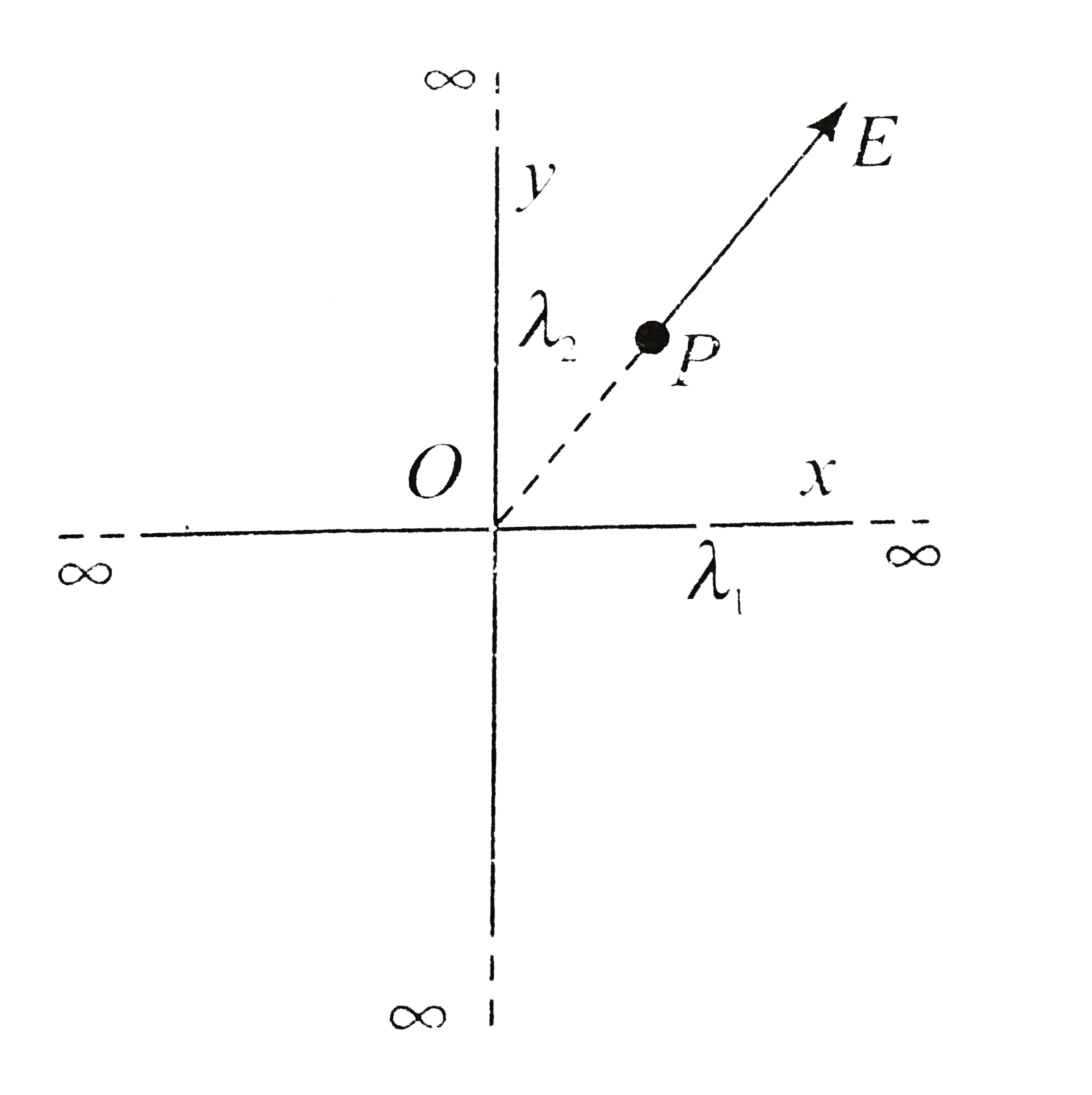
Two mutually perpendicular infinite wires along x-axis and y-axis carry charge densities `lambda_1 and lambda_2`. The electric line of force at P is along the line `y = x//(sqrt3)`, where P is also a point lying on the same line. Find `lambda_2//lambda_1`.

Text Solution

Verified by Experts

The correct Answer is:

C

Net electric field is `overline p, vecE=vecE_1+vecE_2` due to vertical wire
`vecE_2=lamda_2/(2 pi e_0 x)` due to vertical wire in x-direction, a angle of electric field with x direction
`tan a =E_1/E_2 =(lamda_1//2 pi e_0 y)/(lamda_2//2 pi e_0x) or 1/sqrt3 = (lamda_1x)/(lamda_2y) or lamda_2/lamda_1=x/y sqrt3 or lamda_2/lamda_1=3`
Promotional Banner

Topper's Solved these Questions

  • ELECTROSTATICS

    VMC MODULES ENGLISH|Exercise JEE MAIN|65 Videos
  • ELECTROSTATICS

    VMC MODULES ENGLISH|Exercise JEE Advanced (Archive)|89 Videos
  • ELECTROSTATICS

    VMC MODULES ENGLISH|Exercise LEVEL - 1|105 Videos
  • ELECTROMAGNETIC INDUCTION & ALTERNATIVE CURRENT

    VMC MODULES ENGLISH|Exercise IMPECCABLE|52 Videos
  • ENERGY & MOMENTUM

    VMC MODULES ENGLISH|Exercise JEE ADVANCE (ARCHIVE) - TRUE/FALSE TYPE|1 Videos

Similar Questions

Explore conceptually related problems

Two mutually perpendicular wire carry charge densities lambda_1 and lambda_2 . The electric lines of force makes angle alpha with second wire, then lambda_1//lambda_2 is

A wire AMB is placed along y-axis having linear charge density lambda C/m. The electric field intensity at point P is ( PM=0.1 m)

Two mutually perpendicular long straight conductors carrying uniformly distributed charges of linear charges densities lambda_(1) and lambda_(2) are positon at a distance a from each other. How does the interaction between the rods depends on a ?

For an infinite line of charge having linear charge density lambda lying along x-axis the work done in moving a charge q form C to A along CA is

Two uniformly long charged wires with linear densities lambda and 3lambda are placed along X and Y axis respectively. Determined the slope of electric field at any point on the l ine y=sqrt3x

An infinite thread of charge density lambda lies along z-axis. The potential difference between points A (4, 3, 4) and (3, 4, 0) is

An infinitely long wire with linear charge density +lambda is bent and the two parts are inclined at angle 30^@ as shown in fig, the electric field at point P is :

Two particle are moving perpendicular to each with de-Broglie wave length lambda_(1) and lambda_(2) . If they collide and stick then the de-Broglie wave length of system after collision is : (A) lambda = (lambda_(1) lambda_(2))/(sqrt(lambda_(1)^(2) + lambda_(2)^(2))) (B) lambda = (lambda_(1))/(sqrt(lambda_(1)^(2) + lambda_(2)^(2))) (C) lambda = (sqrt(lambda_(1)^(2) + lambda_(2)^(2)))/(lambda_(2)) (D) lambda = (lambda_(1) lambda_(2))/(sqrt(lambda_(1) + lambda_(2)))

The line x/a-y/b=1 cuts the x-axis at P. The equation of the line through P and perpendicular to the given line is

(i) Two infinitely long line charges each of linear charge density lambda are placed at an angle theta as shown in figure. Find out electric field intensity at a point P, which is at a distance x from point O along angle bisector of line charges. (ii) Repeat the above question if the line charge densities are lambda and -lambda . as shown in figure.

VMC MODULES ENGLISH-ELECTROSTATICS-LEVEL - 2
  1. A sphere of charges of radius R carries a positive charge whose volume...

    Text Solution

    |

  2. Charges Q1 and Q2 lie inside and outside, respectively, of a closed su...

    Text Solution

    |

  3. Two mutually perpendicular infinite wires along x-axis and y-axis carr...

    Text Solution

    |

  4. An electric charge 10^(-8) C is placed at the point (4m, 7m, 2m). At t...

    Text Solution

    |

  5. Two fixed charges -2Q and +Q are located at points (-3a,0) and (+3a,0)...

    Text Solution

    |

  6. Two spherical shells are as shown in figure. Suppose r is the distance...

    Text Solution

    |

  7. A solid sphere having uniform charge density rho and radius R is shown...

    Text Solution

    |

  8. At a distance of 5cm and 10 cm from surface of a uniformly charge soli...

    Text Solution

    |

  9. S(1) and S(2) are two equipotential surfaces on which the potentials a...

    Text Solution

    |

  10. Some equipotential plane parallel surfaces are shown in the figure. Th...

    Text Solution

    |

  11. In a certain region of space, the potential is given by V=k(2x^(2)-y^(...

    Text Solution

    |

  12. A, B, C, D, P and Q are points in a uniform electric field. The potent...

    Text Solution

    |

  13. An electric field is given by E=(y hat(i)+ xhat(k))N//C. Work done in ...

    Text Solution

    |

  14. Two particles X and Y of equal mass and with unequal positive charges,...

    Text Solution

    |

  15. The diagram shows a small bead of mass m carrying charge q. The bead c...

    Text Solution

    |

  16. The diagram shows three infinitely long uniform line charges placed on...

    Text Solution

    |

  17. A unit positive point charge of mass m is projected with a velocity V ...

    Text Solution

    |

  18. Potential at a point A is 3 volt and at a point B is 7 V, an electro...

    Text Solution

    |

  19. Three point charge Q,4Q and 16Q are placed on a straight line 9cm long...

    Text Solution

    |

  20. Three identical spheres each of radius a and mass m are placed such th...

    Text Solution

    |
