Home
Class 12
PHYSICS
Consider two electric dipoles P(1) and ...

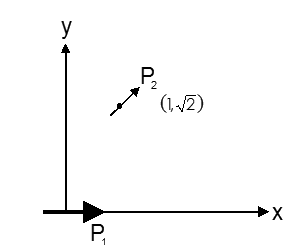
Consider two electric dipoles `P_(1)` and `P_(2)` placed at (0, 0) and (1,`sqrt2` ) respectively. The centers of these dipoles are fixed so that they can rotate about their centers but the centers cannot move. Answer the following questions based on this arrangement.

Initially `P_(1)` is held such that it is pointing towards positive x-axis and `P_(2)` is free to rotate. In the equilibrium position, `P_(2)` will point :

A

along x axis

B

along y-axis

C

along line joining `P_(1)` and `P_(2)`

D

along some arbitrary angle from x-axis

Text Solution

Verified by Experts

The correct Answer is:
B


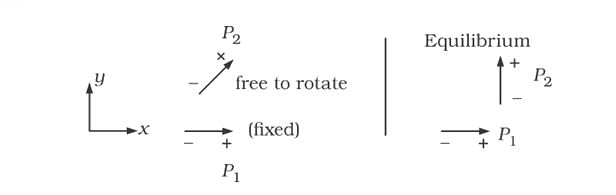
In equilibrium position, `P_2` will align itself `botr to P_1` (along the electric field of `P_1`) along y-axis.
Promotional Banner

Topper's Solved these Questions

  • ELECTROSTATICS

    VMC MODULES ENGLISH|Exercise JEE MAIN|65 Videos
  • ELECTROSTATICS

    VMC MODULES ENGLISH|Exercise JEE Advanced (Archive)|89 Videos
  • ELECTROSTATICS

    VMC MODULES ENGLISH|Exercise LEVEL - 1|105 Videos
  • ELECTROMAGNETIC INDUCTION & ALTERNATIVE CURRENT

    VMC MODULES ENGLISH|Exercise IMPECCABLE|52 Videos
  • ENERGY & MOMENTUM

    VMC MODULES ENGLISH|Exercise JEE ADVANCE (ARCHIVE) - TRUE/FALSE TYPE|1 Videos

Similar Questions

Explore conceptually related problems

Consider two electric dipoles P_(1) and P_(2) placed at (0, 0) and (1, sqrt2 ) respectively. The centers of these dipoles are fixed so that they can rotate about their centers but the centers cannot move. Answer the following questions based on this arrangement. Now P_(2) is fixed in the equilibrium position obtained in last question and P_(1) is released so that it can rotate freely. In its equilibrium position P_(1) will point along:

Two short dipoles phat(k) and P/2 hat(k) are located at (0,0,0) & (1m, 0,2m) respectivley. The resultant electric field due to the two dipoles at the point (1m, 0,0) is

Two short dipoles phat(k) and P/2 hat(k) are located at (0,0,0) & (1m, 0,2m) respectivley. The resultant electric field due to the two dipoles at the point (1m, 0,0) is

In the figure, two point charges +q and -q are placed on the x-axis at (+a,0) and (-a,0) respectively. A tiny dipole of dipolem moment (p) is kept at the origin along the y-axis. The torque on the dipole equals

Electric field intensity (E) due to an electric dipole varies with distance (r ) from the point of the center of dipole as :

Two identical electric dipoles of dipole moments p are placed as shown in the figure. The electrostatic force on dipole placed along x-axis is (d

The coordinates of the point A and B are (a,0) and (-a ,0), respectively. If a point P moves so that P A^2-P B^2=2k^2, when k is constant, then find the equation to the locus of the point Pdot

Two point electric dipoles with dipole moment P_(1) and P_(2) are separated by a distance r with their dipole axes mutually perpendicular as shown. The force of interaction between the dipoles is (where k=(1)/(4piepsilon_(0)) )

A tiny electric dipole of dipole moment vecP = P_0hatj is placed at point (l,0). There exists an electric field vecE = 2ax^2hati + (2by^2 + 2cy)hatj .

A dipole of electric dipole moment p is placed in a uniform electric field of strength E. If theta is the angle between positive direction of p and E, then the potential energy of the electric dipole is largest when theta is

VMC MODULES ENGLISH-ELECTROSTATICS-LEVEL - 2
  1. The dipole moment of a system of charge +q distributed uniformly on an...

    Text Solution

    |

  2. The figure shows a nonconducting ring which has positive and negative ...

    Text Solution

    |

  3. Along the x-axis, three charges q/2,-q and q/2 are placed at x=0,x=a ...

    Text Solution

    |

  4. An electric dipole is placed at the centre of a hollow conducting sphe...

    Text Solution

    |

  5. For the situation shown in the figure (r gt gt length of dipole) mark ...

    Text Solution

    |

  6. Consider two electric dipoles P(1) and P(2) placed at (0, 0) and (1,...

    Text Solution

    |

  7. Consider two electric dipoles P(1) and P(2) placed at (0, 0) and (1,...

    Text Solution

    |

  8. Consider two electric dipoles P(1) and P(2) placed at (0, 0) and (1,...

    Text Solution

    |

  9. A thin non-conducting ring or radius a has a linear charge density lam...

    Text Solution

    |

  10. A large sheet carries uniform surface charge density sigma. A rod of l...

    Text Solution

    |

  11. A metallic spherical shell of radius R has a charge -Q on it. A point...

    Text Solution

    |

  12. Two concentric conducting spheres of radii R and 2R are crrying charge...

    Text Solution

    |

  13. Two identical conducting spheres, fixed in space, attract each other w...

    Text Solution

    |

  14. There are four concentric shells A, B, C and D of radii a,2a,3a and 4a...

    Text Solution

    |

  15. A conducting sphere of radius R(2) has a spherical cavity of radius R...

    Text Solution

    |

  16. A conducting sphere of radius R(2) has a spherical cavity of radius R...

    Text Solution

    |

  17. A conducting sphere of radius R(2) has a spherical cavity of radius R...

    Text Solution

    |

  18. For the situation shown in (fig. 3.147), mark the correct statement (s...

    Text Solution

    |

  19. Three identical metallic plates are kept parallel to one another at se...

    Text Solution

    |

  20. Two refracting media are separated by a spherical interface as shown i...

    Text Solution

    |

