Home
Class 12
PHYSICS
A metallic spherical shell of radius R h...

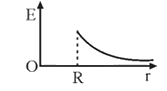
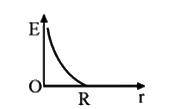
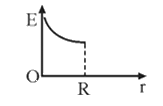
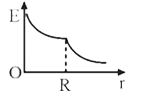
A metallic spherical shell of radius R has a charge -Q on it. A point charge +Q is placed at the centre of the shell. Which of the graphs shown below may correctly represent the variation of electric field E with distance r from the centre of shell ?

A

B

C

D

Text Solution

AI Generated Solution

The correct Answer is:

To solve the problem, we need to analyze the electric field \( E \) at different distances \( r \) from the center of a metallic spherical shell with a charge \( -Q \) and a point charge \( +Q \) placed at its center. ### Step-by-Step Solution: 1. **Understanding the Setup**: - We have a metallic spherical shell of radius \( R \) with a charge of \( -Q \). - A point charge \( +Q \) is placed at the center of the shell. - We need to find the variation of the electric field \( E \) with distance \( r \) from the center. **Hint**: Visualize the setup with a diagram showing the shell and the point charge. 2. **Electric Field Inside the Shell (r < R)**: - According to Gauss's law, the electric field inside a conductor in electrostatic equilibrium is zero. - For \( r < R \), the only charge enclosed by a Gaussian surface is the point charge \( +Q \). - The electric field \( E \) at a distance \( r \) from the center can be calculated using the formula: \[ E = \frac{kQ}{r^2} \] - Here, \( k \) is Coulomb's constant. **Hint**: Remember that the electric field inside a conductor is zero, but inside the cavity (where the point charge is), it is determined by the point charge. 3. **Electric Field on the Surface of the Shell (r = R)**: - At the surface of the shell, the electric field is given by: \[ E = \frac{kQ}{R^2} \] - This is the electric field just at the surface. **Hint**: The electric field is not zero at the surface; it is determined by the charge enclosed. 4. **Electric Field Outside the Shell (r > R)**: - For \( r > R \), the total charge enclosed by a Gaussian surface is \( +Q + (-Q) = 0 \). - Therefore, the electric field \( E \) outside the shell is zero: \[ E = 0 \] **Hint**: For distances greater than the radius of the shell, consider the net charge enclosed. 5. **Graphing the Electric Field**: - For \( r < R \), the electric field \( E \) is inversely proportional to \( r^2 \) and approaches infinity as \( r \) approaches zero. - At \( r = R \), the electric field is at a finite value \( \frac{kQ}{R^2} \). - For \( r > R \), the electric field drops to zero. **Hint**: Sketch the graph based on the behavior of \( E \) in the three regions: inside, on the surface, and outside the shell. ### Conclusion: The graph representing the variation of electric field \( E \) with distance \( r \) from the center of the shell should show: - An increasing electric field as \( r \) approaches zero, - A finite value at \( r = R \), - A drop to zero for \( r > R \). The correct graph would depict these characteristics, confirming that the electric field is zero outside the shell and behaves according to the inverse square law inside the cavity.

To solve the problem, we need to analyze the electric field \( E \) at different distances \( r \) from the center of a metallic spherical shell with a charge \( -Q \) and a point charge \( +Q \) placed at its center. ### Step-by-Step Solution: 1. **Understanding the Setup**: - We have a metallic spherical shell of radius \( R \) with a charge of \( -Q \). - A point charge \( +Q \) is placed at the center of the shell. - We need to find the variation of the electric field \( E \) with distance \( r \) from the center. ...
Promotional Banner

Topper's Solved these Questions

  • ELECTROSTATICS

    VMC MODULES ENGLISH|Exercise JEE MAIN|65 Videos
  • ELECTROSTATICS

    VMC MODULES ENGLISH|Exercise JEE Advanced (Archive)|89 Videos
  • ELECTROSTATICS

    VMC MODULES ENGLISH|Exercise LEVEL - 1|105 Videos
  • ELECTROMAGNETIC INDUCTION & ALTERNATIVE CURRENT

    VMC MODULES ENGLISH|Exercise IMPECCABLE|52 Videos
  • ENERGY & MOMENTUM

    VMC MODULES ENGLISH|Exercise JEE ADVANCE (ARCHIVE) - TRUE/FALSE TYPE|1 Videos

Similar Questions

Explore conceptually related problems

Which one of the following graphs represents the variation of electric field with distance r from the centre of a charged spherical conductor of radius R?

If r is distance measured from centre of a charged shell and R is its radius, then the graph which may correctly represent variation of electric field (E) is

A thin spherical conducting shell of radius R has a charge q. Another charge Q is placed at the centre of the shell. The electrostatic potential at a point P a distance R/2 from the centre of the shell is

A thin spherical conducting shell of radius R has a charge q. Another charge Q is placed at the centre of the shell. The electrostatic potential at a point P a distance R/2 from the centre of the shell is

A point charge is kept at the centre of a metallic insulated spherical shell. Then

A point charge is kept at the centre of a metallic insulated spherical shell. Then

A charge Q is uniformly distributed in a dielectric sphere of radius R (having dielectric constant unity). This dielectric sphere is enclosed by a concentric spherical shell of radius 2R and having uniformly distributed charge 2Q. Which of the following graph correctly represents variation of electric field with distance r from the common centre?

A thin metallic spherical shell contains a charge Q on it. A point charge q is placed at the center of the shell and another charge q_1 is placed outside it as shown in the figure. All the three charges are positive. Find the force on the charge a. at centre due to all charges. b. at center due to shell.

A spherical insulator of radius R is charged uniformly with a charge Q throughout its volume and contains a point charge Q/16 located at its centre. Which of the following graphs best represents qualitatively, the variation of electric field intensity E with distance r from the centre?

A conducting shell of radius R carries charge–Q. A point charge +Q is placed at the centre of shell. The electric field E varies with distance r (from the centre of the shell) as :

VMC MODULES ENGLISH-ELECTROSTATICS-LEVEL - 2
  1. The dipole moment of a system of charge +q distributed uniformly on an...

    Text Solution

    |

  2. The figure shows a nonconducting ring which has positive and negative ...

    Text Solution

    |

  3. Along the x-axis, three charges q/2,-q and q/2 are placed at x=0,x=a ...

    Text Solution

    |

  4. An electric dipole is placed at the centre of a hollow conducting sphe...

    Text Solution

    |

  5. For the situation shown in the figure (r gt gt length of dipole) mark ...

    Text Solution

    |

  6. Consider two electric dipoles P(1) and P(2) placed at (0, 0) and (1,...

    Text Solution

    |

  7. Consider two electric dipoles P(1) and P(2) placed at (0, 0) and (1,...

    Text Solution

    |

  8. Consider two electric dipoles P(1) and P(2) placed at (0, 0) and (1,...

    Text Solution

    |

  9. A thin non-conducting ring or radius a has a linear charge density lam...

    Text Solution

    |

  10. A large sheet carries uniform surface charge density sigma. A rod of l...

    Text Solution

    |

  11. A metallic spherical shell of radius R has a charge -Q on it. A point...

    Text Solution

    |

  12. Two concentric conducting spheres of radii R and 2R are crrying charge...

    Text Solution

    |

  13. Two identical conducting spheres, fixed in space, attract each other w...

    Text Solution

    |

  14. There are four concentric shells A, B, C and D of radii a,2a,3a and 4a...

    Text Solution

    |

  15. A conducting sphere of radius R(2) has a spherical cavity of radius R...

    Text Solution

    |

  16. A conducting sphere of radius R(2) has a spherical cavity of radius R...

    Text Solution

    |

  17. A conducting sphere of radius R(2) has a spherical cavity of radius R...

    Text Solution

    |

  18. For the situation shown in (fig. 3.147), mark the correct statement (s...

    Text Solution

    |

  19. Three identical metallic plates are kept parallel to one another at se...

    Text Solution

    |

  20. Two refracting media are separated by a spherical interface as shown i...

    Text Solution

    |
